Clear Sky Science · en
Permafrost and wildfire carbon emissions indicate need for additional action to keep Paris Agreement temperature goals within reach
Why Frozen Ground Matters for Our Future
Far north of most human settlements lies an enormous hidden storehouse of ancient plant material locked in permanently frozen ground, or permafrost. As the Arctic heats up far faster than the rest of the planet, that frozen vault is beginning to open, releasing greenhouse gases that add more heat to the atmosphere. This study asks a pressing question with real-world consequences: when we count how much carbon humanity can still emit while keeping global warming within the Paris Agreement’s 1.5 °C and 2 °C goals, what happens if we properly include permafrost thaw and increasingly intense northern wildfires? The answer, the authors find, is sobering—our remaining carbon budget is significantly smaller than most current estimates assume.
Hidden Carbon Beneath the Arctic
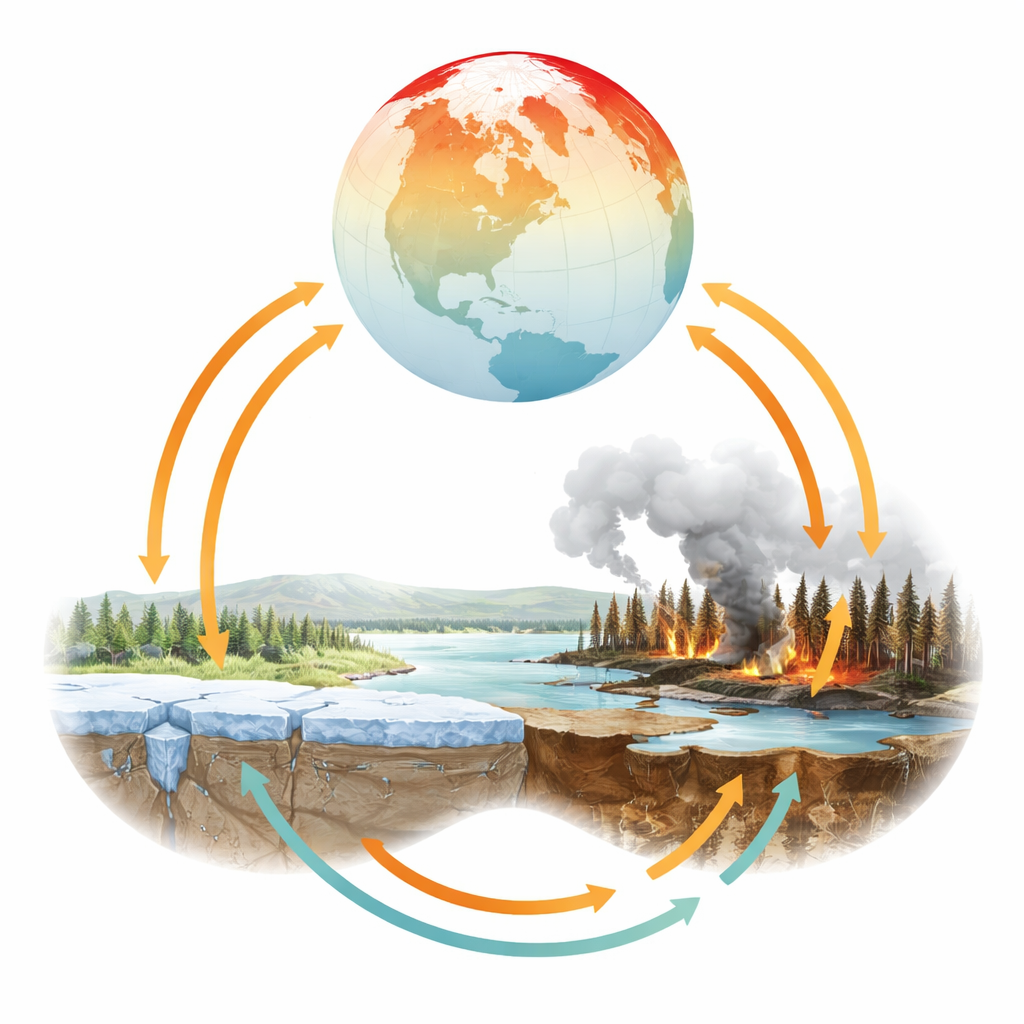
The soils of the northern permafrost region hold roughly as much carbon as all the carbon already in the atmosphere, much of it stored in the top few meters of frozen ground. As the Arctic warms—currently up to about 1 °C per decade in some areas—this frozen organic matter begins to thaw. Microbes wake up and start decomposing it, releasing carbon dioxide and methane. Previous global climate models have mostly represented this as a slow, top-down deepening of the seasonally thawed layer, a process the authors call “gradual thaw.” Those models already predict substantial greenhouse gas emissions from permafrost this century, but they leave out some of the most dramatic ways the ground can fail.
Sudden Collapse and Spreading Fire
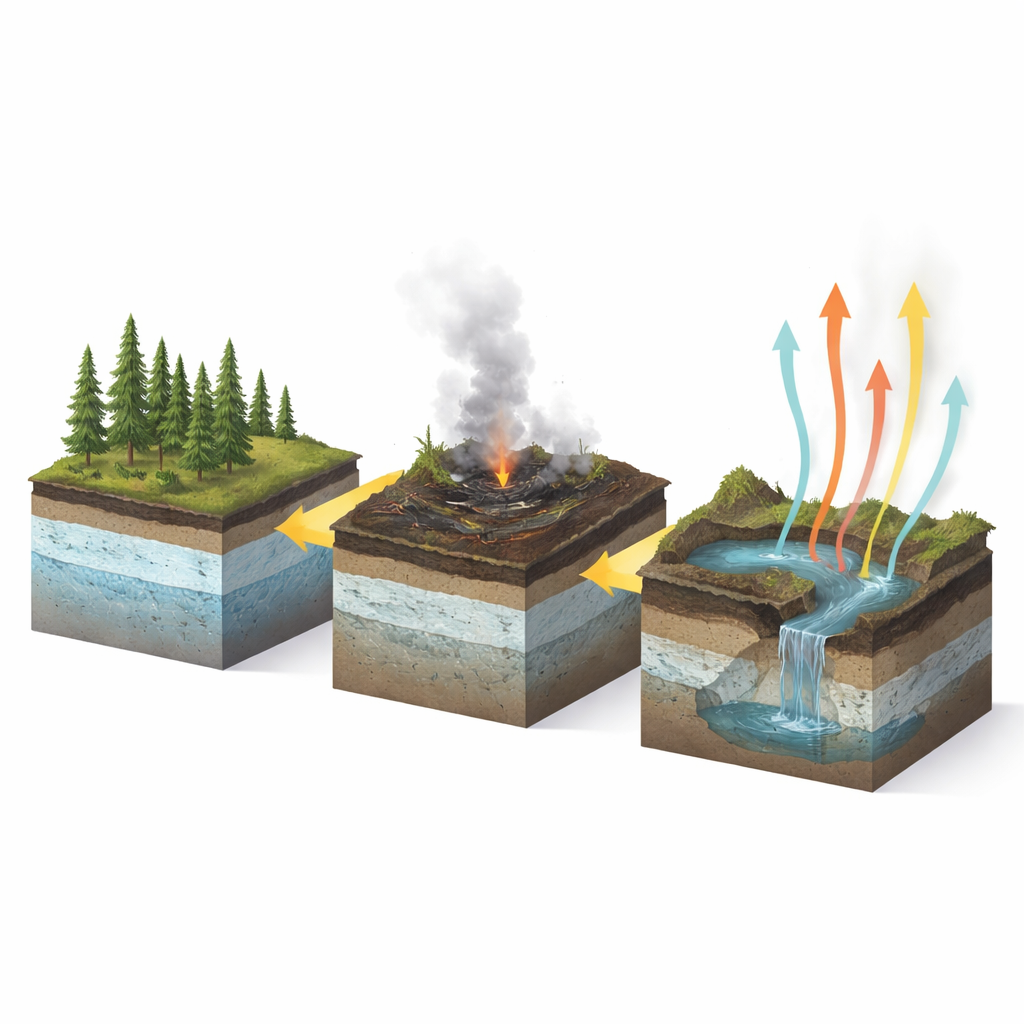
Two powerful processes have been largely missing from global assessments. The first is “abrupt thaw,” where ice-rich ground collapses unevenly, forming slumps, sinkholes, and new lakes and wetlands that can rapidly expose and decompose large volumes of previously frozen carbon, often under waterlogged conditions that favor methane production. The second is wildfire. In recent decades, boreal forests and tundra have seen more frequent, deeper-burning fires driven by longer fire seasons, more lightning, and warmer, drier conditions. These fires do not just burn trees; in northern regions they can consume thick layers of organic soil and roots, directly releasing below-ground carbon and priming the ground for faster and deeper thaw, including the formation of new thermokarst features.
Building a More Complete Climate Calculator
To understand what these overlooked processes mean for the global climate budget, the researchers extended a compact Earth system model known as OSCAR. The original model already emulated gradual permafrost thaw based on four detailed land surface models. The team added three new pieces: a module for abrupt thaw based on previous work that tracked how thermokarst features expand with rising temperature; a module for below-ground combustion using data on burned area and soil carbon loss from northern fires; and a post-fire thaw module capturing how burning deepens the seasonally thawed layer and can trigger both short-lived and long-lasting additional thaw. They then drove this enhanced model with a range of future socio-economic and emissions scenarios to explore how permafrost and fire emissions evolve through the 21st century.
How Much Extra Warming Fuel Is Released
When the model included only gradual thaw, projected permafrost emissions between 2025 and 2100 ranged from about 108 to 235 billion tons of carbon dioxide equivalent, depending on how aggressively the world cuts emissions. Adding abrupt thaw and fire-related processes raised total emissions to between roughly 387 and 624 billion tons—an increase of 166 to 258 percent over gradual thaw alone. On shorter time scales, through mid-century, these underrepresented processes still contributed the majority of emissions. Abrupt thaw was especially important for methane, while both abrupt thaw and fire had similar overall contributions to long-term carbon release. In terms of climate feedback, the combined permafrost and wildfire processes roughly tripled the amount of carbon released per degree of global warming compared with gradual thaw alone.
What This Means for Climate Targets
The most policy-relevant result concerns the world’s remaining carbon budget—the total amount of carbon dioxide humanity can emit from fossil fuels and land use while still having a reasonable chance of holding warming below a chosen target. When all thaw and fire processes were included, the remaining budget from 2025 shrank by about 124 ± 62 billion tons of CO₂ for the 1.5 °C limit and 258 ± 96 billion tons for 2 °C. That corresponds to reductions of about a quarter and a sixth, respectively, compared with a model that ignores permafrost entirely. Even if only the currently underrepresented processes (abrupt thaw and fire) are considered on top of gradual thaw, they still eat into the latest IPCC and Global Carbon Budget estimates by double-digit percentages. In practical terms, this means less “headroom” for human emissions than many planning exercises assume.
Living With a Shrinking Safety Margin
For non-specialists, the central takeaway is that the Arctic’s frozen ground and northern wildfires act as an amplifier of climate change that current policy debates only partially recognize. Even in scenarios where human emissions fall quickly, permafrost and fire-related emissions continue for many decades and increase after mid-century, locking in long-term warming and local impacts such as ground subsidence and landscape collapse that are effectively irreversible on human time scales. The study does not argue that the Paris Agreement goals are out of reach, but it shows they are harder to achieve than carbon budgets that neglect these processes would suggest. Accounting for permafrost and wildfire feedbacks thus strengthens the case for faster and deeper cuts in greenhouse gas emissions today, while highlighting the need to plan for their inevitable, long-lasting consequences.
Citation: Schädel, C., Gasser, T., Rogers, B.M. et al. Permafrost and wildfire carbon emissions indicate need for additional action to keep Paris Agreement temperature goals within reach. Commun Earth Environ 7, 306 (2026). https://doi.org/10.1038/s43247-026-03189-5
Keywords: permafrost thaw, Arctic warming, wildfire emissions, carbon budget, Paris Agreement