Clear Sky Science · en
Optimizing quantum chemistry simulations with a hybrid quantization scheme
Why this matters for future chemistry
Designing new medicines, batteries, and materials increasingly depends on computer simulations of how electrons move and interact. Classical computers struggle with this task because the calculations explode in cost as systems grow. Quantum computers promise a breakthrough, but today’s quantum chemistry algorithms use different internal languages for describing electrons, making it hard to combine the best ideas into a single workflow. This paper introduces a way to smoothly translate between those languages inside one quantum circuit, unlocking more efficient simulations for a wide range of chemical and materials problems.
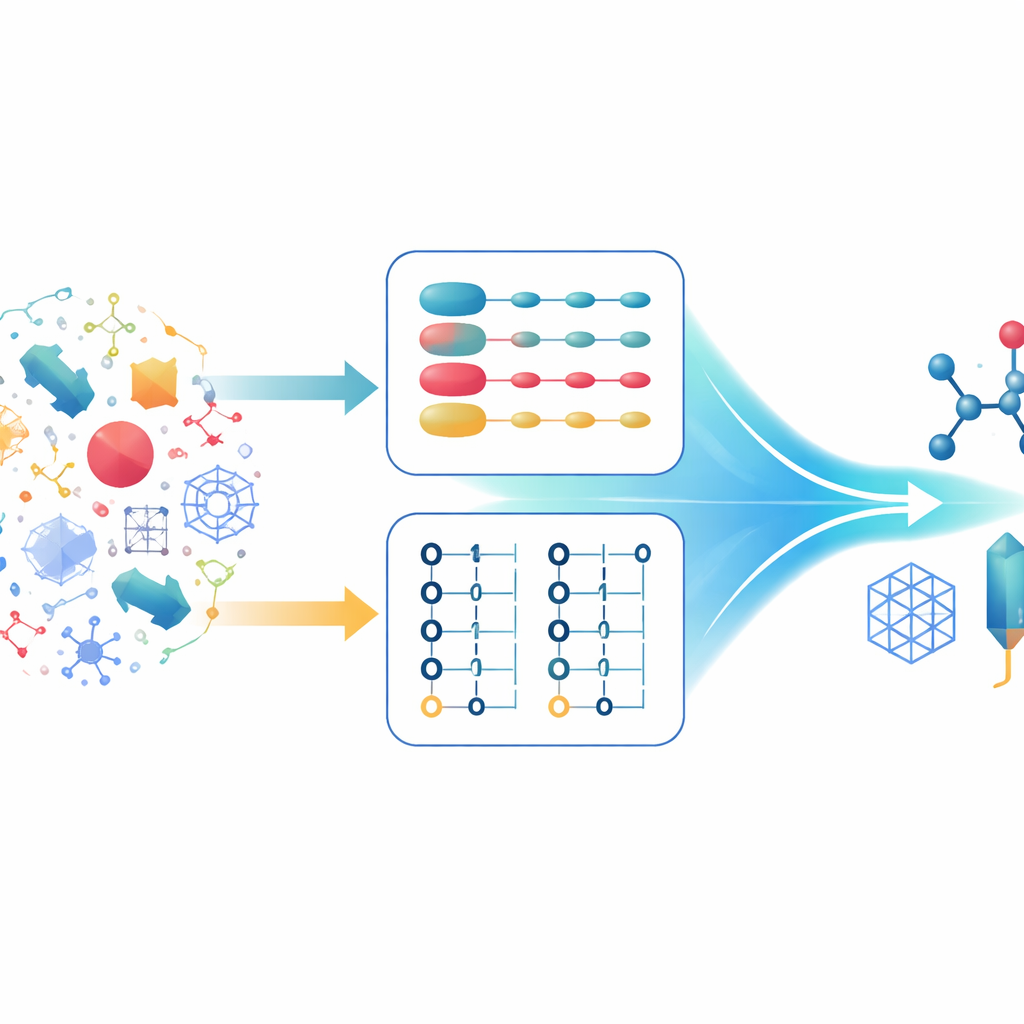
Two ways to describe the same electrons
Quantum chemists typically describe many-electron systems using two main formalisms. In the first, each electron is tracked individually, and the overall state is built from combinations of single-electron states. This is especially powerful when working with highly regular mathematical descriptions of space, such as plane waves, which are well suited to extended solids. In the second formalism, the focus shifts from electrons to orbitals being occupied or empty. This description naturally respects the rules that no two electrons can occupy the same state and easily handles situations where the number of electrons changes. Each approach has strengths and weaknesses, and modern quantum algorithms have been carefully optimized around one or the other, but not both at once.
A quantum “translator” between encodings
The authors propose a hybrid quantization scheme that acts like a translator between the two ways of encoding electrons on a quantum computer. They build on compact data layouts that store orbital indices in binary form, and show that these shared structures allow conversion between the first-quantized and an efficient second-quantized encoding using only a modest number of quantum logic gates. The key theoretical result, Theorem 1, proves that this translation can be done with a gate count that grows only slightly faster than linearly with the number of electrons, and only logarithmically with the number of orbitals. Importantly, the overhead of switching representations is small compared with the savings gained by choosing the best description for each part of a simulation.
Mixing and matching for real chemical workflows
Armed with this translator, the paper shows how to re-engineer full quantum simulation workflows. For ground-state calculations of molecules and bulk materials, one can prepare the electronic ground state in the second-quantized form that is most efficient for molecular orbitals, then convert to first quantization to measure collections of electronic properties using a technique called classical shadows. This strategy sharply cuts the number of times the expensive ground state needs to be prepared—by factors of tens to thousands in the authors’ numerical tests for common molecules and large basis sets. For localized defects or adsorbed molecules on surfaces, the method supports combining descriptions tailored to the extended solid with more compact orbitals near the region of interest, improving how local observables are estimated.
Better motion and light–matter simulations
The hybrid scheme also improves simulations where atoms move or electrons are added and removed. In Born–Oppenheimer molecular dynamics, electrons are treated quantum mechanically while nuclei move according to classical forces derived from the electronic state. Here, translating to the first-quantized encoding enables more efficient force calculations from reduced density matrices, leading to large savings in the repeated measurements required at each time step. For spectroscopic and electron ionization problems—where electrons can hop in or out of a material—the underlying time evolution is most efficient in the first-quantized plane-wave description, but the electron-changing operations themselves fit naturally in the second-quantized view. The authors show how to weave back and forth between these encodings so that each step of computing Green’s functions or ionization probabilities uses the most economical tool.
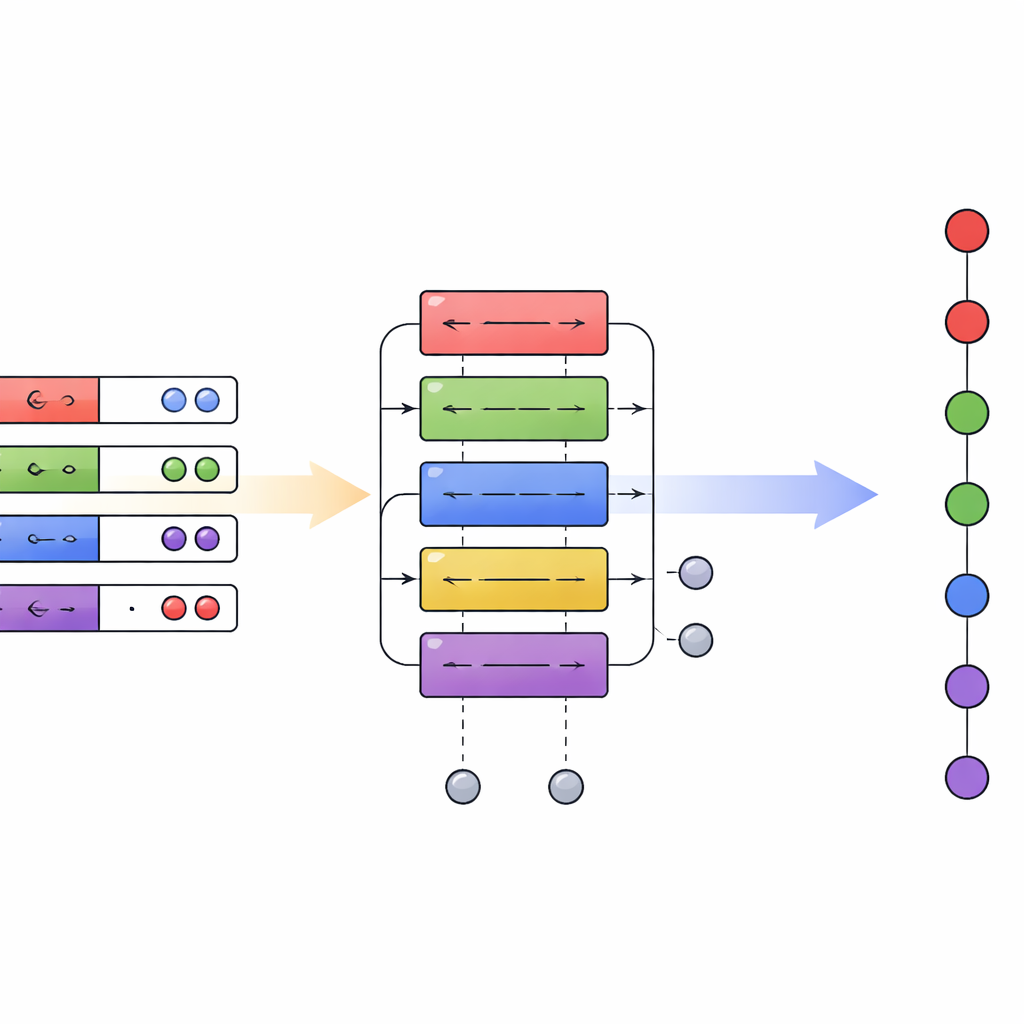
A new blueprint for quantum chemistry on quantum computers
Overall, the paper demonstrates that a carefully designed translation layer between different quantum encodings can yield broad, polynomial-scale efficiency gains without requiring radically new hardware. By making it practical to combine first- and second-quantized algorithms within a single circuit, the hybrid quantization framework lays out a more flexible blueprint for quantum chemistry. As quantum processors mature, this ability to choose the right representation at each stage—rather than being locked into one—could substantially reduce the resources needed to simulate realistic chemical systems, bringing applications like accurate reaction modeling, materials discovery, and advanced spectroscopy closer to practical quantum advantage.
Citation: Ku, C., Chen, YC., Hu, A. et al. Optimizing quantum chemistry simulations with a hybrid quantization scheme. Commun Phys 9, 148 (2026). https://doi.org/10.1038/s42005-026-02577-9
Keywords: quantum chemistry, quantum algorithms, electron structure, materials simulation, spectroscopy