Clear Sky Science · en
Mapping the discrete folding landscape
From Flat Sheets to Smart Shapes
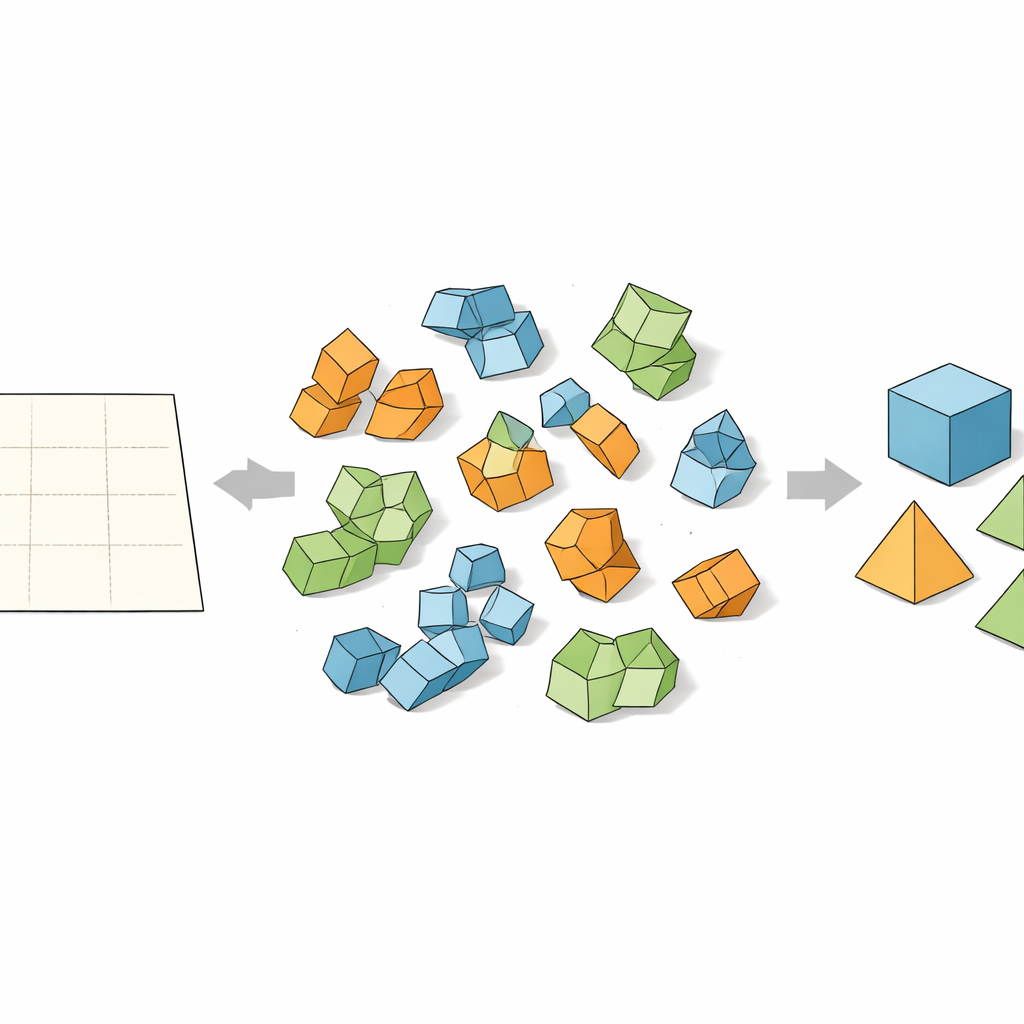
Imagine building robots, medical devices, or even space telescopes not by bolting parts together, but by folding a single flat sheet so it pops into shape on its own. This study tackles a key problem behind that vision: how to understand every possible way a flat pattern can fold into a three dimensional object, including the many ways it can go wrong, so engineers can design folding processes that are faster, cleaner, and more reliable.
Why Folding Matters in Modern Technology
Folding is no longer just an art form; it is becoming a practical manufacturing strategy across scales, from DNA based nanostructures to meter sized deployable satellites. Turning flat materials into complex shapes reduces waste, avoids glue and welding, and works well with techniques like laser cutting and 3D printing. Folded materials can be tuned to be extremely stiff, absorb impacts, or change shape when heated or stretched, which is why they are appearing in soft robots, medical implants, and space hardware. But to truly harness folding, designers need to know not just the start and end shapes, but every step in between.
The Challenge of Too Many Ways to Fold
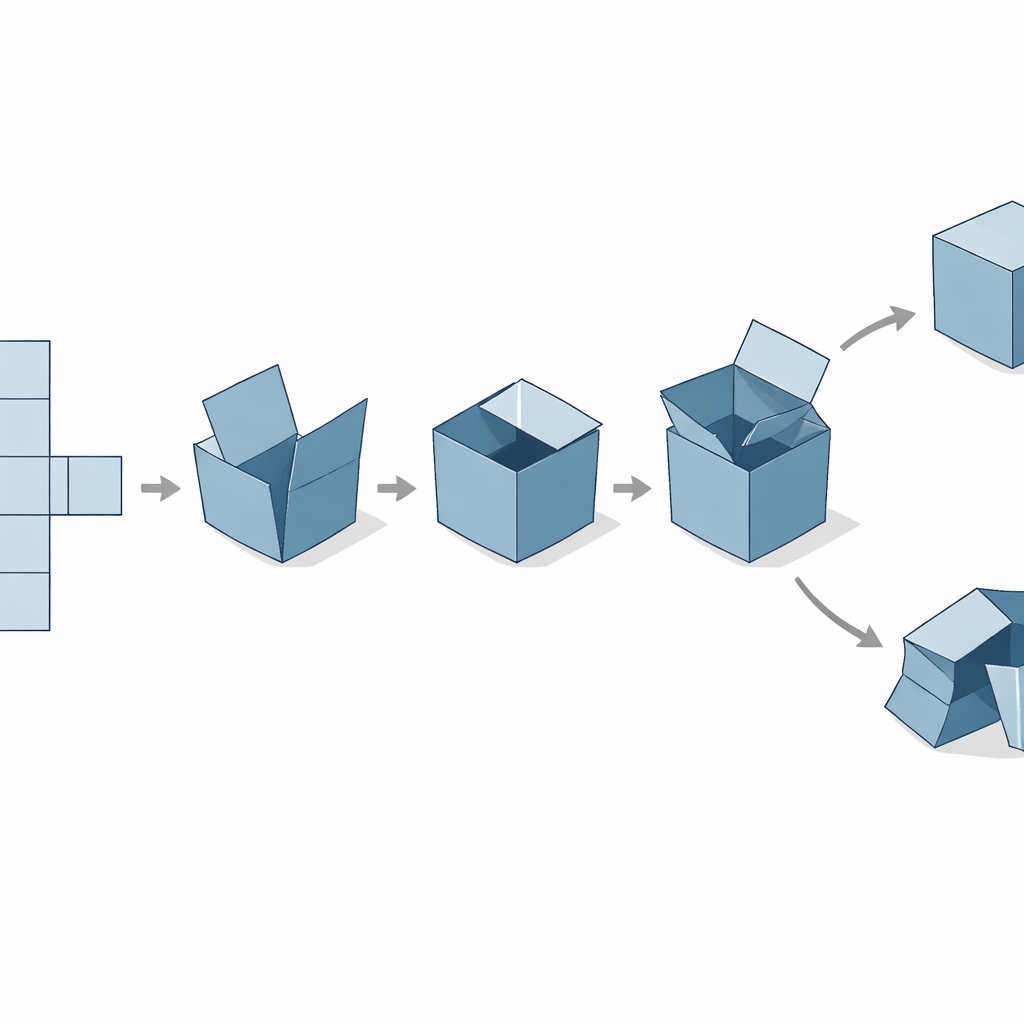
Designing a foldable object starts with a flat template, called a net, that can be cut and folded into a target shape such as a cube or more complex polyhedron. In principle, one could list every way to cut and fold along the edges, but the number of possible sequences explodes as more edges are involved. Even a simple cube already has thousands of possible cut orders, and larger shapes have tens of millions. Many of these sequences are effectively the same or never let a face actually swing free. Existing approaches either sample only the most likely routes, or simulate folding directly and risk missing rare but important pathways, leaving designers without a complete map of the folding process.
Turning Shapes into Networks
The authors solve this by translating each three dimensional shape and its flat templates into graphs, where faces become dots and shared edges become links. Cutting an edge corresponds to removing a link, while folding or unfolding changes how faces can move around each other. Starting from a folded polyhedron and its net, the algorithm systematically removes links in all relevant combinations, but organizes them smartly so it avoids repeating work. Each distinct pattern of connected faces is encoded as a unique binary code, which allows quick checks for duplicates. The method then groups detailed configurations into broader “folding states,” defined by which edges actually allow faces to move, and builds a directed network that captures how one state can follow another as cuts are added.
Seeing Every Path, Including the Wrong Ones
Using the cube as a test case, the algorithm recovers all eleven known nets and finds eighteen distinct intermediate folding states, linked into a complete “folding landscape.” This landscape shows every route from flat pattern to finished cube, and how different nets share many of the same intermediate shapes. The method extends naturally to more complex situations, such as templates that can fold into more than one final structure, and to misfolds, where panels lock in a way that prevents the intended shape from ever closing. By inserting these misfolded structures into the analysis, the authors reveal which sequences of cuts and folds tend to trap the system and how alternative paths can steer around these dead ends.
Designing Better Folding for Real Devices
In plain terms, the study provides a way to draw a complete map of how a flat pattern can fold up, including all side roads and wrong turns. This map is independent of the material or scale, so it applies equally to self assembling nanostructures driven by thermal motion and to large origami inspired robots powered by motors. Once the map is known, engineers can attach physical rates or costs to each step, turning it into a tool for choosing folding paths that are faster, more robust, or easier to control. The authors argue that such landscapes could feed future machine learning tools that automatically design nets and folding sequences for new devices, helping turn folding into a predictable, programmable manufacturing strategy.
Citation: Neves, J.C., Marques, B.R., Dias, C.S. et al. Mapping the discrete folding landscape. Commun Phys 9, 153 (2026). https://doi.org/10.1038/s42005-026-02554-2
Keywords: origami engineering, self folding materials, polyhedron nets, graph based algorithms, folding pathways