Clear Sky Science · en
Contrasting phenological shifts in diurnal and nocturnal Lepidoptera under climate change
Why the timing of butterflies and moths matters
Across the world, plants and animals are shifting the timing of key life events as the climate warms. For butterflies and moths, when adults take to the air determines whether they find nectar, mates, and suitable weather. This study asks a deceptively simple question with big implications: do daytime butterflies and nighttime moths adjust their seasonal schedules in the same way as the climate changes, or does living by the sun versus the moon lead to different responses?
Light, temperature, and the seasonal clock
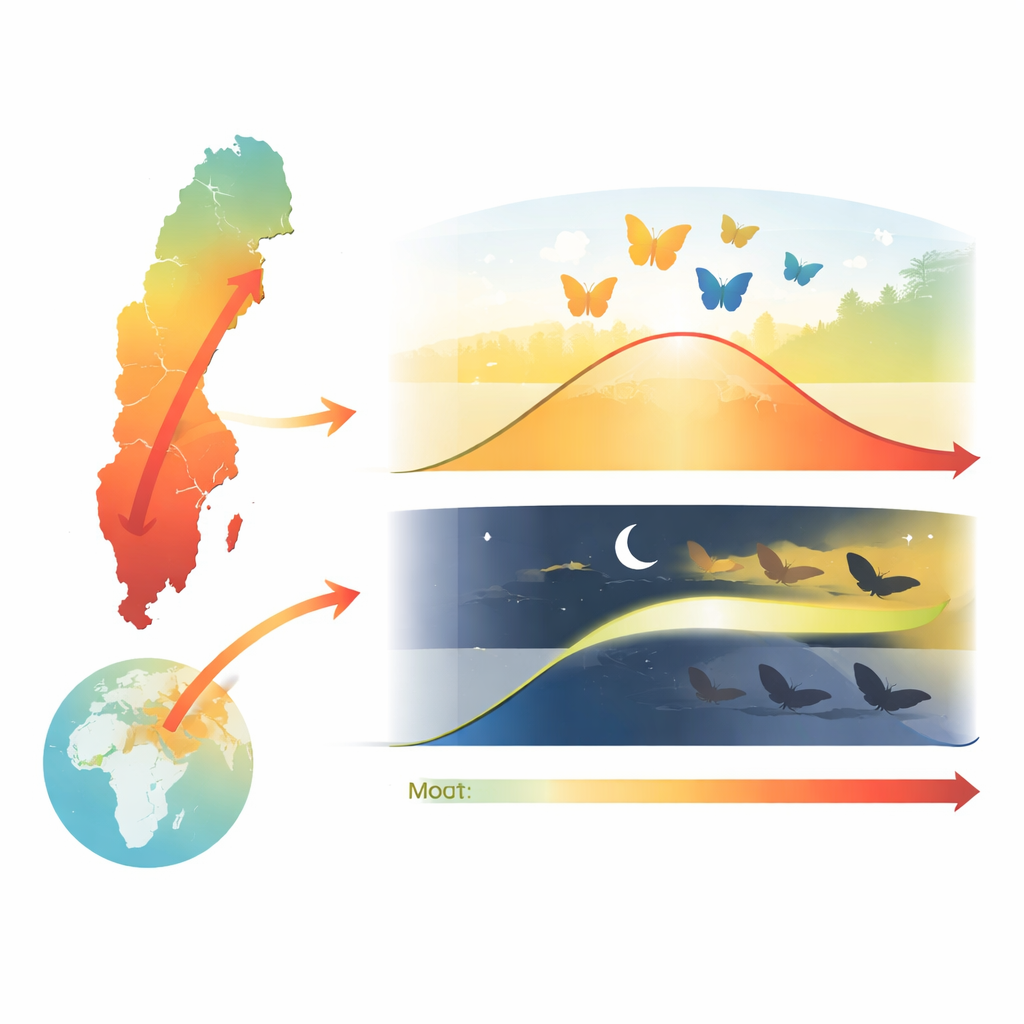
The researchers propose that the timing of insect activity is shaped by two overlapping clocks. One is temperature, which is warming and often encourages earlier activity. The other is day length, set by Earth’s orbit and unaltered by climate change. In northern Sweden, the peak in daylight hours comes about a month before the peak in temperature. Day-active butterflies can warm themselves by basking in the sun, but they are limited to the daylight window. Night-active moths must endure cooler conditions yet are less restricted by how long the day is. The team suggests that this difference in how species use light and heat creates distinct “time-spaces” for activity in diurnal (day-active) versus nocturnal (night-active) insects.
A decade-spanning look at flying seasons
To test their ideas, the authors assembled more than 1.7 million records from citizen scientists across Sweden, spanning 44 years (1981–2024). They focused on 363 species of larger butterflies and moths and used statistical methods that look at the full spread of sightings rather than just the very first or last observation. For each species, they estimated four aspects of its flying season: when it starts, when it peaks, when it ends, and how long it lasts. They also considered where along Sweden’s north–south gradient each record came from, how many generations per year a species typically has, and which life stage survives the winter.
Different day–night responses to a warming world
Overall, most species now begin flying later in spring, peak earlier in the season, and finish sooner, leading to a shorter adult activity period than four decades ago. Yet daytime and nighttime species differ sharply. Diurnal species, mainly butterflies, have shifted their peak flight earlier and their end date earlier, noticeably compressing their flying season. By contrast, nocturnal moths now tend to start and peak slightly later, but their season length and end date have changed little. These contrasts persist even after accounting for how many generations species have per year or whether they overwinter as larvae. The findings support the idea that being constrained to daylight makes diurnal insects respond to warming in a different way than their nocturnal relatives.
North–south differences across a long country
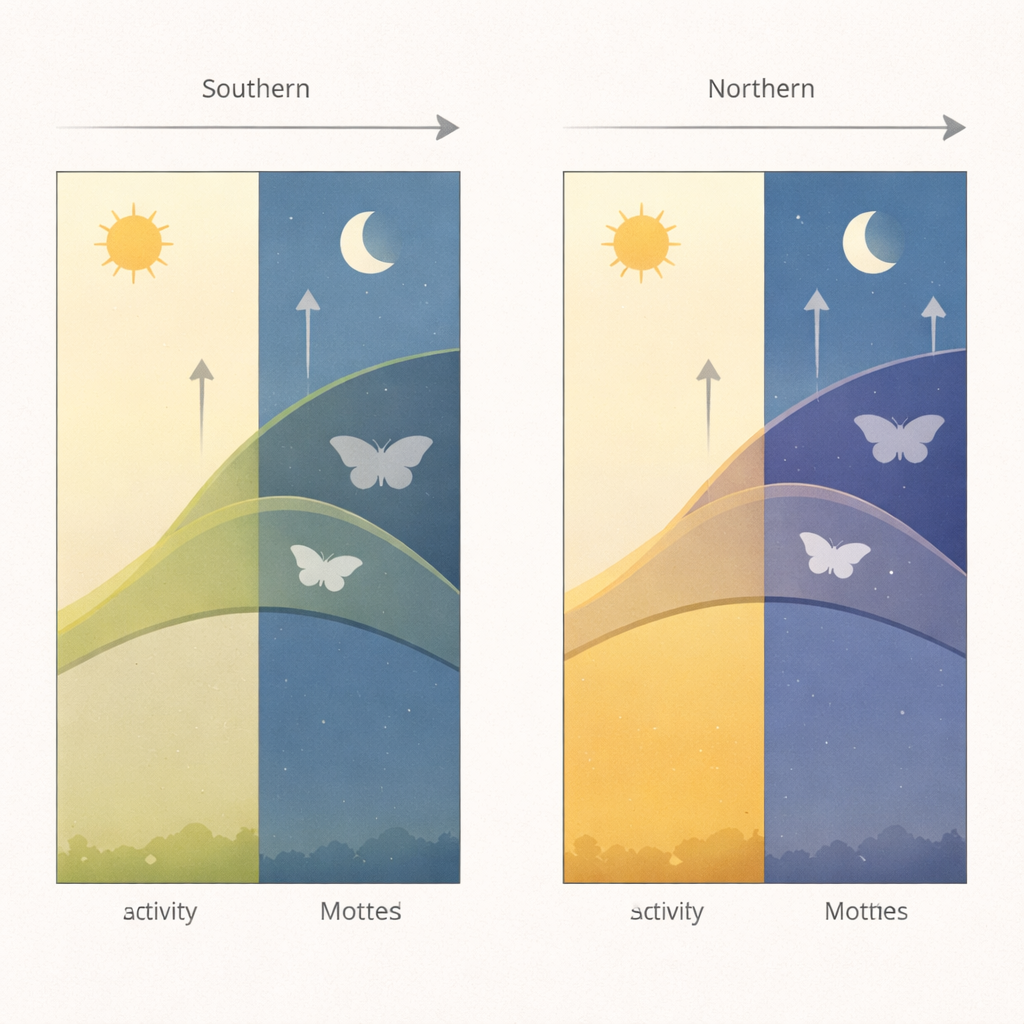
Latitude adds another layer to the story. In northern Sweden, summers are shorter but feature very long days, while southern regions have milder, longer seasons. For both butterflies and moths, flight seasons at higher latitudes tend to start later, end earlier, and be shorter overall. However, the timing of the peak differs between day and night fliers. In nocturnal moths, the peak of activity is remarkably similar from south to north. In diurnal butterflies, the peak shifts to later dates as one moves north, and the contrast between butterflies and moths is strongest at the highest latitudes. This pattern suggests that the tight coupling between daylight, temperature, and the need to bask makes butterfly flight peaks more sensitive to latitude than those of moths.
What this means for ecosystems and people
Butterflies and moths pollinate plants, feed birds and bats, and include species that can damage crops and forests. If day- and night-active species adjust their seasonal timing differently, the balance of who is present when in an ecosystem may shift. Some interactions—such as pollination or predator–prey relationships—could be weakened or reshuffled. This study shows that simply asking whether insects are moving earlier or later in the year is not enough. Whether a species lives by daylight or darkness turns out to be a key part of how it responds to climate change, with consequences that can ripple through entire communities and the services they provide to humans.
Citation: Forsman, A., Karimi, B. & Franzén, M. Contrasting phenological shifts in diurnal and nocturnal Lepidoptera under climate change. Commun Biol 9, 538 (2026). https://doi.org/10.1038/s42003-026-10062-w
Keywords: climate change, butterflies, moths, phenology, day versus night activity