Clear Sky Science · en
Virtual reality interventions for attention deficit/hyperactivity disorder: a systematic review
New Tools for a Common Childhood Struggle
Many families know the daily challenges of attention-deficit/hyperactivity disorder (ADHD): unfinished homework, restless bodies, and constant reminders to focus. This article looks at a new kind of help—virtual reality (VR)—and asks a simple question: can carefully designed VR games and simulations meaningfully ease ADHD symptoms and build real-world skills for children, teens, and even adults?
Why Virtual Worlds Might Help Real-Life Focus
ADHD affects about one in every twelve children and adolescents worldwide and often continues into adulthood. Medicines and behavior therapy can help, but they do not work for everyone and may bring side effects or motivation problems. Traditional non-drug approaches, like paper-and-pencil exercises or computer tasks, can be boring and hard to stick with over time. VR, by contrast, can drop a child into a vivid classroom, playground, or game-like world that reacts to their choices in real time. The authors of this systematic review combed through research from 2001 to 2025 to see whether this promise holds up when VR is used as a structured intervention rather than just entertainment.
Three Kinds of VR Experiences Studied
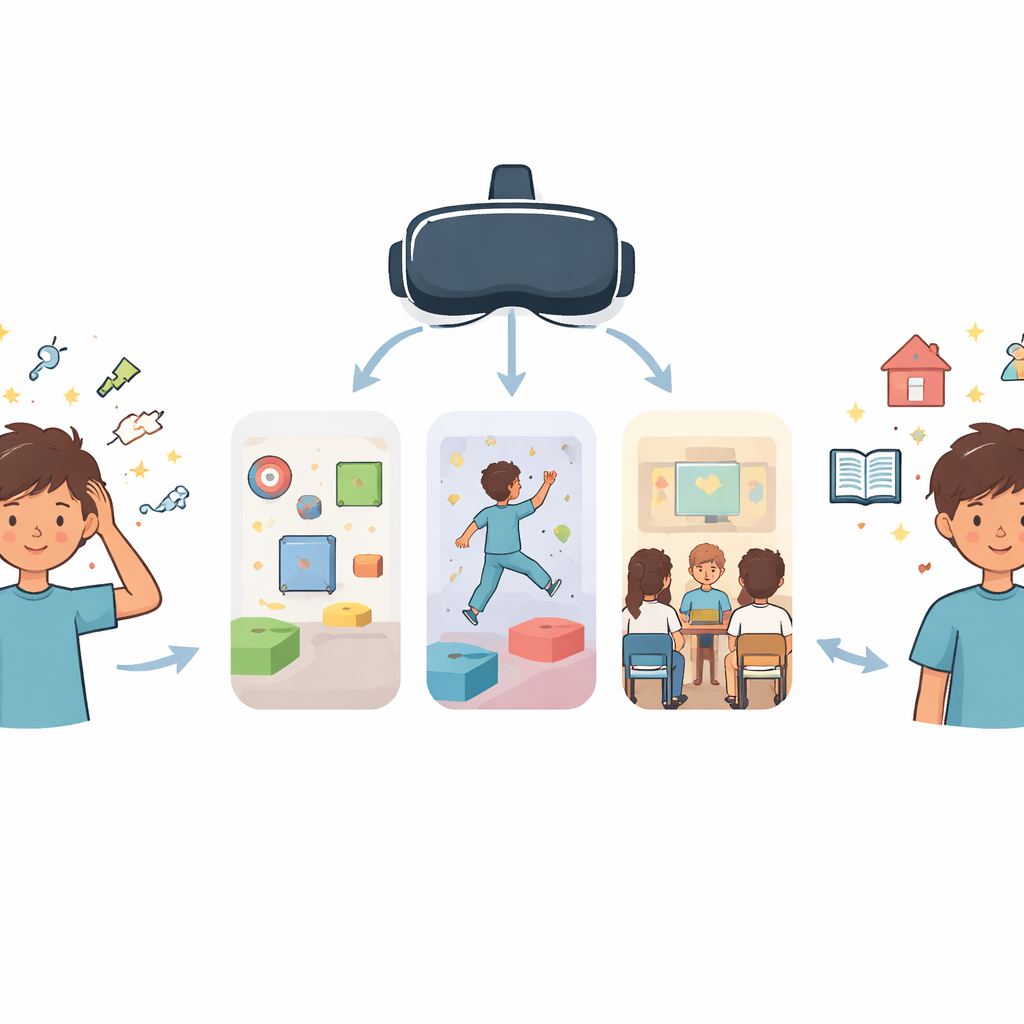
The review grouped 22 studies with 896 participants into three main styles of VR training. The first and most common was interactive game training, where players complete attention and memory challenges inside immersive worlds that reward quick, accurate responses. The second, called exergaming, combines body movement—jumping, balancing, reaching—with thinking tasks, so that mind and muscles are trained together. The third type uses virtual scenarios that mimic everyday settings like classrooms or social gatherings, often to practice following instructions, handling distractions, or navigating social situations. Each style taps different skills, from mental focus to emotional control.
What the Studies Found About Benefits
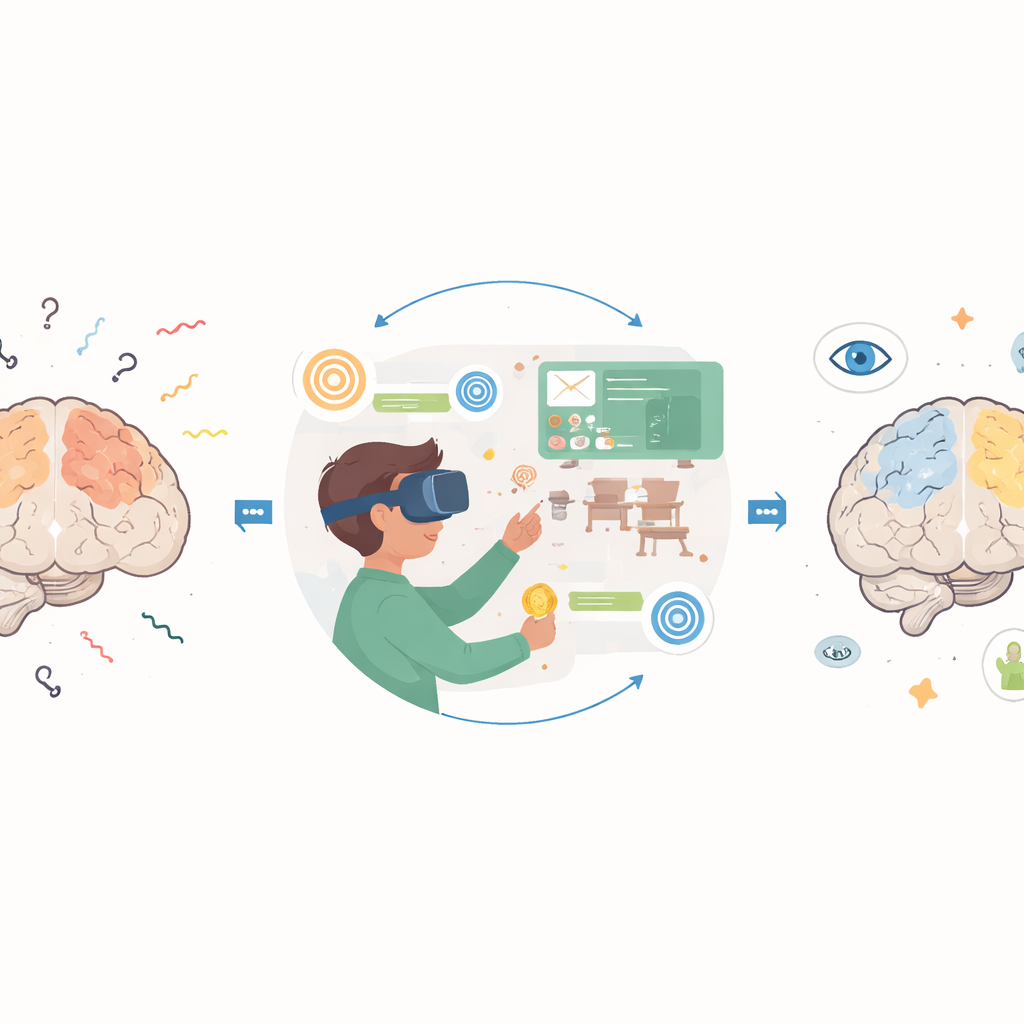
Across many experiments, VR-based programs generally outperformed doing nothing and often matched or enhanced standard treatments. Children and teens who used VR training typically showed sharper attention, fewer impulsive errors, and better performance on tasks that measure planning, working memory, and problem-solving. Some studies reported boosts in social skills, emotional regulation, school learning, and even physical coordination. In a few cases, the gains rivaled those from stimulant medication, and when VR was added on top of usual care—such as drugs or traditional therapy—the combination often led to stronger improvements than standard care alone. Brain-scanning and brainwave studies hinted that VR may help key control areas of the brain work more efficiently, though this evidence is still early.
How Long, How Often, and How Well It Is Tolerated
Not all VR programs were equally powerful. The clearest and most lasting benefits tended to come from longer courses—at least eight weeks of repeated sessions—rather than one-off or very short exposures. Session lengths commonly ranged from 20 to 60 minutes, one to four times a week. Importantly for families and clinicians, most children stuck with the programs: many studies reported adherence above 85 percent, and some reached perfect completion rates. Participants usually described the experiences as fun and motivating, which is rare for therapy. Side effects were mostly mild and temporary, such as a heavy-feeling headset or brief dizziness, and no serious harms were reported.
Limits of the Evidence and What Comes Next
Despite encouraging results, the authors warn that current research has gaps. Many studies were small, used different kinds of VR systems, and measured success in different ways, making it hard to compare results or run strong statistical summaries. A few trials showed little or no change in core symptoms, and one even found that a single session of VR training made some adults more distractible, underscoring that not every design will be helpful. The cost and availability of VR equipment may also limit who can access these tools, especially outside well-resourced clinics or schools. The authors call for larger, better-controlled trials that use common outcome measures and test who benefits most from which type of VR experience.
What This Means for Families and Clinicians
Overall, this review suggests that VR is more than a fancy toy: when thoughtfully designed and used over enough time, it can be a practical, engaging way to reduce key ADHD symptoms and strengthen thinking, emotional, and social skills. VR does not replace medicine or therapy, but it may become a valuable partner to them, especially for children who struggle to stay motivated with ordinary exercises. As technology improves and becomes more affordable, tailored VR programs—whether game-like workouts, movement-based adventures, or lifelike practice classrooms—could become part of everyday ADHD care, offering focused help in a format that feels more like play than treatment.
Citation: Cao, Y., Ma, L., Liu, N. et al. Virtual reality interventions for attention deficit/hyperactivity disorder: a systematic review. npj Digit. Med. 9, 303 (2026). https://doi.org/10.1038/s41746-026-02505-9
Keywords: ADHD, virtual reality therapy, serious games, child mental health, digital therapeutics