Clear Sky Science · en
Randomized-controlled trial of skills-based vr vs. distraction vr vs. sham VR for chronic low back pain
Why this matters for people with back pain
Chronic low back pain is one of the most common reasons people struggle with work, sleep, and daily life, and many turn to opioid painkillers that bring risks as well as relief. Virtual reality (VR) headsets promise a drug-free way to ease pain at home, either by teaching coping skills or simply by offering an absorbing escape. This study tested whether two types of VR could truly outperform a simple, "placebo-like" VR experience for people living with long-lasting low back pain.
Three kinds of virtual journeys
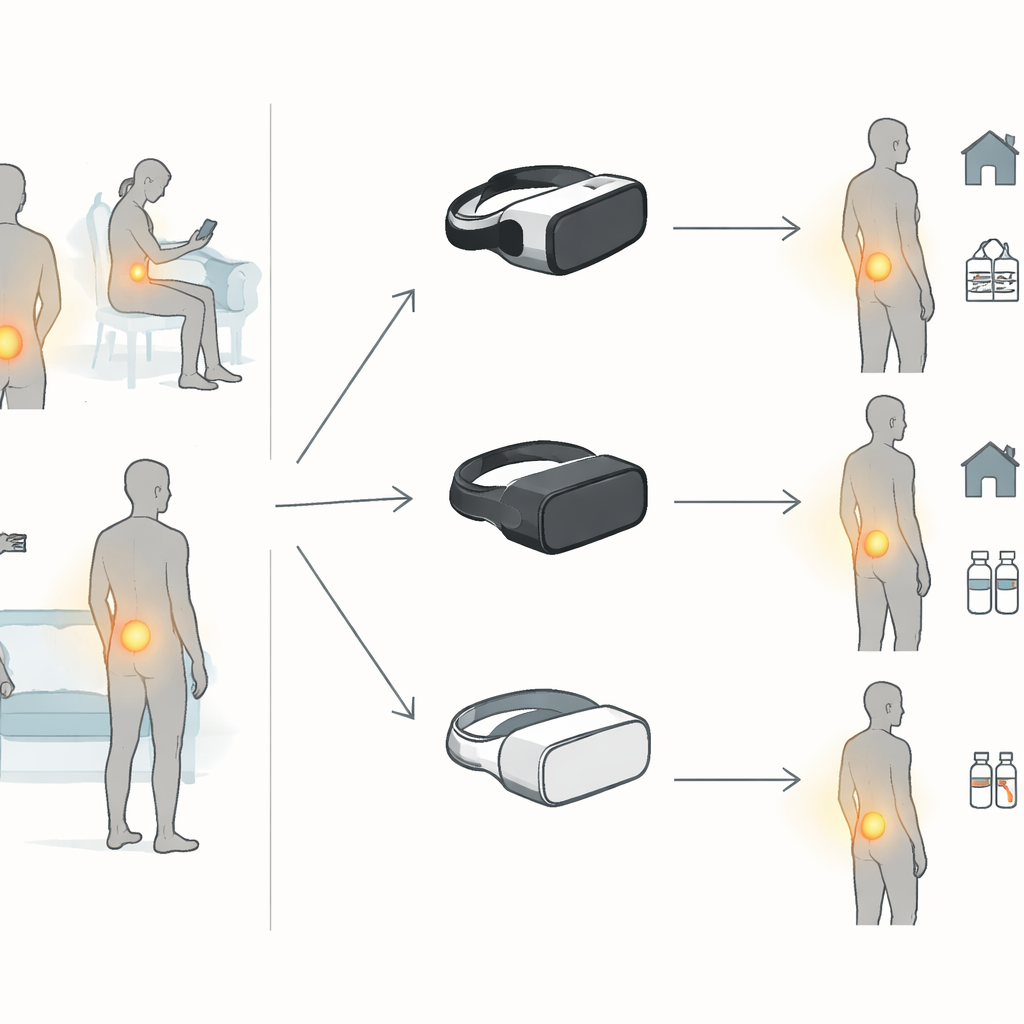
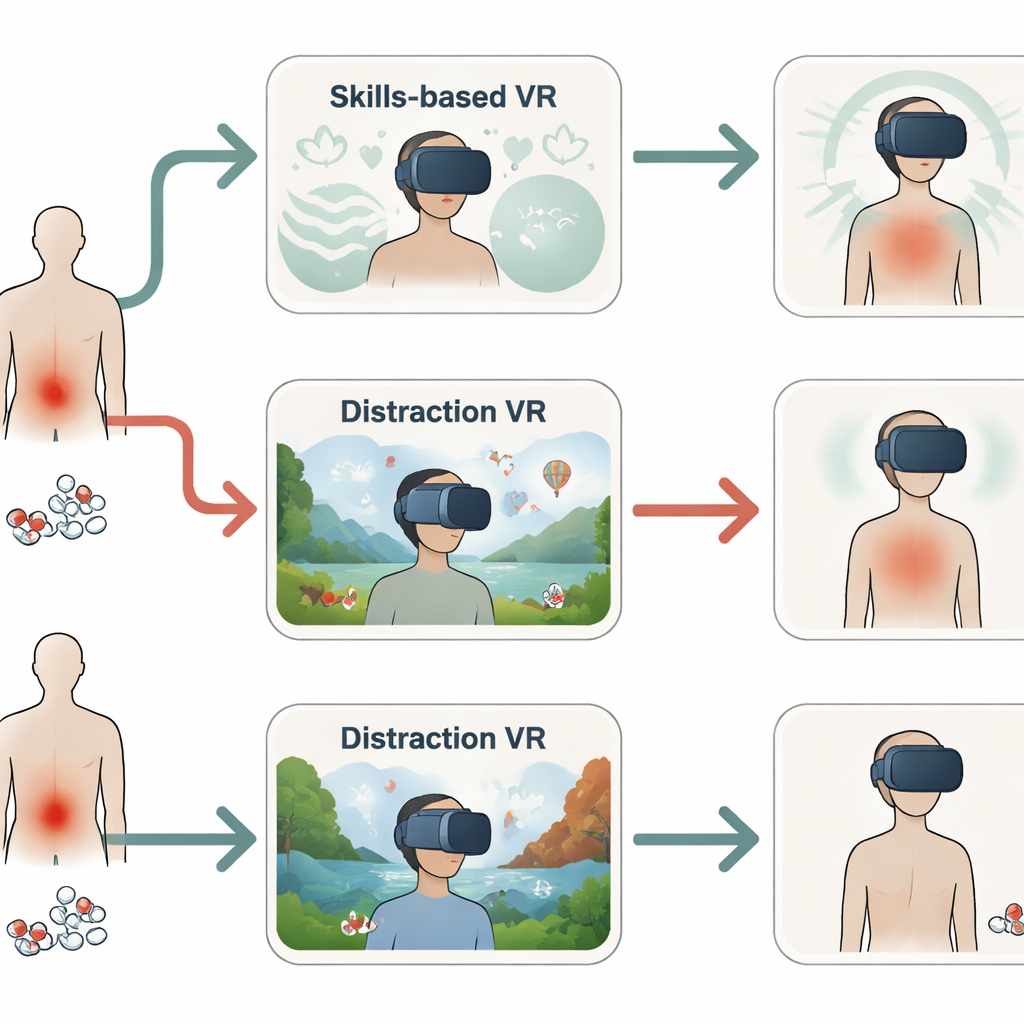
Researchers enrolled 385 adults with chronic low back pain and randomly assigned them to one of three home-based VR programs. One group used a skills-based VR course that taught breathing, relaxation, and body-awareness exercises in short daily sessions over eight weeks. A second group used a distraction VR program built around immersive 360-degree nature and scenic videos intended mainly to capture attention and pull the mind away from pain. The third group wore the same type of headset but watched flat, two-dimensional nature footage designed to feel like VR without any built-in therapeutic features. All participants were encouraged to use their assigned program daily and wore a wrist device to track movement and sleep.
What happened to pain and daily life
The main yardstick was how much pain interfered with daily activities, measured repeatedly over three months. All three groups—skills-based VR, distraction VR, and sham VR—reported modest improvements. On average, people said pain got in the way of life a little less than at the start of the study. However, when the researchers compared the groups to one another, neither of the two active VR programs clearly beat the sham VR for this main outcome or for most related measures, such as physical function, sleep quality, overall pain ratings, or mood. Even when looking only at people who used their headsets regularly, the differences between groups remained small and statistically uncertain.
Surprising signals about anxiety and opioid use
Although the headline result was that all three VR approaches performed similarly on pain interference, two important patterns stood out. First, people who began the study with higher levels of anxiety seemed to benefit more from the skills-based VR program, showing greater drops in how much pain disrupted their lives at the two-month mark compared with anxious participants in the sham group. In contrast, starting levels of depression did not predict who would respond. Second, the distraction VR group showed a stronger decline in daily opioid use over 90 days than the sham VR group, suggesting that getting deeply absorbed in virtual scenes might help some people rely less on pain pills, even if their reported pain interference changed only modestly.
Using VR at home and staying with it
Participants used their headsets at home with little in-person support, demonstrating that remote VR therapy is practical on a large scale. Many completed a substantial number of sessions, and overall usage was similar across the three groups. Side effects were mostly mild and temporary, with cybersickness—feelings like nausea, dizziness, or eye strain—being the most common complaint. A few people reported neck discomfort or skin irritation from the headset or wristband, but serious problems were rare and unrelated to the devices.
What this means for people seeking relief
This study shows that simply putting on a VR headset, even with fairly simple content, may offer some relief from chronic low back pain, but the benefits are modest and not clearly stronger with more sophisticated programs—at least as they are currently designed. For people with high anxiety, a structured skills-focused VR course may hold extra promise, while distraction-focused VR might help some users cut back on opioid use. The findings suggest that VR is a feasible, generally safe home tool, but future versions will likely need more targeted psychological techniques and better matching to individual needs before they can reliably outperform simpler, placebo-like VR experiences.
Citation: Spiegel, B.M.R., Eberlein, S.A., Persky, S. et al. Randomized-controlled trial of skills-based vr vs. distraction vr vs. sham VR for chronic low back pain. npj Digit. Med. 9, 248 (2026). https://doi.org/10.1038/s41746-026-02437-4
Keywords: chronic low back pain, virtual reality therapy, opioid reduction, anxiety and pain, digital pain management