Clear Sky Science · en
Large present-day and future climate forcing due to non-CO2 emissions from global transport
Why our trips matter for the planet
Every car ride, flight, and cargo ship journey quietly changes the planet’s temperature—not just through carbon dioxide (CO2), but also through a mix of other gases and particles. This study asks a deceptively simple question: when we add up all of these ingredients from global transport today and in the coming decades, do they mostly heat or partly cool the Earth? The answer turns out to be surprisingly complex, and it challenges the idea that cutting air pollution is always a straightforward win for the climate.
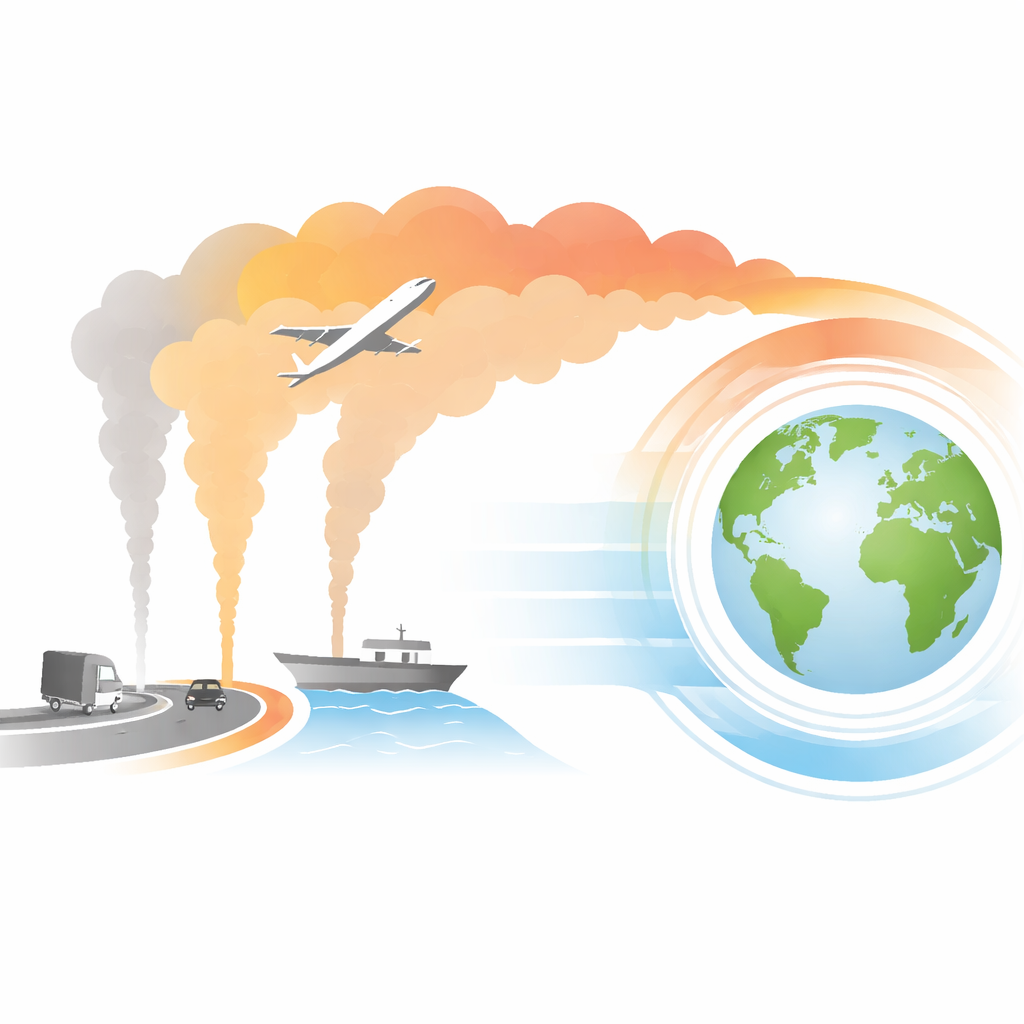
More than just carbon from engines
Modern transport—cars, trucks, planes, and ships—emits huge amounts of CO2 that linger in the air for centuries. But engines also release short-lived substances such as nitrogen oxides, tiny particles, and gases that form ozone and influence methane, another powerful greenhouse gas. These “non-CO2” emissions stay in the atmosphere from days to years, but while they are present, they can strongly affect both air quality and climate. Some, like soot and ozone, tend to warm. Others, especially sulfur-based particles that brighten clouds and reflect sunlight back to space, create a cooling effect. Because planes cruise high in clean air and ships sail over relatively pristine oceans, their non-CO2 emissions can have outsized impacts compared with the amount they emit.
How scientists traced hidden climate effects
The authors used a sophisticated global chemistry–climate model to follow how transport emissions spread, react, and alter clouds and radiation. They combined this with a simpler climate-response model to track the slow build-up of CO2 and long-lived changes in methane from the industrial era to 2050. Crucially, they did this consistently for land transport, aviation, and international shipping using the same emission data sets and three future storylines known as Shared Socioeconomic Pathways (SSP1-1.9, SSP2-4.5, SSP3-7.0). These scenarios range from strong global sustainability efforts with steep pollution cuts to a world of weak cooperation and higher emissions. By comparing versions of the atmosphere with and without transport pollution, they calculated the overall “climate forcing” of each sector—the net push toward warming or cooling.
Cooling side-effects that mask warming
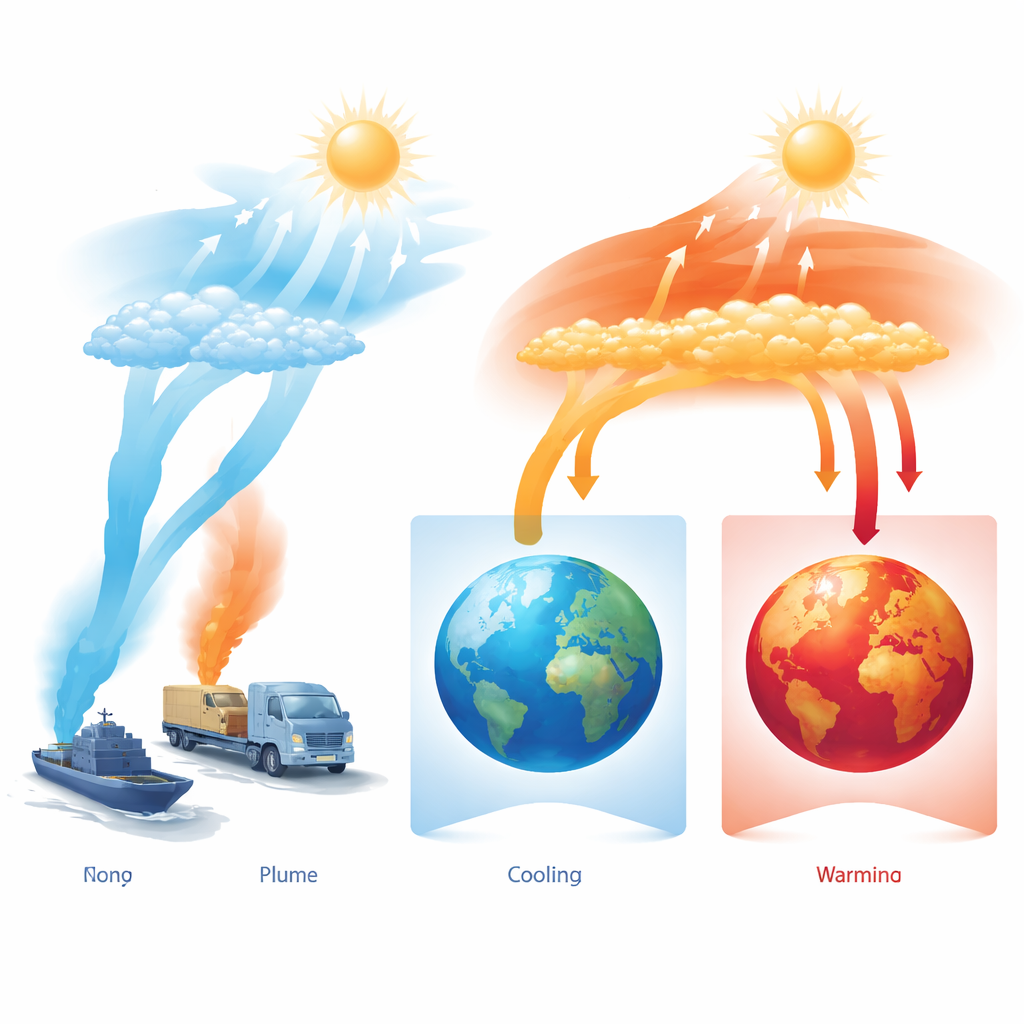
For today’s world, the study finds that non-CO2 emissions from all transport sectors together create a sizable net cooling that hides about 80 percent of the warming that would otherwise come from transport CO2 alone. Land-based transport stands out: its soot and ozone add some warming, but its particles and methane loss cause enough cooling that the non-CO2 package partly cancels the CO2-driven warming. Shipping is even more striking. Because of sulfur-rich fuel, ship exhaust produces many particles that brighten marine clouds and cool the surface, so that in most cases shipping has an overall cooling effect, despite emitting CO2. Aviation shows a more balanced picture: high-altitude particles and changes in clouds cool, while contrail clouds and ozone warm, ending in a modest net warming.
What happens in cleaner futures
Looking ahead to 2050, the balance shifts but does not disappear. In all three future scenarios, CO2 from transport keeps stacking up in the atmosphere, driving continued warming. At the same time, air-pollution rules and cleaner technologies reduce many non-CO2 emissions, especially sulfur particles. As a result, the cooling “offset” from non-CO2 components shrinks to roughly 25–60 percent of transport’s CO2 warming, depending on the scenario. In the most sustainable pathway (SSP1-1.9), overall human-made pollution drops so much that even the small remaining transport emissions are released into a very clean background atmosphere. Under such conditions, each bit of particle or nitrogen oxide pollution is more effective at altering clouds and methane, so transport’s residual non-CO2 emissions still produce noticeable cooling, even though their absolute amounts are low.
What this means for climate and clean air
The study highlights an uncomfortable tension: many of the short-lived pollutants we want to eliminate for health reasons currently help to mask some of the warming caused by CO2. As these pollutants are reduced, the hidden warming from long-lived gases will be revealed unless CO2 is cut even more aggressively. For shipping, this is already visible as sulfur rules sharply weaken its cooling effect. Yet in a world that seriously cleans up all emissions, the remaining non-CO2 pollution from transport can still create sizable climate effects because the atmosphere is so clean. The authors conclude that climate strategies for transport cannot focus on CO2 alone. To avoid nasty surprises, policies must account for both warming and cooling contributions of non-CO2 emissions while still prioritizing clean air—meaning deeper and faster reductions in CO2 are essential as we phase out the short-lived pollutants.
Citation: Hendricks, J., Righi, M., Brinkop, S. et al. Large present-day and future climate forcing due to non-CO2 emissions from global transport. npj Clim Atmos Sci 9, 99 (2026). https://doi.org/10.1038/s41612-026-01383-y
Keywords: transport emissions, non-CO2 climate forcing, shipping and aviation, aerosols and clouds, future climate scenarios