Clear Sky Science · en
Population-based comparison of post-acute sequelae of COVID-19 and health-related quality of life across pandemic periods: Omicron era versus early pandemic
Why this study matters for everyday life
Many people worry not only about catching COVID-19 but also about how long symptoms may linger afterward. As the Omicron variant has become the dominant form of the virus, a key question is whether it leaves fewer people with long lasting problems compared with infections from the early pandemic. This study followed thousands of adults in one German state to see how often people developed ongoing health issues months after infection and how much these problems affected daily life and work.
Two waves of infection, one shared survey
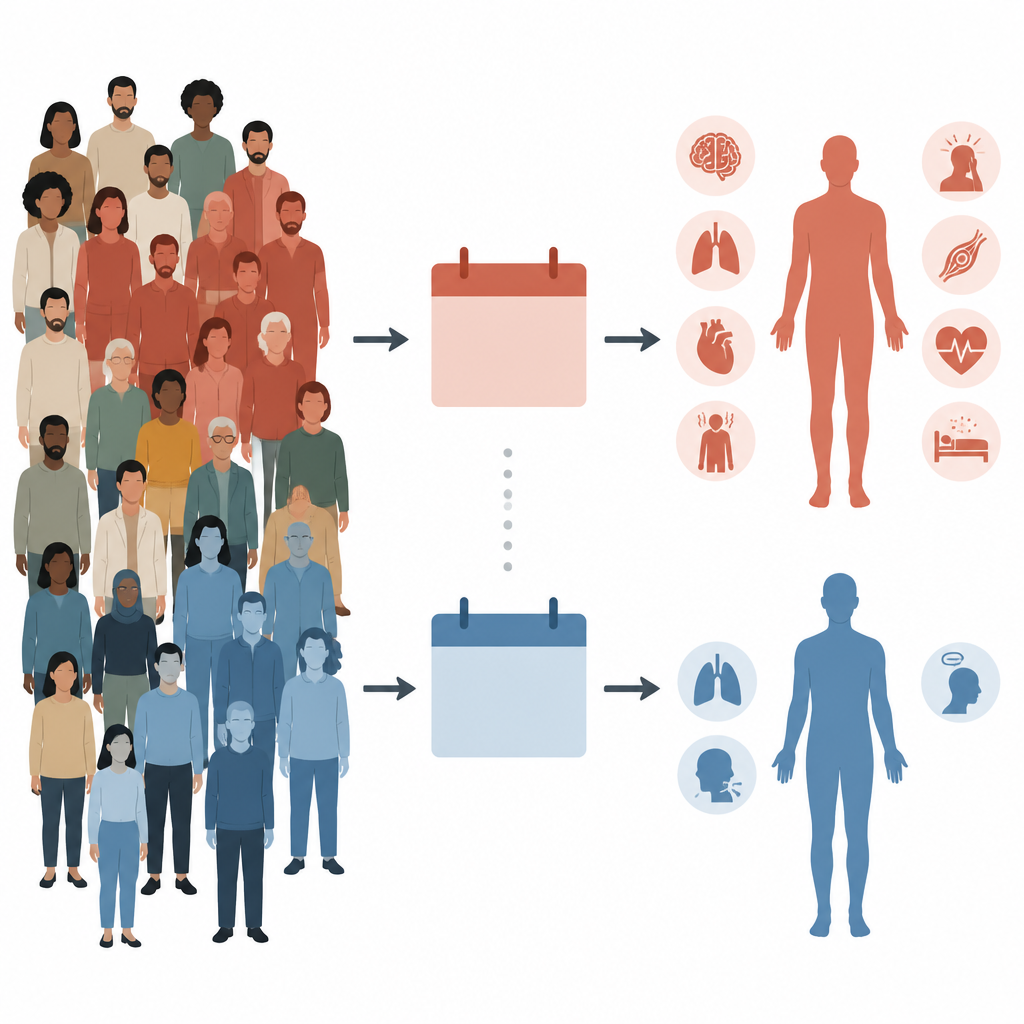
The researchers drew on two large groups of adults aged 18 to 65 who had tested positive for SARS-CoV-2. One group was infected in late 2020 to early 2021, when the original virus and Alpha variant were circulating and almost nobody was vaccinated. The second group caught the virus in mid 2022, when Omicron subvariants BA.5, BA.2 and BA.4 dominated and most people had received at least one vaccine dose. Both groups received the same detailed questionnaire months after infection, asking about 30 different symptoms, how strongly they interfered with daily life, and how people rated their general health and ability to work.
Who counted as having long lasting problems
Instead of counting every minor complaint, the team focused on health changes that truly limited daily life. A person was classified as having post COVID-19 syndrome if their general health or working capacity had recovered to at most 80 percent of what it was before infection and they had at least one new symptom of moderate or strong intensity that had not been present before. The researchers also tested two other ways of defining long COVID that relied more directly on symptom lists. For all definitions, they used statistical models to adjust for age, sex and education so that fair comparisons could be made between the early pandemic and Omicron groups.
How often long symptoms appeared
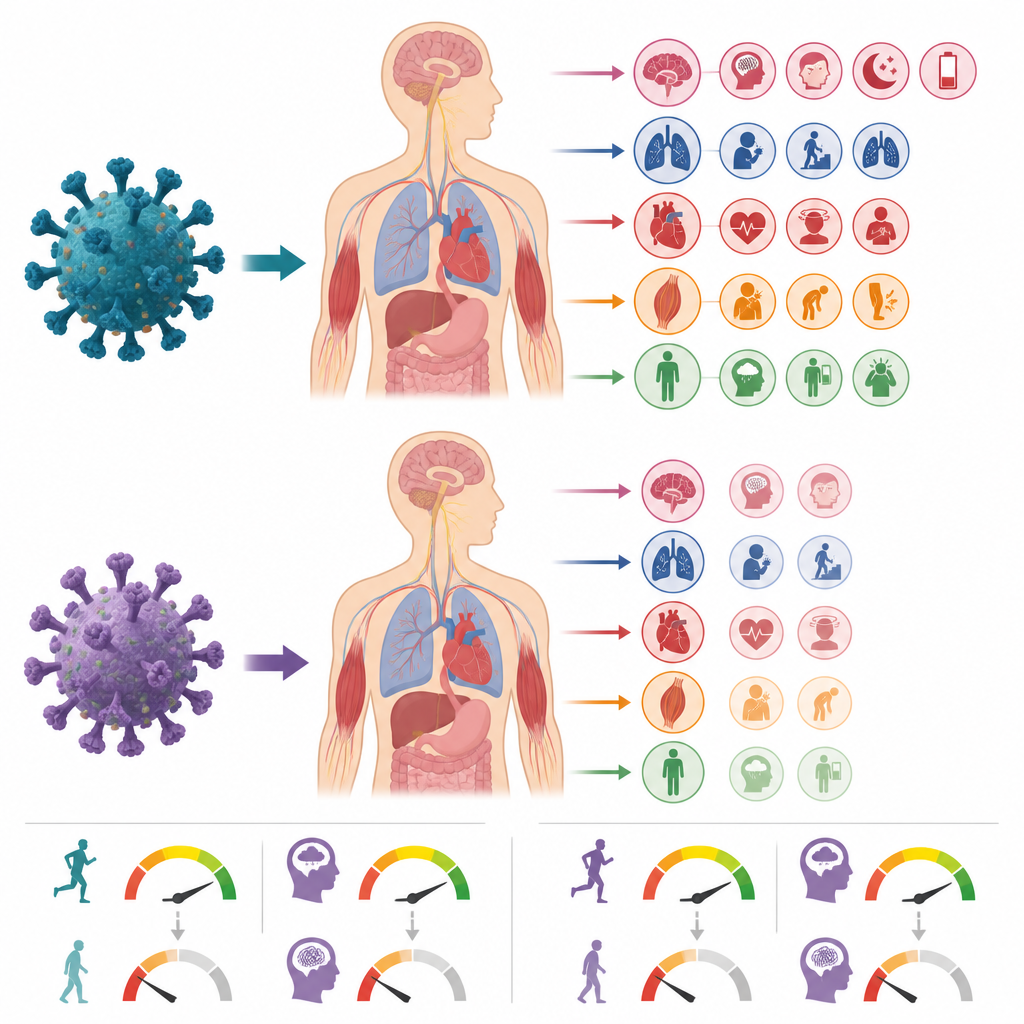
The share of people meeting the main definition of post COVID-19 syndrome was almost twice as high after early pandemic infections as after Omicron infections: about 30 percent versus 15 percent. When the team used the alternate definitions, the pattern stayed the same, though the exact numbers shifted. Certain clusters of symptoms were clearly less common after Omicron. Problems such as fatigue, memory and concentration issues, chest discomfort, and changes in smell or taste all appeared less often months after Omicron infection. For example, changes in smell or taste were reported by only about 2 percent of Omicron cases compared with nearly 12 percent in the early pandemic group.
Who faced higher risk in both periods
Even though the overall risk dropped in the Omicron era, the types of people most likely to develop long lasting problems were strikingly similar across both waves. Women, people with lower levels of education, current smokers, those living with obesity, and individuals with pre existing health conditions all had higher risks. People who needed medical treatment during the acute infection, especially hospital care, were also more likely to report persistent symptoms later, suggesting that a tougher initial illness often went hand in hand with longer recovery.
Quality of life for those who did not bounce back
The study also examined health related quality of life using a standard questionnaire that measures both physical and mental wellbeing. Among participants who met the definition of post COVID-19 syndrome, scores on these scales were clearly worse than in those who had recovered fully, and the size of this drop was much larger than what doctors usually consider a meaningful change. Importantly, these scores were very similar in affected people from the early pandemic and Omicron eras. In other words, while Omicron infections were less likely to lead to long term problems, those who did develop persistent symptoms felt just as limited in their daily and emotional life as earlier long COVID patients.
What this means going forward
For the general public, this study brings a mixed message. On the positive side, the risk of long lasting health problems appears lower for Omicron era infections than for infections early in the pandemic, likely reflecting both changes in the virus and widespread vaccination. At the same time, for the many people who do develop ongoing symptoms, their physical and mental wellbeing can be strongly and comparably reduced, regardless of when they were infected. This underlines the need for continued prevention, follow up care and support services for those living with post COVID-19 syndrome, even as the acute threat of the virus seems to have eased.
Citation: Peter, R.S., Nieters, A., Sedelmaier, L. et al. Population-based comparison of post-acute sequelae of COVID-19 and health-related quality of life across pandemic periods: Omicron era versus early pandemic. Sci Rep 16, 15603 (2026). https://doi.org/10.1038/s41598-026-52945-2
Keywords: long COVID, Omicron variant, post COVID-19 syndrome, quality of life, SARS-CoV-2