Clear Sky Science · en
Clinical transfer accuracy of pressure-moulded versus 3D-printed drilling guides for orthodontic mini-implants in the anterior palate: a randomized prospective clinical study
Why tiny screws in the palate matter
Modern braces often rely on very small screws in the roof of the mouth to anchor tooth movements that would otherwise be hard to achieve. These orthodontic mini-implants act like hidden hooks fixed in bone, allowing teeth to be moved with precision and without depending on rubber bands or headgear. But for them to work safely and comfortably, they must be placed exactly where planned. This study asks a practical question for everyday orthodontic care: when placing these mini-implants with the help of a guide, is a conventional pressure-moulded guide as accurate, or even better, than a sleek 3D-printed one?
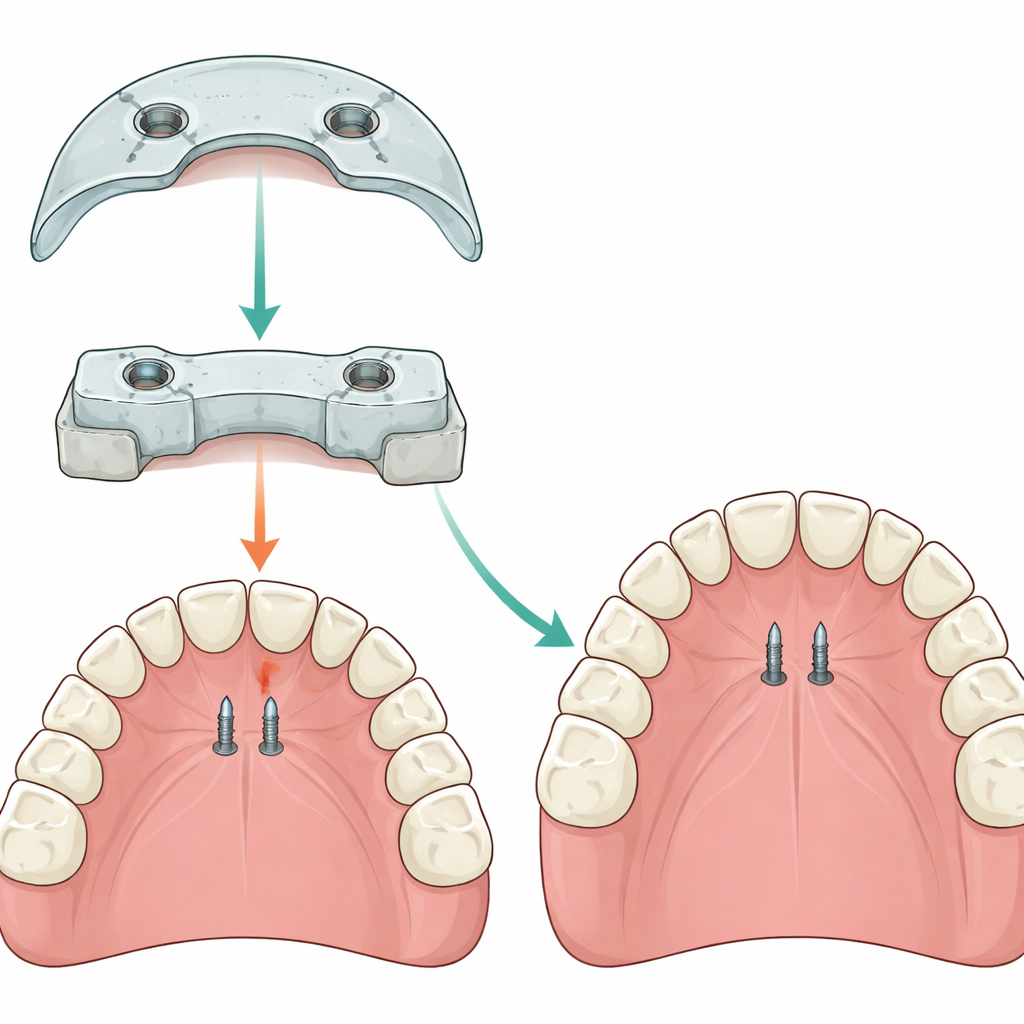
Guided helpers for precise screw placement
To place mini-implants in the front part of the palate, many orthodontists now use digitally planned guides. First, a digital scan of the teeth is combined with a side-view X-ray of the head. On this fused image, the clinician chooses the best implant positions, aiming for enough bone while staying clear of sensitive structures. From this plan, a custom guide is produced that fits over the teeth and palate and contains sleeves or channels that steer the drill and the screw into the intended path. The goal is simple: make the real-world placement match the virtual plan as closely as possible.
Two ways to make a guide
The research team compared two common manufacturing routes. In the pressure-moulded approach, a physical model of the upper jaw is created from the digital plan. Metal sleeves stand in for the future implant positions, and a plastic sheet is heated and pressed over the model to form a snug, transparent splint. In the 3D-printed approach, the guide is designed entirely on a computer, with support wings that rest on several back teeth, and is then printed directly in a rigid resin. Both guide types are designed to control depth and angle of the screws, but they touch and stabilize on the palate and teeth in slightly different ways.
Testing accuracy in real patients
The study enrolled 30 patients who needed palatal mini-implants for their orthodontic treatment. Each patient received two screws in the front palate, either along the midline or just to the side of it. Half of the patients were treated with pressure-moulded guides and the other half with 3D-printed guides. After the screws were placed, the researchers took a new digital scan and matched it to the original treatment plan. They then measured how far the actual screw heads and tips were from their planned positions in three dimensions, and how much the screw angles differed from the intended direction.
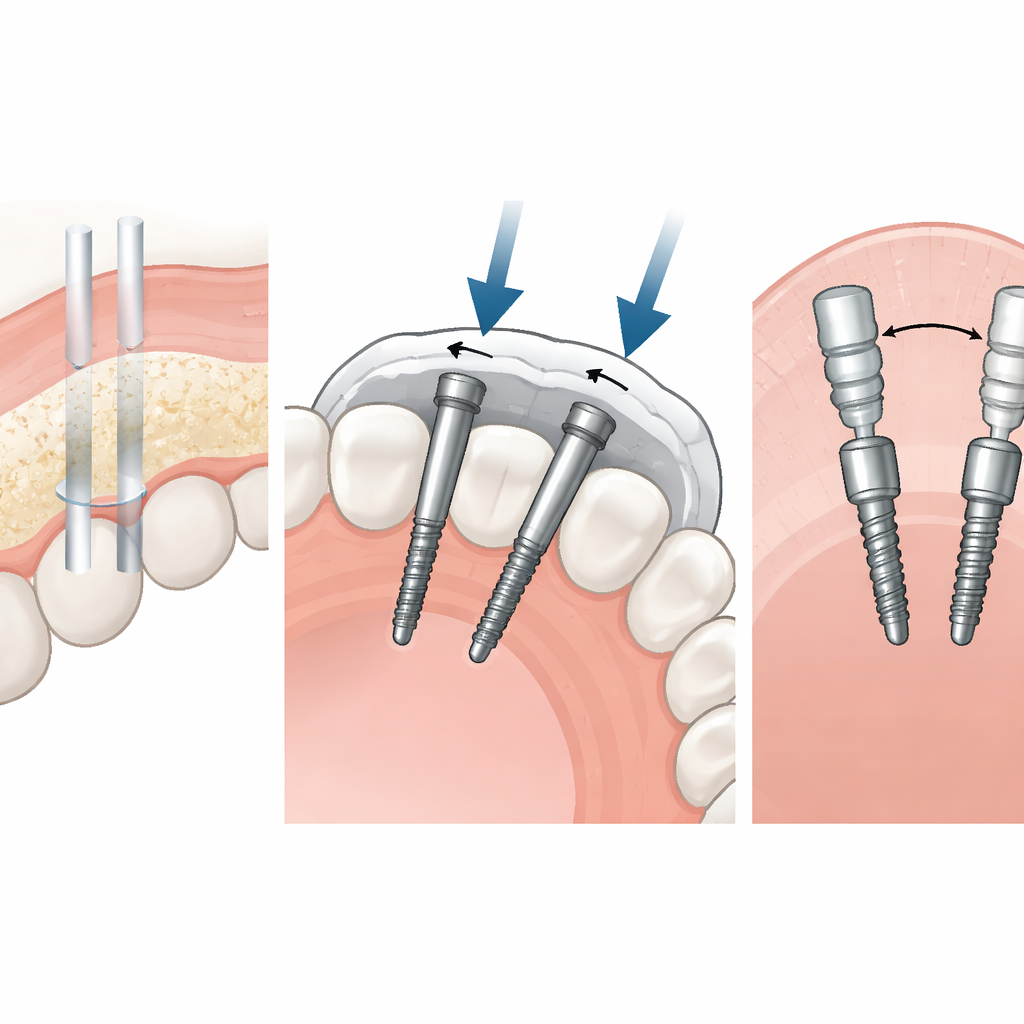
Small differences in angle, similar positions
Both guide types performed very well. On average, the tops of the screws were less than one millimeter away from where they were supposed to be, and the tips inside the bone were only about 1.2 to 1.5 millimeters off. These small shifts are generally considered acceptable in clinical practice. The main difference lay in how much the screws tilted away from the planned angle. Pressure-moulded guides produced smaller angular deviations, around 3.6 degrees, while 3D-printed guides averaged about 5.8 degrees. This difference was most noticeable when the screws were placed slightly off the midline, in so‑called paramedian positions, which are often more demanding because of anatomy and access.
What this means for patients and clinicians
For patients, the reassuring message is that both types of guides allowed orthodontists to place mini-implants in the palate safely and accurately in real clinical conditions. The tiny deviations in position and angle are unlikely to affect comfort or the success of the treatment. For clinicians, the findings suggest that the choice between a pressure-moulded and a 3D-printed guide can be based on cost, workflow, and available equipment, rather than on major differences in accuracy. Pressure-moulded guides may offer a slight edge in how well they control the tilt of the screws, especially in more challenging side-of-midline placements, but both methods are solid options for reliable skeletal anchorage in everyday orthodontics.
Citation: Möhlhenrich, S.C., Ayad, I., Linnerz, F. et al. Clinical transfer accuracy of pressure-moulded versus 3D-printed drilling guides for orthodontic mini-implants in the anterior palate: a randomized prospective clinical study. Sci Rep 16, 13626 (2026). https://doi.org/10.1038/s41598-026-50346-z
Keywords: orthodontic mini-implants, palatal skeletal anchorage, surgical drilling guides, 3D printing in dentistry, clinical accuracy