Clear Sky Science · en
Expert experience-guided virtual datasets for adaptive automatic driving in metro trains
Why smarter metro driving matters
Metro trains are already automated in many cities, but teaching them to drive smoothly, save energy, and still arrive on time usually demands huge amounts of real-world data that are expensive to collect. This study shows how expert knowledge from human train operators can be turned into rich virtual data, allowing computers to learn how to drive metro trains adaptively without depending on years of trial-and-error in daily service.
From driver know-how to virtual journeys
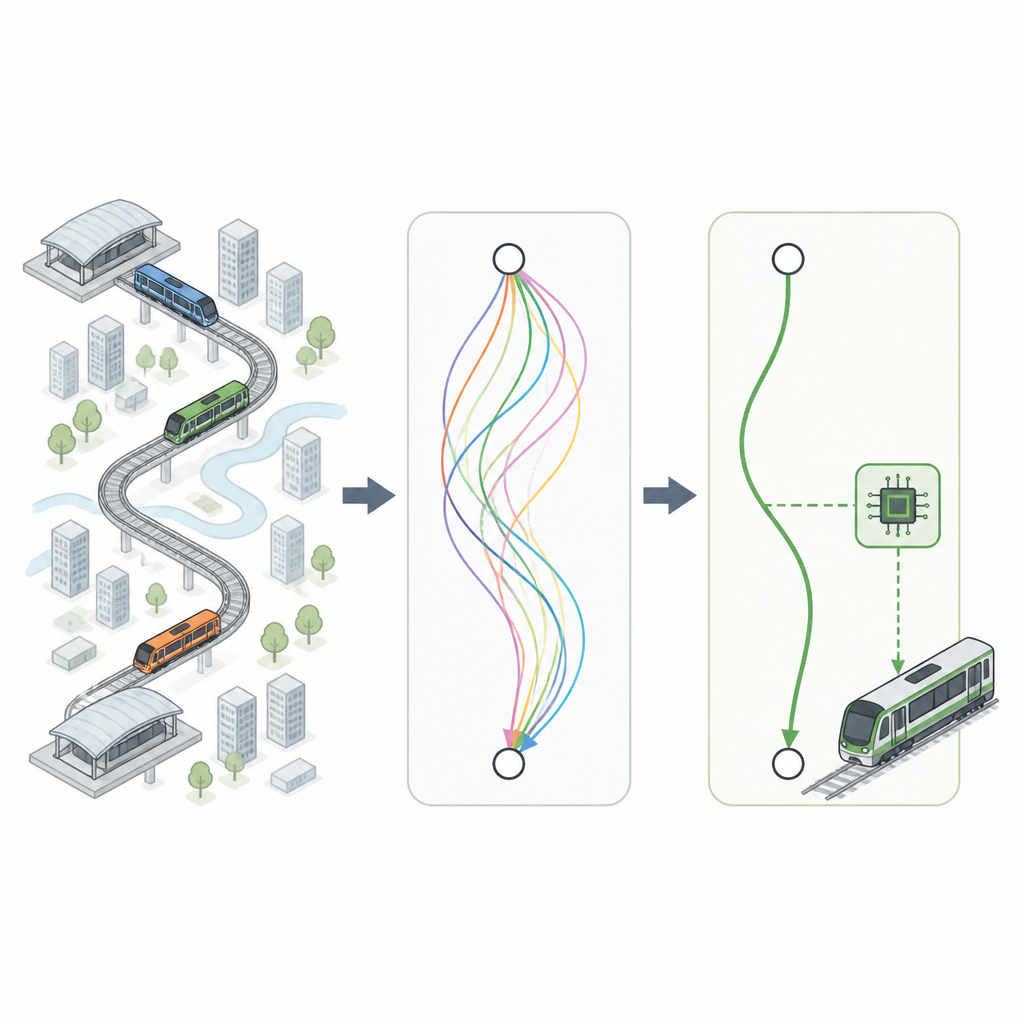
The researchers start by working with metro specialists to capture practical rules of thumb: how quickly trains may speed up or slow down without making passengers uncomfortable, how far apart stations usually are, and how precisely trains must stop at the platform. Using these rules, they generate millions of virtual “driving curves” that describe how a train’s speed should change over distance and time between stations. These curves cover different types of lines, from dense city centers to suburban routes with varying speed limits, while always respecting safety and comfort limits.
Sorting the best rides from the rest
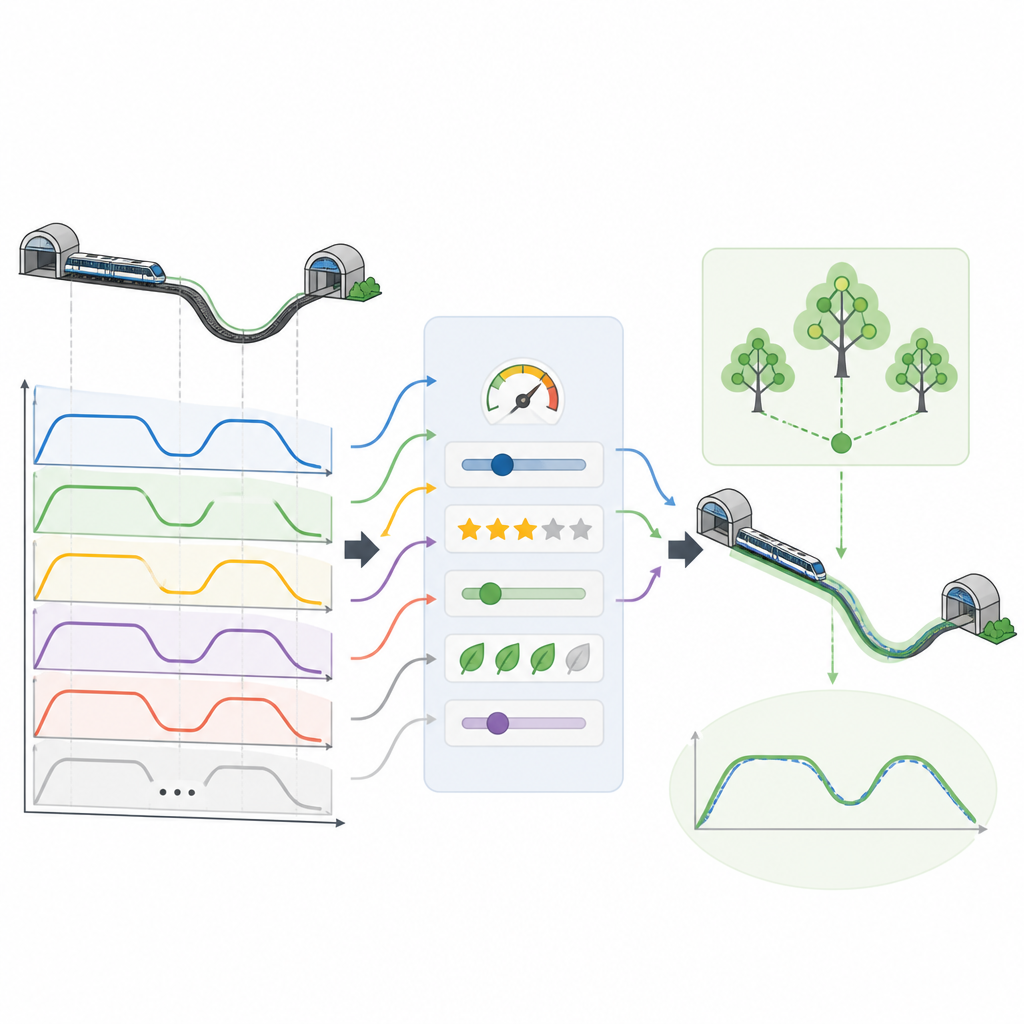
Not every virtual journey is equally good. Some use more electricity than needed, others arrive a little too early or too late, and some may feel less comfortable for riders. To pick the best options, the team applies a decision system inspired by fuzzy logic, a way of handling trade-offs instead of strict yes-or-no rules. Each candidate curve is scored on four aspects: energy use, passenger comfort, how close the actual arrival time is to the target schedule, and how accurately the train stops at the platform. Curves that best balance these goals rise to the top, providing a library of high-quality driving patterns for many station-to-station travel times.
Teaching a model to drive like an expert
Once the top-quality curves are selected, they are converted into a structured dataset that a machine learning model can understand. For each moment of a virtual trip, the dataset records information such as the current speed, position, remaining distance and time to the next station, and which part of the route the train is on. The target the model must learn is the next acceleration choice that will keep the journey on track. The researchers test several learning methods and find that a random forest model, built from many simple decision trees, can accurately reconstruct entire driving curves from these inputs, keeping arrival times and stopping positions within tight limits.
Saving energy and improving the ride
Using this expert-guided virtual data, the framework achieves notable gains when applied to realistic metro scenarios. The selected driving curves cut energy consumption by about twelve percent while maintaining a high level of passenger comfort. At the same time, they keep arrival times and stopping positions within just a few tenths of a second and a few tenths of a meter of their targets, which is crucial for reliable service and safe boarding. Because most of the learning happens on virtual journeys rather than real tracks, the approach also reduces the cost and complexity of data collection compared with traditional methods.
What this means for future city travel
For non-specialists, the key message is that metro trains can be taught to drive more like experienced human operators, but at scale and without years of manual tuning. By encoding expert rules into vast virtual datasets and then letting machine learning refine how trains accelerate, coast, and brake, the system supports smoother rides, lower energy bills, and precise station stops, all while fitting into existing automatic train operation setups. This makes it easier for cities, including those with limited technical infrastructure, to upgrade their metro networks to smarter, more adaptive automatic driving.
Citation: Huang, Y., Zhao, W., Chen, D. et al. Expert experience-guided virtual datasets for adaptive automatic driving in metro trains. Sci Rep 16, 15044 (2026). https://doi.org/10.1038/s41598-026-47220-3
Keywords: metro automation, adaptive automatic driving, virtual datasets, train energy efficiency, passenger comfort