Clear Sky Science · en
A hierarchical approach for finding undiscovered populations of an endangered bumble bee
Why a hidden bee matters
The rusty patched bumble bee once buzzed across much of the eastern United States and Canada, but today it survives in only a fraction of its former range and is listed as endangered. Most recent sightings come from city parks and gardens, raising a critical question: are these bees truly city specialists, or are we just not looking hard enough elsewhere? This study set out to search beyond urban hotspots, using a carefully planned survey strategy to uncover overlooked populations and give conservationists a clearer map of where this rare pollinator still hangs on. 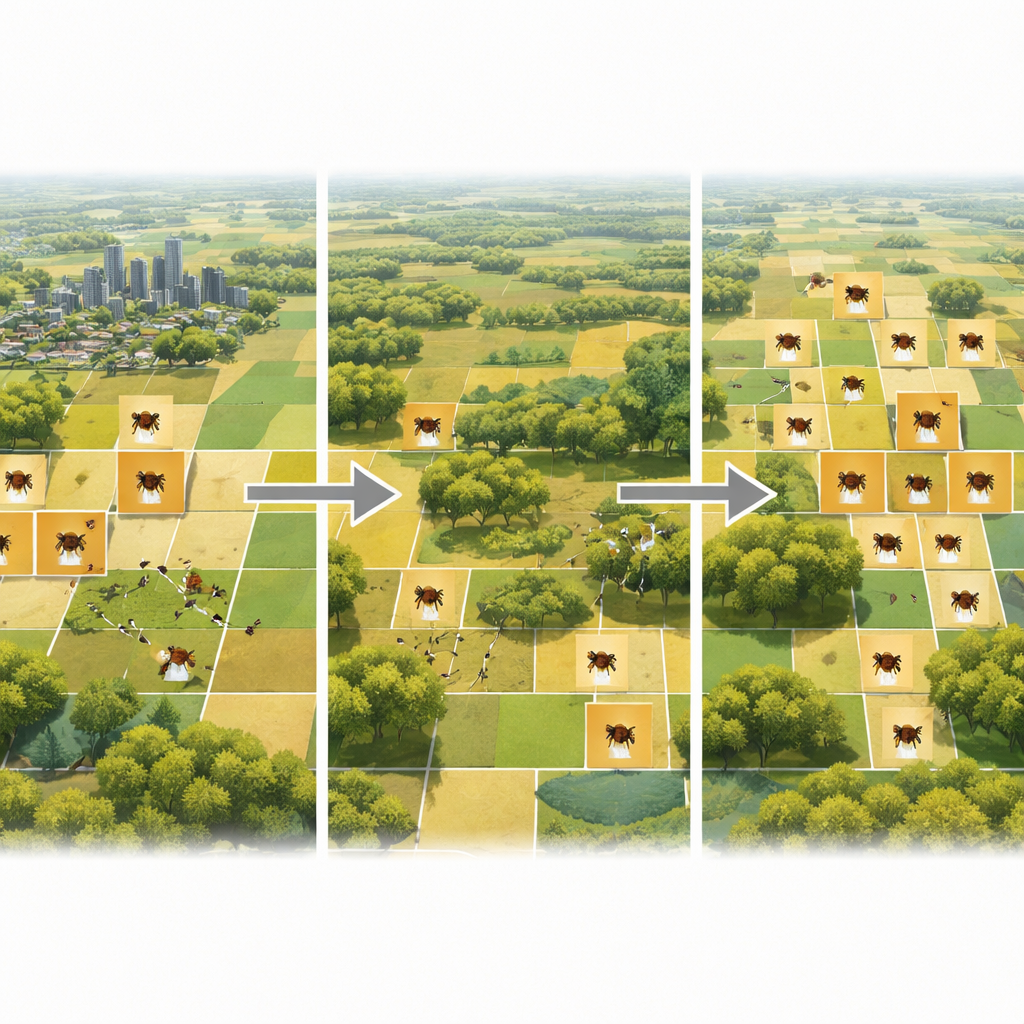
Looking beyond the city limits
Conservation agencies currently track the bee’s status using a checkerboard of large 100 km² “grid cells” across its historical range. Yet most recent records are clustered around Midwestern cities, in part because community scientists understandably prefer places that are easy to reach. To break free of this urban bias, the researchers focused on grid cells in Minnesota, Wisconsin, and Illinois where the bee had not been seen since 2017 but lay next to cells where it was known to occur. The idea was simple: if neighboring cells hold bees, the empty-looking ones might too—they just have not been searched well.
How the search grid worked
Within each chosen grid cell, the team zoomed in to a second level of detail. Using satellite maps, land-cover data, and public databases of past bee and flower sightings, they picked out smaller patches likely to offer good foraging: wildflower-rich grasslands, roadsides, park edges, and other accessible spots. These smaller patches, about the size of three soccer fields, became the basic units for on-the-ground surveys. Field crews checked each candidate site in advance to ensure there were blossoms either present or expected soon, and then selected up to four patches per grid cell for intensive bee searches. 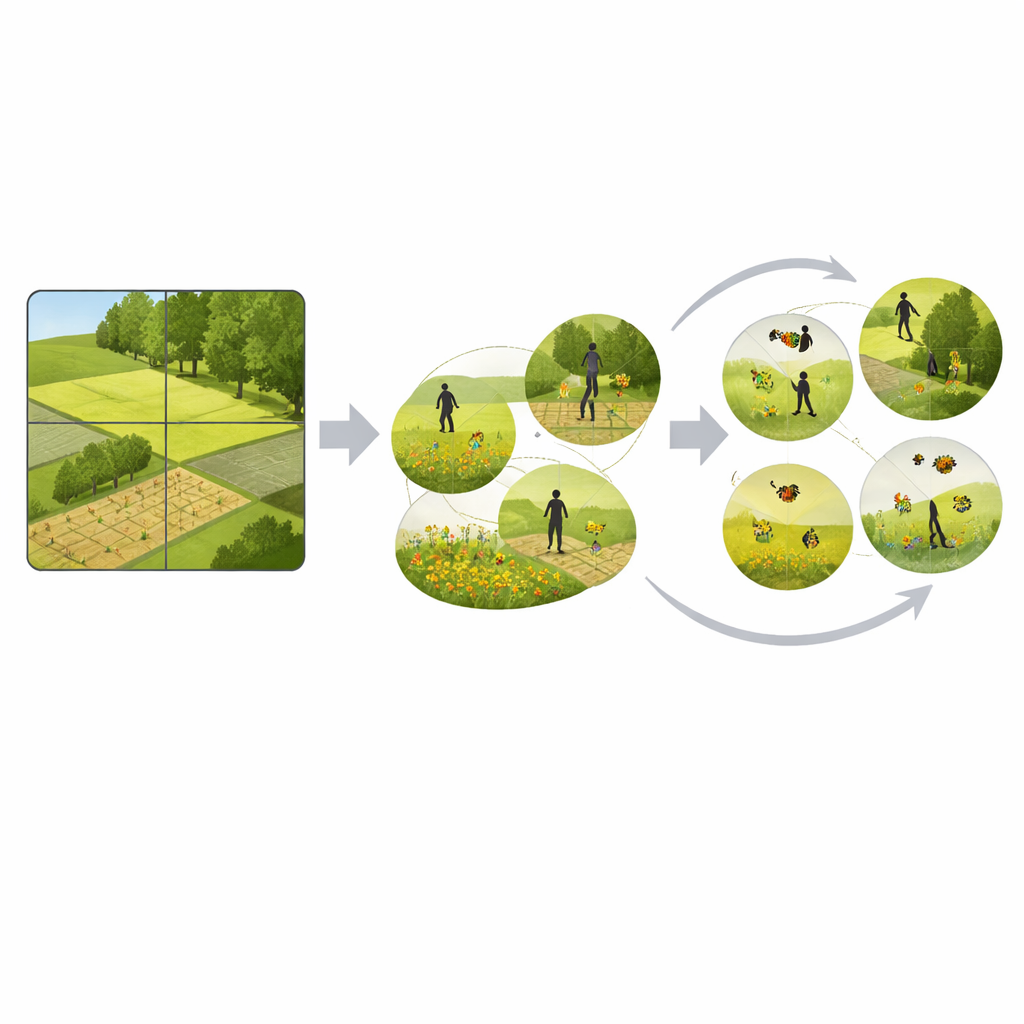
Timing and technique in the field
Surveyors walked each patch on foot, watching flowers for bumble bees during timed 30‑minute “visual encounter” sessions. Two observers often worked simultaneously but independently, photographing any suspected rusty patched bumble bees so identifications could be confirmed later. Each patch could be visited up to three times over the summer, but the design included a crucial twist: as soon as a rusty patched bumble bee was confirmed anywhere within a grid cell, all remaining surveys in that grid were stopped. This “removal” approach sacrificed some detail about how bees were spread within a cell, but it greatly increased the number of grid cells the team could check during the brief flight season.
What the team discovered
The search proved remarkably successful. The researchers surveyed 105 grid cells and detected rusty patched bumble bees in 57 of them, expanding the known occupied area in the Midwest by about 5,700 square kilometers. When they accounted for the fact that even careful searches can miss bees, their statistical model suggested that roughly 67 of the 105 grid cells were actually occupied. Occupancy was highest in Wisconsin, moderate in Illinois, and lower in Minnesota, where past monitoring has already been extensive. A key pattern emerged: grid cells surrounded by more occupied neighbors were much more likely to host the bee, supporting the idea that the species persists in clusters across the landscape. By contrast, the amount of developed land—cities and suburbs—within a grid cell or around individual patches did not reliably predict whether bees were present.
Rethinking the bee’s neighborhood
These results challenge the notion that the rusty patched bumble bee is now mainly an urban insect. While cities still serve as important strongholds, the study shows that bees also occupy less developed areas that have simply received less attention from observers. Using their model, the authors identified 145 additional grid cells across the three states that have several occupied neighbors but little or no recent survey effort. Their analysis suggests that 30–60% of these unsurveyed cells may harbor bees, making them high priorities for future field work and long‑term monitoring.
What this means for saving the species
For a layperson, the message is hopeful but urgent. A thoughtful, two-level search strategy revealed that the endangered rusty patched bumble bee is more widespread than current maps suggested, with many populations hiding in plain sight outside big cities. By systematically targeting grid cells next to known populations and carefully choosing flower-rich patches within them, conservationists can greatly improve their chances of finding rare species. The same approach can be adapted to other threatened bees and pollinators, helping scientists move beyond scattered, city-centered records toward a truer picture of where vulnerable insects still survive—and where protection and habitat restoration efforts will matter most.
Citation: Otto, C., Schrage, A., Lothspeich, A. et al. A hierarchical approach for finding undiscovered populations of an endangered bumble bee. Sci Rep 16, 13759 (2026). https://doi.org/10.1038/s41598-026-46861-8
Keywords: rusty patched bumble bee, endangered pollinators, species occupancy, wild bee monitoring, Midwestern conservation