Clear Sky Science · en
YOLO11-BSCS: an enhanced attention-optimized framework for real-time indoor flame and smoke detection in elderly care mobile robots
Why fire safety for seniors needs smarter helpers
More older adults are living at home with limited mobility, often spending long hours alone indoors. A small kitchen flame or a wisp of smoke can quickly turn into a life threatening fire, especially for people who move slowly or use walking aids. This study explores how to give mobile helper robots sharper eyes for spotting indoor flames and smoke in time to warn and guide vulnerable seniors to safety.
Robots that watch over the home
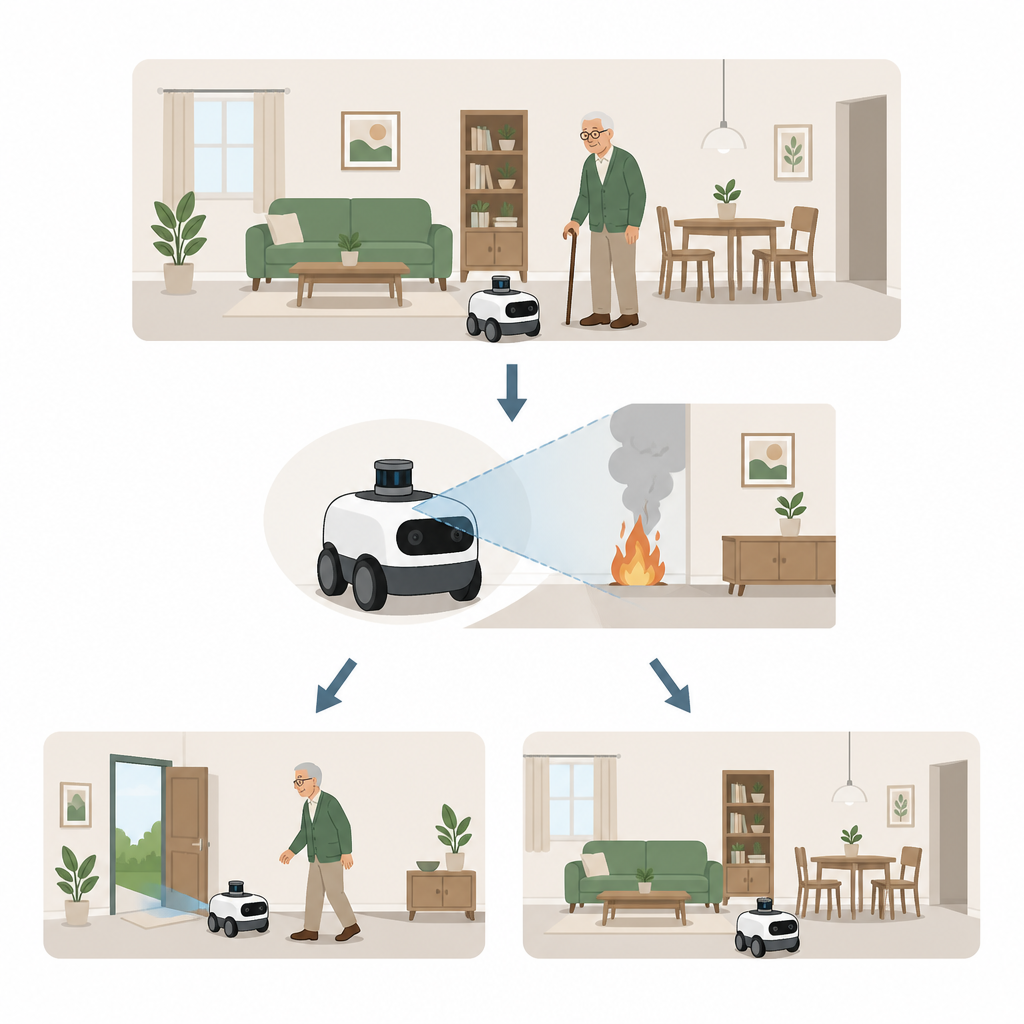
The researchers focus on mobility robots designed to assist disabled elderly people in daily life. Beyond carrying items or providing companionship, these robots can patrol rooms with built in cameras, acting as moving safety guards. Fire is a major risk in such settings, with many deaths linked to late detection. Unlike fixed smoke alarms, a mobile robot can look directly at stoves, sockets, and other danger spots, even in cluttered or changing rooms. To be truly useful, however, its vision system must spot small, early stage flames and faint smoke in real time while running on limited onboard computing power.
Teaching a robot to see fire and smoke
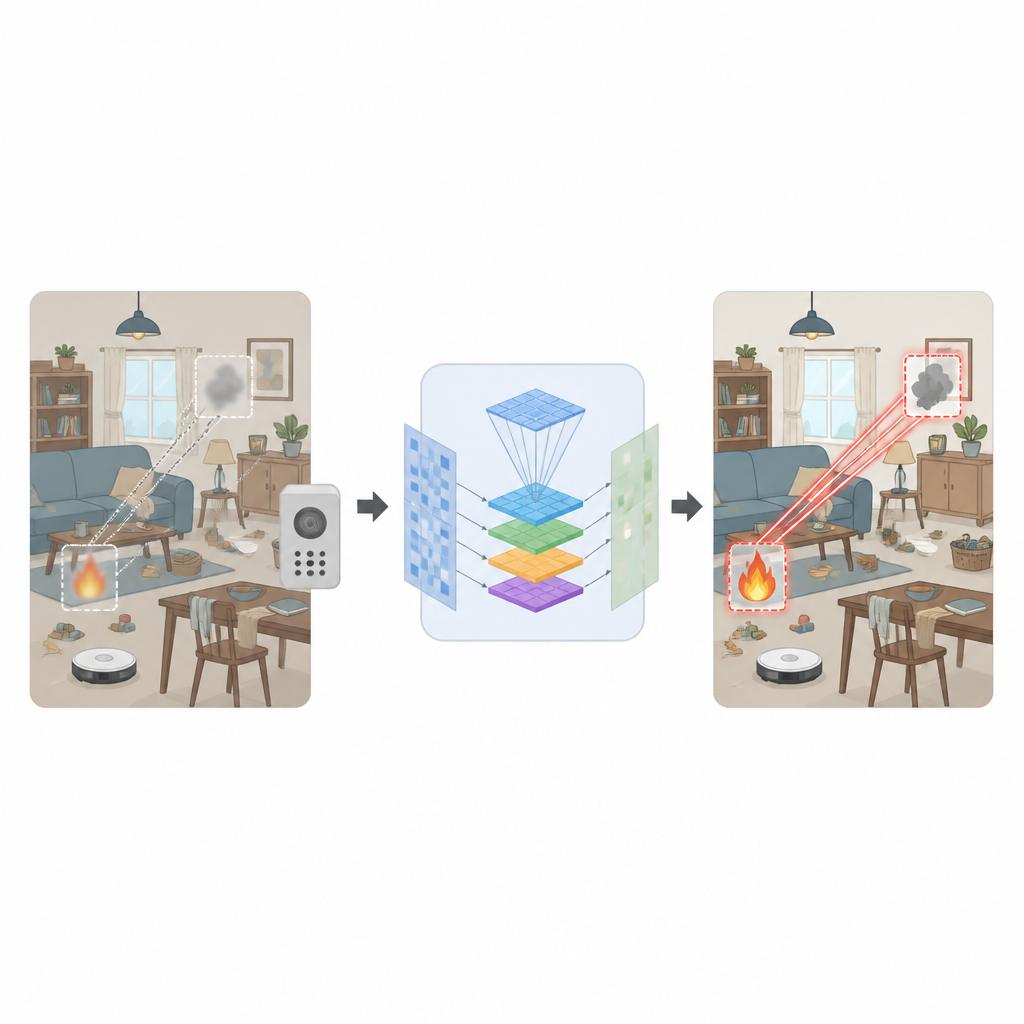
Modern fire watching robots rely on deep learning, where a computer model learns patterns from thousands of images instead of following hand written rules. The team builds on a recent vision system called YOLO11s, known for scanning images quickly in a single pass. They create an improved version named YOLO11 BSCS, tuned specifically for indoor flames and smoke. To train it, they assemble a large image collection from laboratory databases, the web, and carefully staged indoor scenes such as kitchens, bedrooms, and senior apartments. The pictures capture flames and smoke at many sizes, angles, and lighting conditions, and are expanded through rotation, noise, and grayscale conversion so the model can cope with blurry or unusual views.
Giving the robot sharper focus and faster thinking
The core advance of YOLO11 BSCS lies in three upgrades that together make the robot both more accurate and more efficient. First, an attention module helps the system concentrate on important visual regions, such as slender tongues of flame or thin smoke drifting across a busy background, instead of treating every pixel equally. Second, a redesigned set of convolutions trims away repeated or low value image information in both space and color channels. This cuts the number of internal calculations, improving speed without throwing away useful details. Third, the team refines the way the model learns to draw boxes around hazards, using a training rule that better balances box position, size, and shape, so detections line up more tightly with the true fire and smoke areas.
Putting the new vision system to the test
To see whether these changes matter in practice, the authors compare YOLO11 BSCS with well known detection models, including several versions of YOLO and the widely used Faster R CNN. All systems are trained and tested on the same indoor fire image sets, and each experiment is repeated several times with different random starts to ensure stable results. The improved model reaches higher precision, meaning fewer false alarms, and higher recall, meaning fewer missed hazards. Its overall scoring measure, which balances both, rises several percentage points above the original YOLO11s, even while using fewer parameters than many rival models. Additional tests on new images from previously unseen rooms show that the system still spots flames and smoke reliably, indicating good generalization beyond the training data.
What this means for safer home care
In plain terms, the study shows that a carefully tuned vision system can help indoor care robots notice fire and smoke earlier and more reliably, without demanding heavy computer hardware. YOLO11 BSCS lets a robot quickly scan rooms, lock onto small or partially hidden flames and smoke, and support timely alarms or guidance for residents who may struggle to escape on their own. While further work is needed to test the system on real devices and to broaden it to other hazards, this research points toward a future where mobile helpers quietly patrol our homes, providing an extra layer of safety for some of the most vulnerable members of society.
Citation: Wang, Y., Wang, Y., Wei, Z. et al. YOLO11-BSCS: an enhanced attention-optimized framework for real-time indoor flame and smoke detection in elderly care mobile robots. Sci Rep 16, 14956 (2026). https://doi.org/10.1038/s41598-026-45957-5
Keywords: indoor fire detection, elderly care robots, smoke recognition, deep learning vision, real-time safety monitoring