Clear Sky Science · en
Comprehensive assessment of heavy metal(loid) contamination and health risks in agricultural soils near the Menzel Bourguiba steel smelter, Tunisia
Why this local soil story matters to you
Near the Tunisian city of Menzel Bourguiba, a long‑running steel plant has quietly loaded nearby farm soils with toxic metals. This study shows how that pollution travels from factory smokestacks into the ground beneath crops and homes, and then into the bodies of people who live and work there. By tracing both the level of contamination and the health risks it creates, especially for children, the research offers a clear warning for industrial and farming communities worldwide.
Farms beside a steel factory
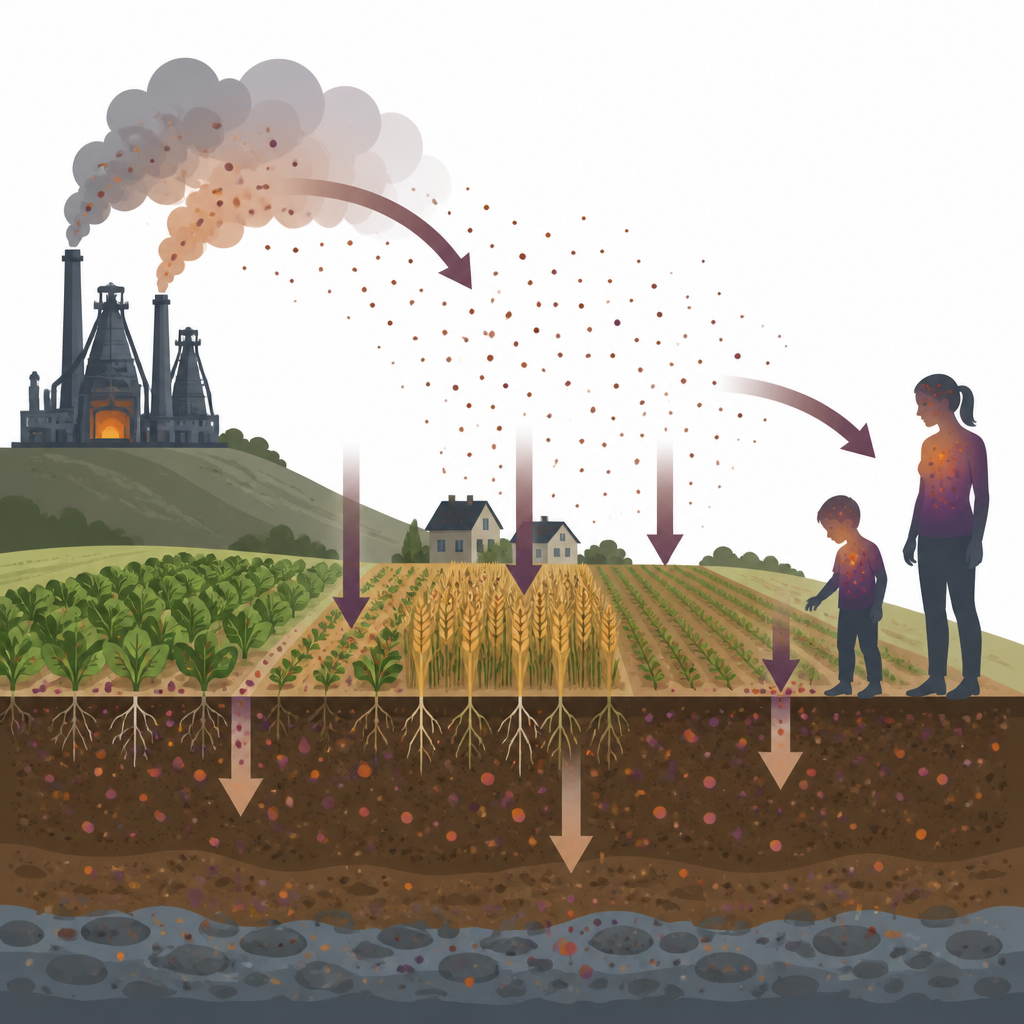
The steel smelter at Menzel Bourguiba has operated since the 1960s on a low hill ringed by agricultural land where people grow food and live. The region has a mild Mediterranean climate, and the main soils are clays and sandy clays that tend to hold on to contaminants. For decades, exhaust gases, wastewater and solid waste from the plant were released with little control. To see what lingered in the soil, the researchers collected 20 samples from the top 20 centimeters of nearby fields, the layer most likely to touch human skin, be accidentally swallowed as dust, or be taken up by plant roots. They then measured eight metals and metalloids, including lead, cadmium, arsenic and chromium, that are known to harm human health.
How polluted are these fields
To judge how unusual the soil metal levels were, the team compared them with natural background values found in typical rocks and fine sediments. They also used several standard indices that show how much a metal has built up and whether the source is likely to be human activity. Iron, a common element, was used as a reference because its levels stayed close to natural values, suggesting that the plant was not significantly adding iron to the soil. In contrast, most other metals were clearly elevated. Cadmium levels were about 18 times higher than typical shale and nearly 60 times higher than the average continental crust. Lead and zinc were several times above natural levels, while arsenic, chromium and copper showed moderate increases. Only nickel and iron stayed near background. Together with the pattern of decreasing pollution farther from the smelter, this points strongly to the steel works as the main source.
From soil to people, with children at greatest risk
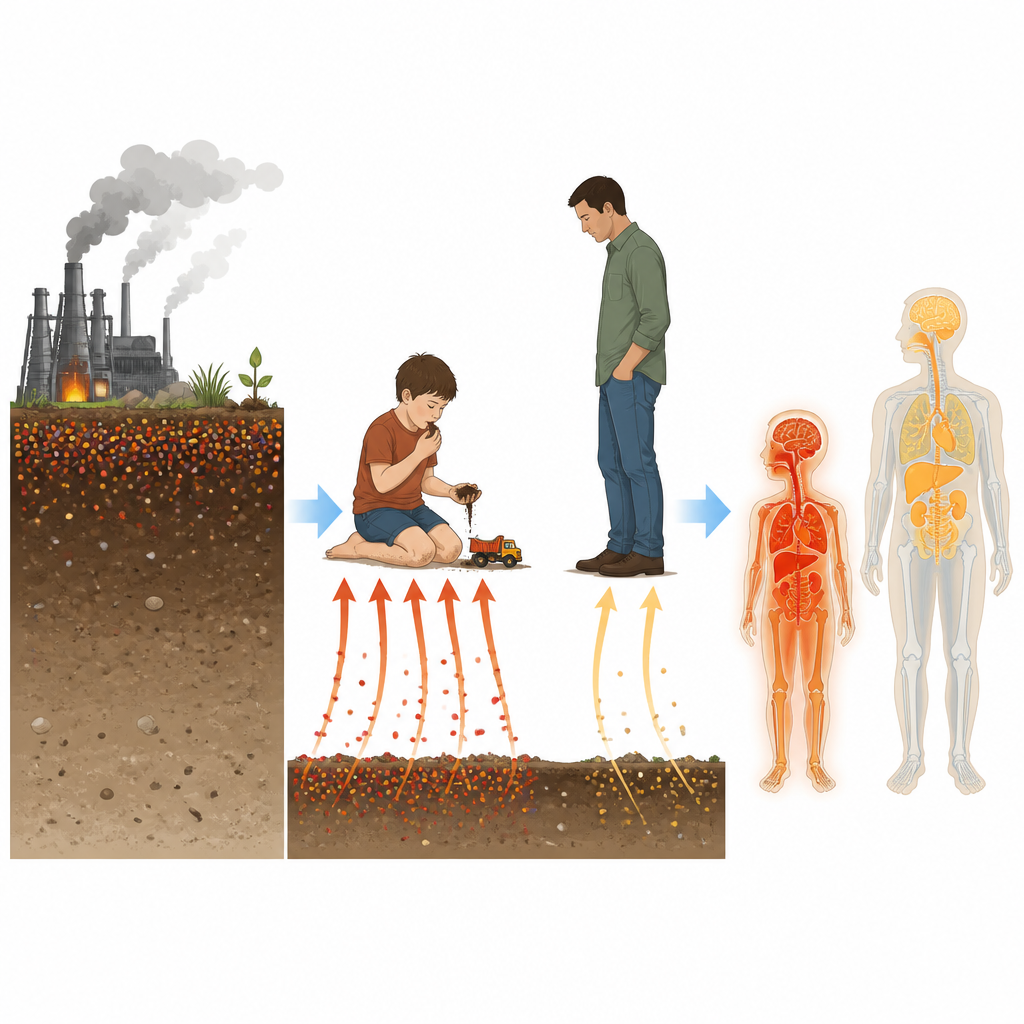
The team then asked what these numbers mean for people who live and farm on this land. They used a standard health‑risk model that tracks three main routes of exposure: swallowing soil and dust, breathing it in, and skin contact. Because real‑world exposure varies from person to person, they ran thousands of computer simulations using Monte Carlo methods, which randomly sample possible values for factors like how much soil a child might ingest. For children, the results are stark. The combined non‑cancer hazard from lead alone often rose above accepted safety limits, with more than half of the simulations showing values higher than one. Iron and arsenic added further pressure. For adults, non‑cancer hazards stayed below the usual threshold, but still contributed to overall concern.
Cancer risks far beyond accepted levels
When the researchers looked at lifetime cancer risk, the picture became even more troubling. For children, the total cancer risk tied to cadmium in soil was often in the range of one to four chances in a thousand, tens of times higher than the level typically considered acceptable. Chromium and arsenic added their own cancer risks, and nickel also played a role. Adults faced lower but still worrisome cancer risks, especially from cadmium. By the 95th percentile of simulations, the overall cancer risk for children reached about 5.7 in a thousand, far exceeding common regulatory targets. A sensitivity analysis showed that how much soil people accidentally ingest, particularly children, dominates the uncertainty in these estimates, while body weight is the second most important factor.
Tracing sources and planning action
To better understand where the metals came from, the study used statistical tools that group elements with similar behavior. Nickel and chromium tended to cluster together in ways that match natural local geology, suggesting much of their presence is geologic. In contrast, cadmium and lead formed a tight cluster that clearly reflects emissions from the steel plant, while combinations of arsenic with iron and cadmium with copper point to specific industrial processes at the facility. The authors also note that their risk estimates may be conservative because they did not include metals entering the body through food or water, and they only sampled once in time.
What this means for nearby families
For residents around the Menzel Bourguiba smelter, the study concludes that soils have become a significant route of toxic exposure, with children facing both non‑cancer and cancer risks well above widely used benchmarks. The authors call for prompt responses: medical screening for affected children, better pollution controls at the plant, temporary limits on growing food crops in the most contaminated fields, and longer‑term monitoring of both soil and community health. More broadly, the work illustrates how industrial activity can turn everyday soil into a hidden health hazard and underscores the need to balance heavy industry with strong protections for people and farmland.
Citation: Aydi, A., Sifi, S., Zaghdoudi, S. et al. Comprehensive assessment of heavy metal(loid) contamination and health risks in agricultural soils near the Menzel Bourguiba steel smelter, Tunisia. Sci Rep 16, 15806 (2026). https://doi.org/10.1038/s41598-026-45034-x
Keywords: heavy metals, soil contamination, health risk, steel smelter, Tunisia