Clear Sky Science · en
Syninclusions reveal “ant mosaic” in the Eocene amber forest
Why ancient ants matter today
Ants quietly run much of the modern world’s forests and fields, shaping soils, recycling nutrients, and defending trees from pests. But did these tiny engineers already play such complex roles tens of millions of years ago, under a much warmer climate than today’s? This study looks deep into time using insects trapped in Baltic amber to show that Eocene ants—living in lush forests about 34–38 million years ago—were already locked in intricate battles over territory, much like their descendants today. Understanding how these ancient communities worked offers clues to how life might respond to our rapidly warming planet.
A window into a vanished forest
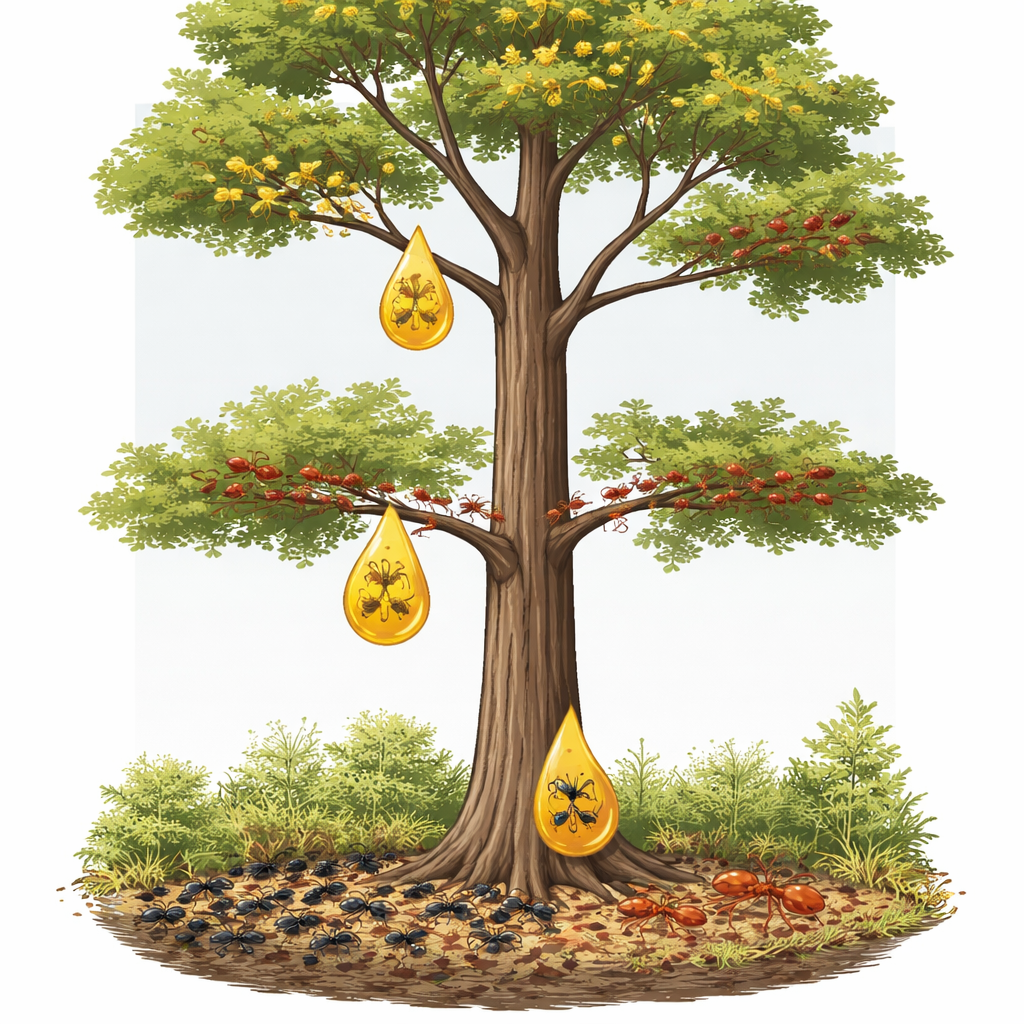
During the Eocene epoch, Earth was a greenhouse world. Temperatures were more than 10 degrees Celsius warmer than today, winters were mild even near the Arctic Circle, and Europe was draped in dense, evergreen forests. These forests oozed sticky resin that sometimes trapped small creatures. Over millions of years that resin hardened into amber, preserving insects in extraordinary detail—down to legs, antennae, and even delicate wings. Baltic amber, from the shores of today’s Baltic Sea, is the richest trove of such fossils and holds thousands of ancient ant specimens, frozen in mid-stride as they foraged on tree trunks and branches.
Snapshots of ant society in a drop of resin
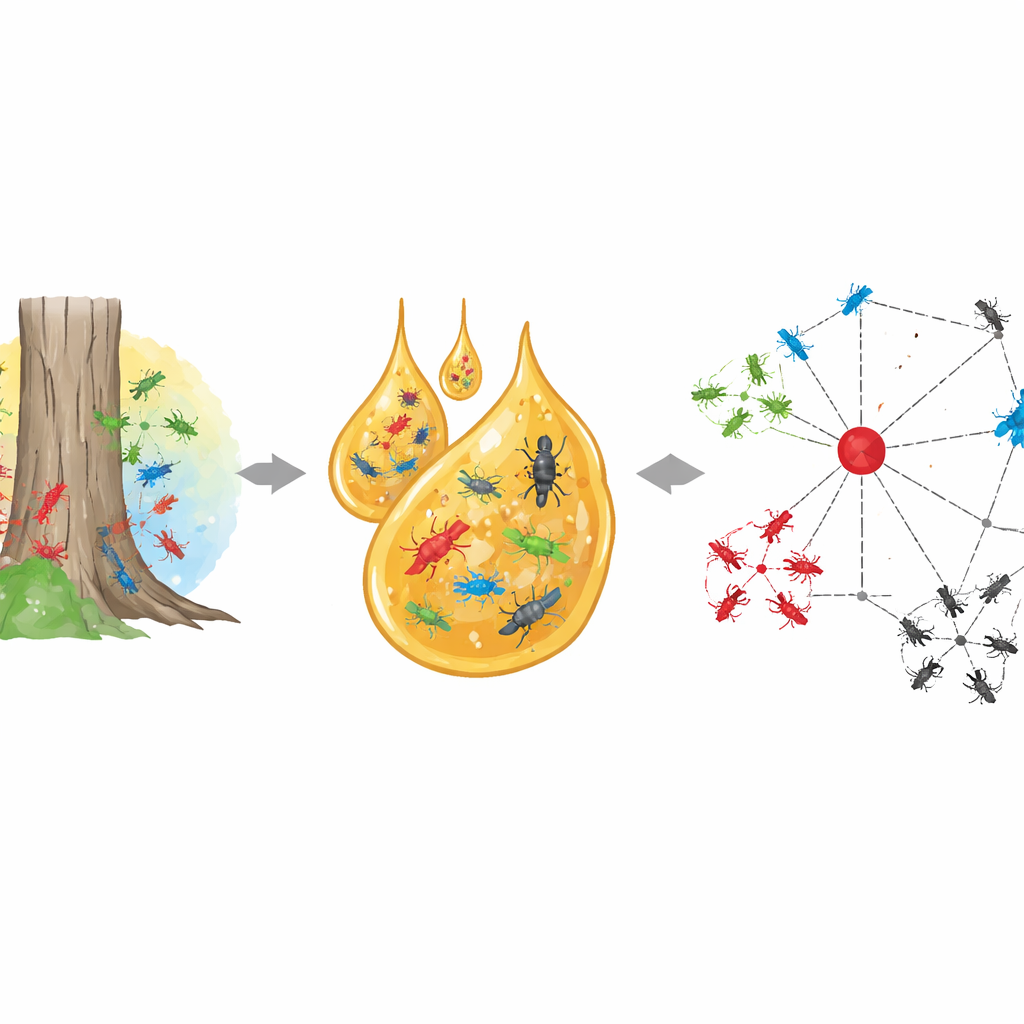
The authors focused on a special kind of amber fossil called a eusyninclusion: a single resin flow that captured several organisms at the same time. Unlike scattered fossils from different layers of rock, these tiny scenes record who was actually living side-by-side on the same tree. From 3246 fossil ants in 2904 amber pieces, the team identified 110 such multi-species inclusions, representing 37 different ant species. By counting which species tended to appear together and which rarely shared the same amber piece, they could reconstruct the invisible web of contacts, conflicts, and avoidance that structured these ancient communities.
Hidden neighborhoods in the treetops
When the researchers translated these co-occurrence patterns into a network of relationships, a striking picture emerged. The fossil ant community was not a random jumble but was organized around two very common species that rarely met each other. One, interpreted as a highly territorial tree-dweller, appears abundant in amber yet is almost always alone or with a small, fixed set of partners. The other shows up more often alongside a wide variety of species, suggesting it tolerated a broader range of conditions and played a more flexible, subordinate role. Other ants seem tied to particular layers of the forest—some in the canopy and epiphytes, others closer to the ground or among leaf litter—hinting at a vertically layered “neighborhood map” running up and down each tree.
Competition written in absence
Crucially, the statistical analysis revealed almost no pairs of species that occurred together more often than chance would predict. Instead, many pairs appeared together less often than expected, pointing to mutual avoidance. Several species that likely had similar diets or favored similar parts of the tree almost never share the same amber piece, as if they carved the forest into exclusive territories. This pattern mirrors what ecologists today call an “ant mosaic,” in which aggressive colonies defend patches of canopy and less dominant ants are squeezed into the spaces in between. The study suggests that even in the Eocene’s remarkably even climate, the forest’s physical complexity—branches, bark textures, climbing plants, and shaded ground layers—created countless tiny niches where ants could sort themselves out and compete without driving one another to extinction.
What this means for life in a warming world
To a non-specialist, the main message is that complex, competition-driven ant societies are not a recent invention. They were already in place at least 34 million years ago, under conditions of high carbon dioxide and global warmth. The amber evidence shows that biodiversity in such climates depended not just on temperature, but on the fine-grained structure of habitats—the three-dimensional maze of trunks, vines, and leaf litter that allowed species to specialize and avoid direct conflict. As our own world heats up, this deep-time lesson suggests that protecting and restoring structural richness in forests and other ecosystems may be just as important as limiting temperature rise itself if we hope to maintain thriving insect communities and the services they provide.
Citation: Zharkov, D.M., Dubovikoff, D.A., Khaitov, V.M. et al. Syninclusions reveal “ant mosaic” in the Eocene amber forest. Sci Rep 16, 14569 (2026). https://doi.org/10.1038/s41598-026-44622-1
Keywords: Baltic amber ants, Eocene forests, ant community structure, fossil insect ecology, ancient climate biodiversity