Clear Sky Science · en
Age estimation using the pulp-to-tooth volume ratio of canines based on cone-beam computed tomography: a systematic review and meta-analysis
Why our teeth can tell our age
When law enforcement or disaster teams are faced with unidentified remains, one of the first questions is also the most basic: How old was this person? Teeth can outlast soft tissues and even bones, making them valuable biological timekeepers. This article examines whether a subtle internal feature of canine teeth, visible on modern 3D dental scans, can provide a reliable way to estimate a person’s age without damaging the tooth.
A shrinking space inside the tooth
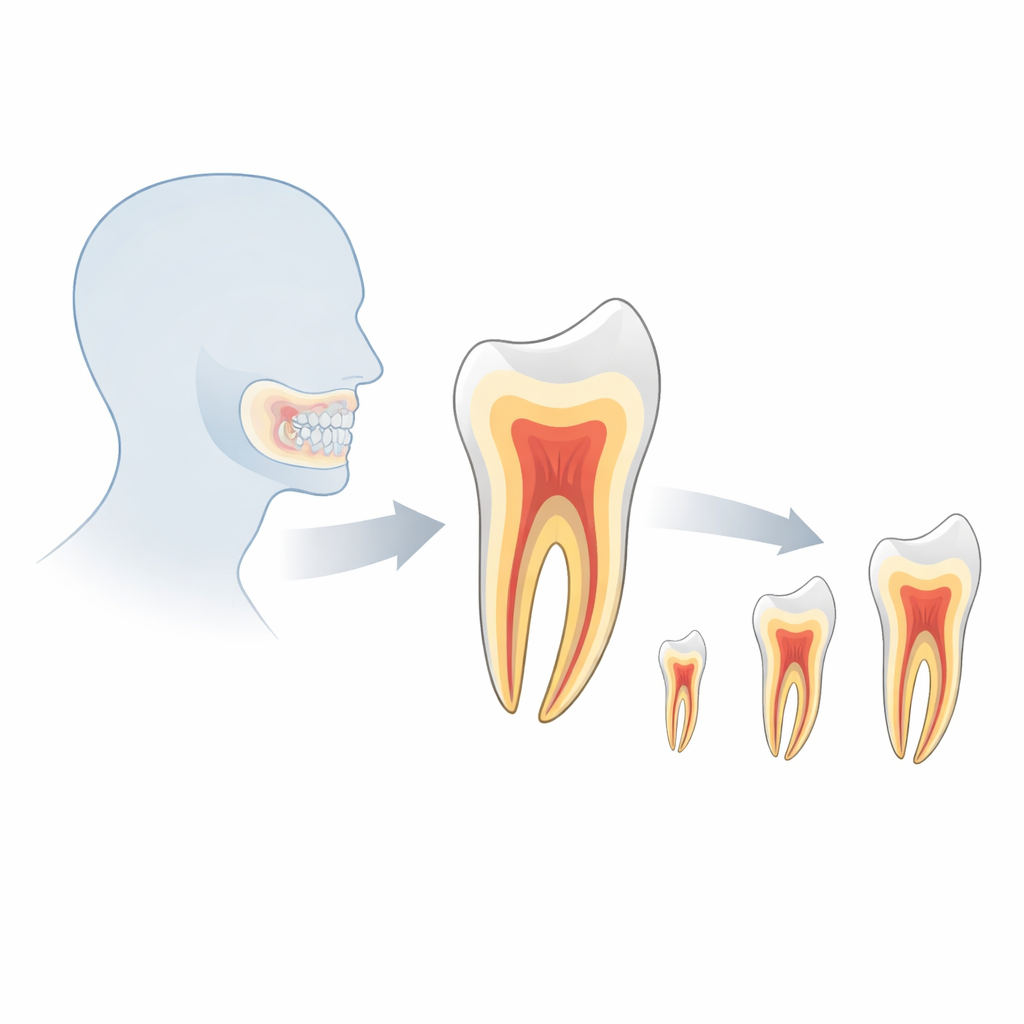
Inside every tooth lies a soft core called the pulp, surrounded by a hard tissue known as dentin. Throughout adult life, the body continues to lay down new dentin along the walls of the pulp chamber. As years pass, this slow buildup makes the hollow space smaller. Because the overall tooth size changes very little in adulthood, the proportion between the pulp volume and the full tooth volume tends to decrease with age. This predictable narrowing has long tempted forensic scientists to use it as a noninvasive “dental clock.”
From flat x-rays to 3D dental scans
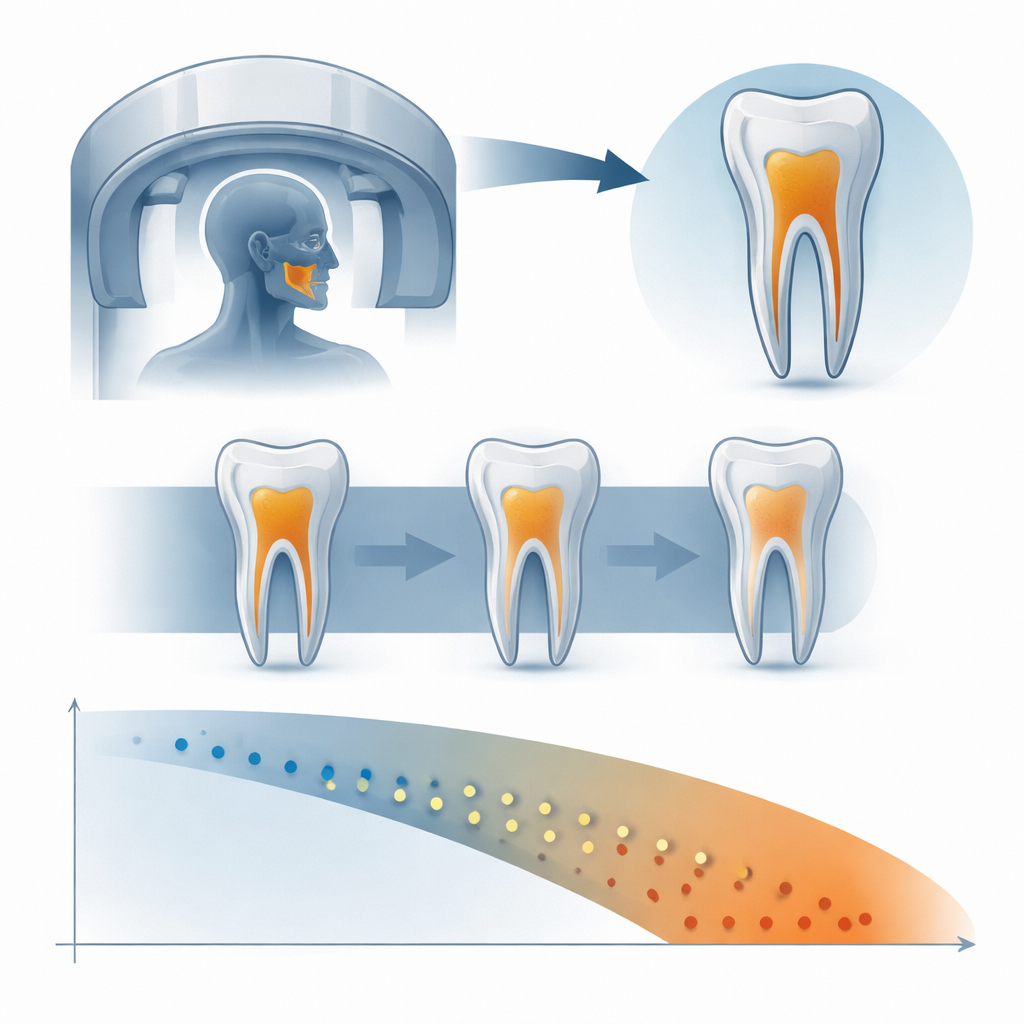
Early age-estimation methods relied on ordinary dental x-rays, which flatten three‑dimensional structures into two‑dimensional images. These pictures can distort size and shape and often blur different structures together, limiting precision. Cone-beam computed tomography (CBCT), now widely used in dentistry, solves many of these problems by producing 3D images with relatively low radiation doses. Using CBCT, researchers can digitally segment a single tooth, separate the hard tissue from the pulp space, and calculate their volumes in three dimensions. Canines are especially attractive for this purpose because they are large, wear down slowly, and are less likely to be lost to cavities or extractions.
Gathering the global evidence
The authors of this paper systematically searched major medical and dental databases in several languages to find all studies that used CBCT to measure the pulp‑to‑tooth volume ratio of canines in adults. Ten studies, published between 2010 and 2024 and drawn from populations in Europe, Asia, and South America, met their criteria. Most included both men and women and covered ages from the teens to the seventies. All were judged to have a low risk of bias using a standard quality checklist, although important details such as scanner settings and exact statistical methods were not always reported clearly.
What the combined data revealed
Nine of the ten studies provided numbers that could be pooled in a meta-analysis, yielding 15 separate estimates of how strongly pulp‑to‑tooth ratio was linked to chronological age. Overall, the authors found that as people get older, the pulp space in their canines tends to occupy a smaller fraction of the tooth volume. When all studies were combined, this association was moderate in strength and highly variable from study to study. After removing three influential outlier datasets, the relationship became stronger: the remaining data suggested a fairly robust negative link between age and pulp‑to‑tooth ratio, meaning that people with smaller pulp spaces tended to be older. Even so, statistical tests showed considerable differences among studies and signs that research with certain types of results may have been more likely to be published.
Why results still need careful handling
The review highlights several reasons why this seemingly simple measurement is not yet a plug‑and‑play age test. Technical factors such as the size of the tiny 3D pixels (voxels) in CBCT images, the software used to outline the pulp, and whether teeth are intact or have been damaged by decay or trauma can all affect the calculated volumes. Biological factors also matter: tooth size and wear patterns vary between populations and even between men and women. Because the original studies used different settings, selection criteria, and age ranges, their results are not perfectly comparable, and the combined estimate may not apply equally well to every group.
What this means for real‑world cases
Forensic experts and clinicians can cautiously use the pulp‑to‑tooth volume ratio of canines from CBCT scans as one piece of evidence when estimating the age of adults whose teeth are fully developed. The current body of research supports a general rule: smaller pulp space relative to tooth size usually points to an older individual. However, the method is not accurate enough to stand alone, especially in legal or identification settings where precision is critical. The authors conclude that more carefully designed, well‑reported studies—using standardized imaging protocols and diverse populations—are needed before this promising dental clock can become a dependable tool in forensic practice.
Citation: da Silva, M.C., Panciera, M.C., Pinto, P.H.V. et al. Age estimation using the pulp-to-tooth volume ratio of canines based on cone-beam computed tomography: a systematic review and meta-analysis. Sci Rep 16, 13921 (2026). https://doi.org/10.1038/s41598-026-44605-2
Keywords: forensic odontology, dental age estimation, cone beam CT, canine pulp volume, secondary dentin