Clear Sky Science · en
Laboratory toxicological assessment of ozone exposure on terrestrial snail Theba pisana and its impact on histopathological alterations
Why Snail Lovers and Farmers Should Care
Garden snails may seem like slow, harmless neighbors, but in many farms they are serious crop pests. At the same time, farmers are searching for alternatives to traditional chemical pesticides. This study explores whether ozone gas—already used to disinfect food and kill insects in stored grain—could also harm a widespread land snail, Theba pisana. By looking not only at survival and body weight but also at internal tissue damage, the researchers show how this gas affects snails in detail and consider what that might mean for future pest control and environmental safety.
A Gas with a Double Identity
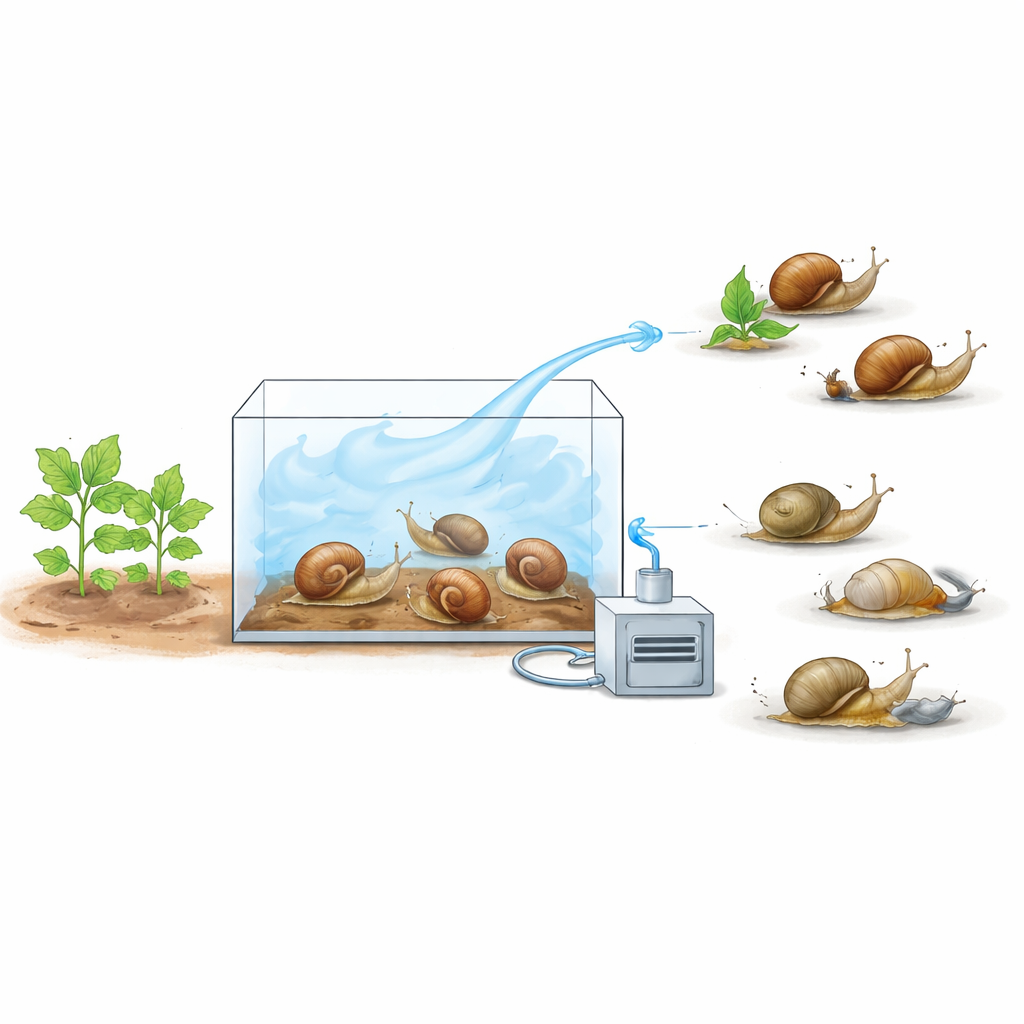
Ozone is a form of oxygen that is highly reactive. In the upper atmosphere it helps shield us from ultraviolet radiation, but at ground level it can damage living cells. Because of this reactivity, ozone has been tested as a way to reduce insects, bacteria, and fungi on stored crops. The white garden snail Theba pisana is an invasive species that thrives in agricultural areas and feeds on many types of plants, making it a costly nuisance. Yet little was known about how ozone affects these snails. The authors set up controlled laboratory experiments to expose adult snails to fixed doses of ozone and then track both outward signs—such as death rates and weight loss—and hidden changes inside key organs.
Short Bursts of Gas, Lasting Harm
Adult snails were placed in a fumigation chamber and exposed for just 30 minutes to one of three ozone concentrations—low, medium, or high—or to normal air as a control. The snails were then kept under standard conditions and monitored for four days. The results showed a clear pattern: the more ozone the animals received, and the longer they were observed afterward, the more died. At the highest level, over half of the snails were dead within 96 hours, whereas none died in the untreated group. The same trend appeared in body weight. Ozone-exposed snails lost much more weight than controls, especially at the highest dose, likely because they produced large amounts of mucus and became dehydrated, signs of stress and injury.
Shells Losing Their Shine
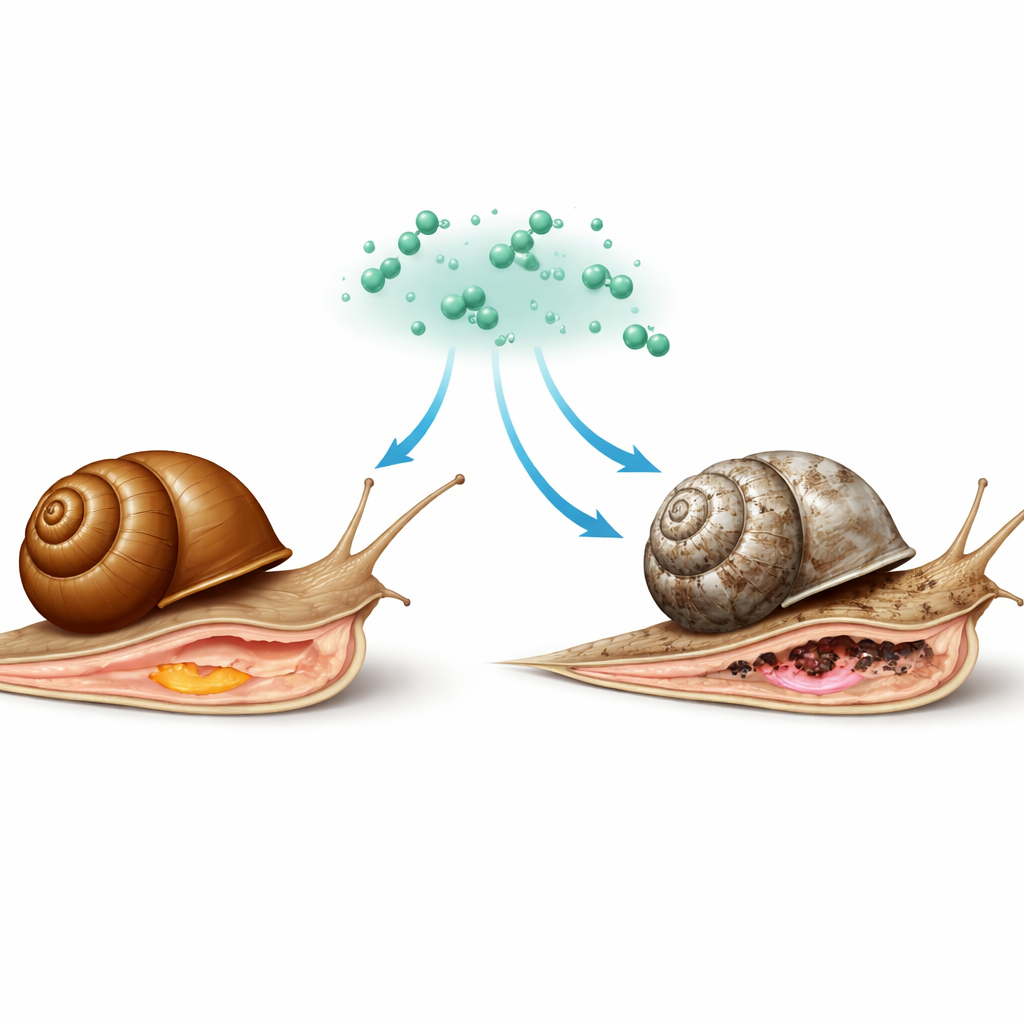
The researchers also asked whether ozone would leave visible traces on the snail’s armor. Before treatment, shells were shiny, with clear growth lines and distinct brown bands. After ozone exposure, the outer surface became dull, the bands faded, and the fine lines that record shell growth were harder to see. Scanning electron microscope images confirmed that the shell surface became rougher and less regular at higher ozone levels. While these changes were confined to the shell’s exterior, they showed that the gas could reach and alter one of the snail’s main physical defenses, potentially making the animal more vulnerable over time.
Hidden Damage Inside the Snail
To understand what the gas was doing internally, the team examined thin tissue slices from the digestive gland and the foot—the muscular “sole” the snail uses to move. In healthy snails, the digestive gland is built from neatly arranged tubules lined with orderly cells, and the foot has a continuous surface layer over well-organized muscle and connective tissue. After ozone exposure, this structure broke down in a dose-dependent way. At low levels, some tubules were shrunken, membranes were partly ruptured, and connective tissue showed early signs of cell death. At higher levels, much of the digestive gland architecture was lost: tubules fused into large, irregular cavities packed with secretions, and the surrounding tissue became necrotic. Similar damage appeared in the foot, where the surface covering split, muscles degenerated, and vacuoles and dark pigments accumulated, all pointing to severe injury that would impair movement and basic bodily functions.
What It Means for Pest Control and the Environment
Taken together, the findings make one point clear: under laboratory conditions, concentrated ozone gas can seriously harm Theba pisana, damaging both its protective shell and its vital soft tissues, and ultimately increasing death and weight loss. This suggests that ozone could, in principle, be used to help control pest snails in tightly controlled settings such as enclosed storage or greenhouses. However, the doses tested here were higher than those usually found outdoors, and the experiments did not examine long-term recovery, effects on other creatures, or broader environmental impacts. The authors therefore emphasize that ozone should not yet be viewed as a ready-made field treatment. Instead, their work provides a detailed starting map of how ozone injures snails, highlighting the need for future studies at lower, more realistic levels and with careful attention to non-target species and ecosystem safety.
Citation: Metwaly, K.H., Elhanbaly, R., Awad, M.A. et al. Laboratory toxicological assessment of ozone exposure on terrestrial snail Theba pisana and its impact on histopathological alterations. Sci Rep 16, 10993 (2026). https://doi.org/10.1038/s41598-026-44106-2
Keywords: ozone toxicity, land snails, agricultural pests, histopathology, biological control