Clear Sky Science · en
Towards the complexity of laugh communication in great apes: exact facial replications in laugh faces of orangutans and chimpanzees
Why Ape Laughter Matters to Us
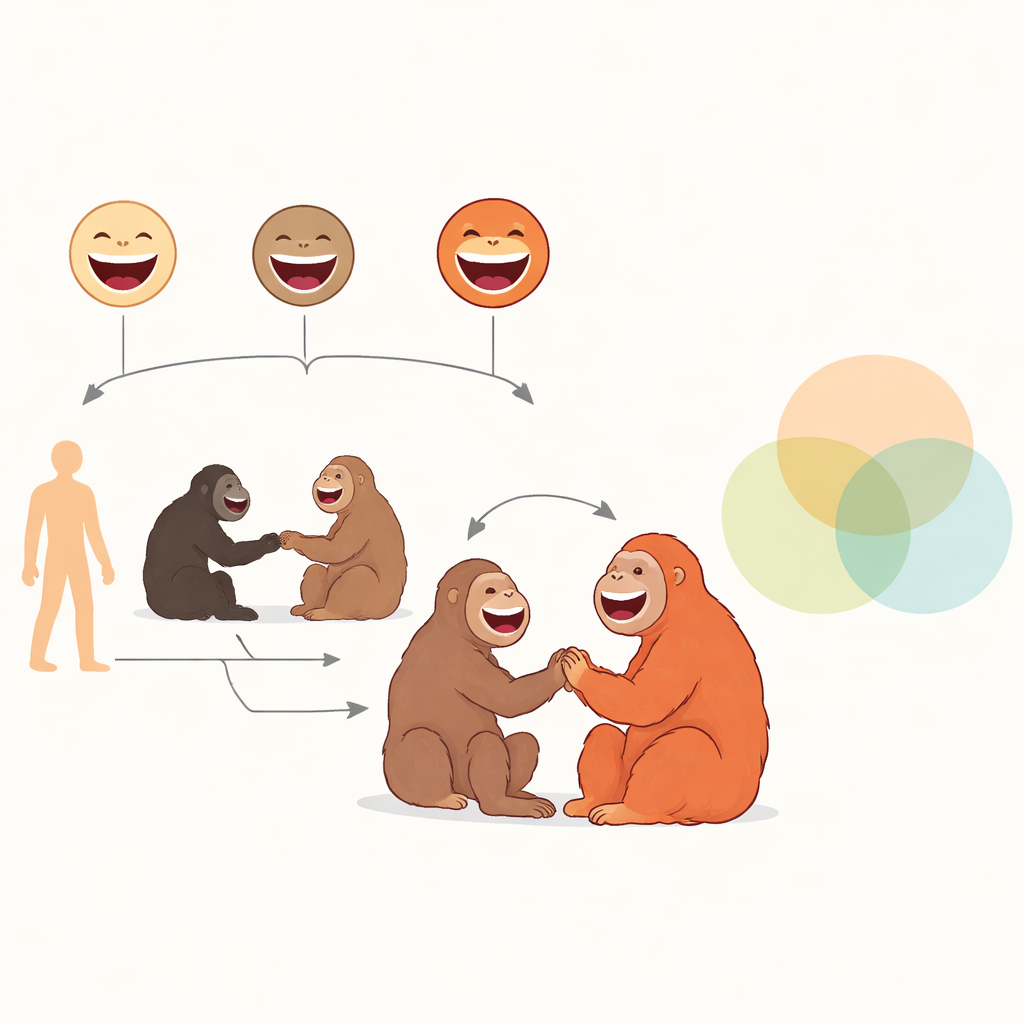
When we laugh with someone, we often end up wearing the same kind of smile or grin they do, almost without thinking. This subtle “copying” of faces helps us feel closer and better understand one another. This study asks whether our great ape cousins—orangutans and chimpanzees—do something similar when they play and laugh together. By watching how their “laugh faces” spread from one individual to another, the researchers explore how complex emotional communication may already have been millions of years before humans evolved.
Two Kinds of Playful Faces
During rough-and-tumble play, great apes often show an open-mouth expression that is closely related to human smiling and laughing. The authors focused on two simple versions of this face: one where only the lower teeth are visible, and another where the upper teeth are also exposed. Earlier work suggested these two versions tend to appear in different situations—faces with upper teeth are more common in rough or risky play, while those without upper teeth are more typical in gentler interactions. The central question here was whether apes match not just that their playmates are laughing, but which version of the laugh face they show.
Watching Laughter Spread Through Play
The team studied 96 orangutans and chimpanzees living in social groups at a rehabilitation center and a wildlife orphanage. They filmed hundreds of play bouts, then carefully coded what each animal was doing, whether play was gentle or rough, who showed which laugh face, and how the other reacted over the next three seconds. This time window is short enough to capture quick, automatic responses but also long enough to include slightly slower, more deliberate reactions. By comparing scenes where a playmate showed a laugh face to similar scenes where they did not, the researchers could separate true facial “copying” from mere coincidence.
Exact Copies of Safer Smiles
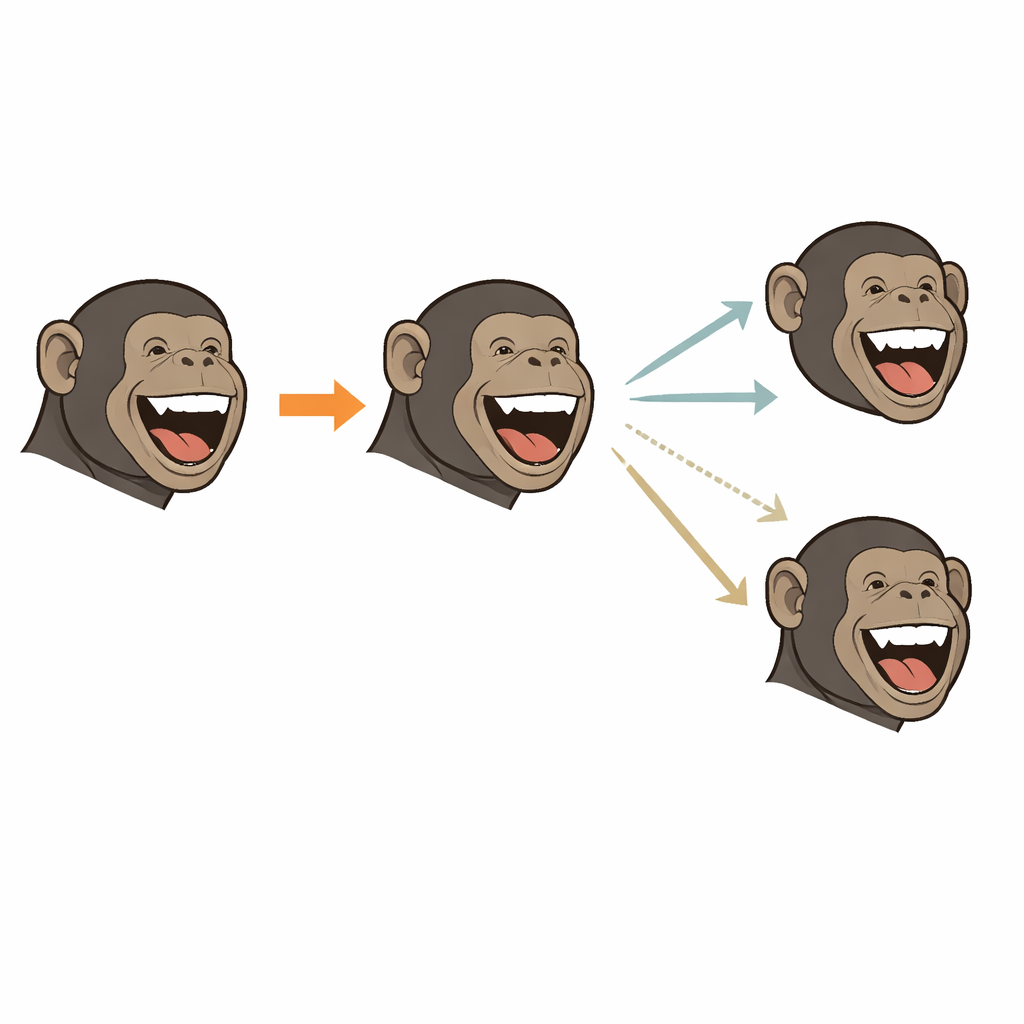
Both orangutans and chimpanzees were more likely to flash an open-mouth laugh face when their playmate had just done so, confirming that laughter is contagious among great apes. More strikingly, when a playmate showed the version without upper teeth, both species tended to respond with that same safer-looking variant rather than switching to the one with upper teeth. This pattern appeared even though many of the reactions happened within about a second, hinting at a largely automatic process. In contrast, when playmates exposed their upper teeth, the responding ape did not strongly favor matching that more intense variant. For chimpanzees, faces with visible upper teeth were tied especially to rough play, suggesting that copying this sharper signal might sometimes be less advantageous.
Play, Bonding, and Being in Sync
For orangutans, individuals who were more likely to match their partners’ laugh-face variant also tended to engage in longer play bouts. This link suggests that fine-tuned facial matching may help keep play going, offering more chances to practice social skills, regulate emotions, and build bonds. Chimpanzees showed clear matching of the safer, no-upper-teeth faces during both rough and gentle play, underlining how important this subtler signal may be in large, complex groups. The study also connects these findings to earlier work on gorillas and humans, building a picture in which small details of the mouth and teeth shape how emotional messages are sent and received across many primate species.
What This Says About Our Shared Past
The results suggest that our habit of copying each other’s smiles and laughs in precise ways did not suddenly appear in humans but has deep evolutionary roots in great apes. Matching the less risky, closed-upper-teeth laugh faces may help apes stay emotionally in tune and better predict each other’s next moves, much as human smiles guide our everyday interactions. This implies that the ancestors of humans and great apes already used nuanced laugh faces as flexible social tools 10–16 million years ago, and that human laughter and smiling later grew even more elaborate on this ancient foundation.
Citation: Austry, D.A., Bard, K., Gibson, V. et al. Towards the complexity of laugh communication in great apes: exact facial replications in laugh faces of orangutans and chimpanzees. Sci Rep 16, 11758 (2026). https://doi.org/10.1038/s41598-026-43992-w
Keywords: great ape laughter, facial mimicry, orangutans, chimpanzees, social play