Clear Sky Science · en
Interoception predicts mental imagery vividness: exploring a key relationship
Feeling Your Body, Seeing Your Mind
When you picture a loved one’s face or imagine walking along a beach, those inner movies feel surprisingly real. This study asks a simple but powerful question: do the signals coming from inside your body—like the beating of your heart—help shape how vivid and controllable those mental pictures are? By looking closely at how people sense their own heartbeat and how clearly they can imagine scenes and shapes, the researchers explore a hidden link between bodily awareness and the richness of our inner world.
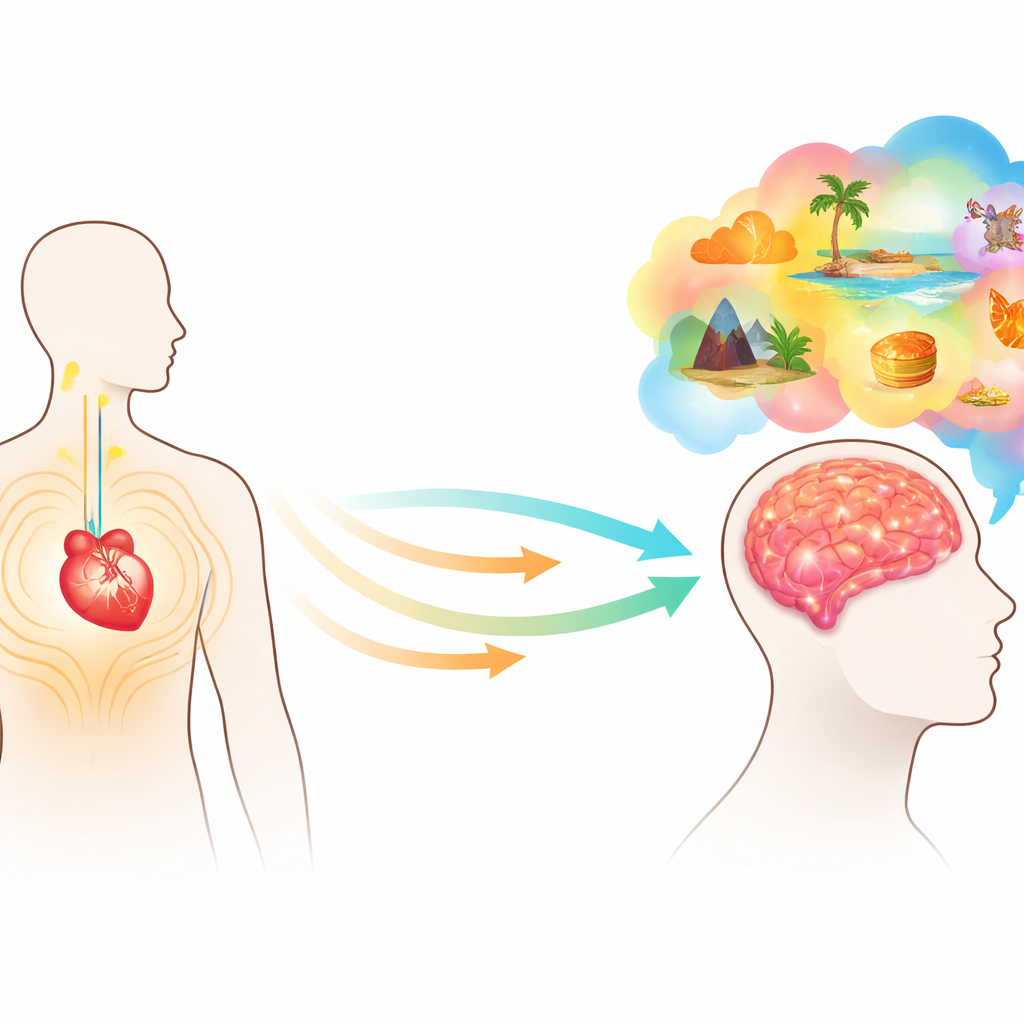
Listening to the Heart from the Inside
The work centers on interoception, our sense of the body’s internal state. Interoception includes noticing heartbeats, breathing, and gut sensations, and it underpins feelings, motivation, and our basic sense of self. Earlier studies hinted that people who report paying close attention to their bodies also report more vivid mental imagery, while those who struggle to imagine (such as people with aphantasia) often describe weaker bodily awareness. However, those findings mostly came from questionnaires. This new study goes further by combining self-reports with hands-on tasks that directly test how accurately people can sense their own heartbeats.
Heart Tasks and Mind Tasks
Over one hundred young adults took part. To probe heartbeat sensitivity, they completed two tasks. In one, they quietly counted their own heartbeats over short time windows without touching their pulse. In the other, they judged whether brief tones were in sync or out of sync with their heartbeat. These tasks captured different ways of “tuning in” to the heart. Participants also filled in a detailed survey of body awareness, rating how much they notice bodily sensations, trust their bodies, and use bodily feelings to regulate emotions. To gauge mental imagery, they performed a classic mental rotation task—deciding whether 3D shapes were the same or different after being turned in space—and rated their everyday imagery vividness on a widely used questionnaire. A demanding number-based memory task served as a comparison to check whether any effects were specific to imagery rather than general brain power.
Different Body Signals, Different Inner Pictures
The results revealed a selective and surprisingly precise pattern. People who were better at judging whether tones matched their heartbeat performed better on the mental rotation task, suggesting that fine-grained heartbeat timing supports the active manipulation of mental images. In contrast, those who were more accurate at simply tracking their heartbeats, and those who reported greater bodily awareness and trust in their bodies, tended to describe their mental images as more vivid. These links showed up even after accounting for basic measures like blood pressure and resting pulse. Importantly, heartbeat measures and body-awareness scores barely related to performance on the number-based memory task, indicating the effects were not just about general attention or intelligence but were tightly tied to imagery.
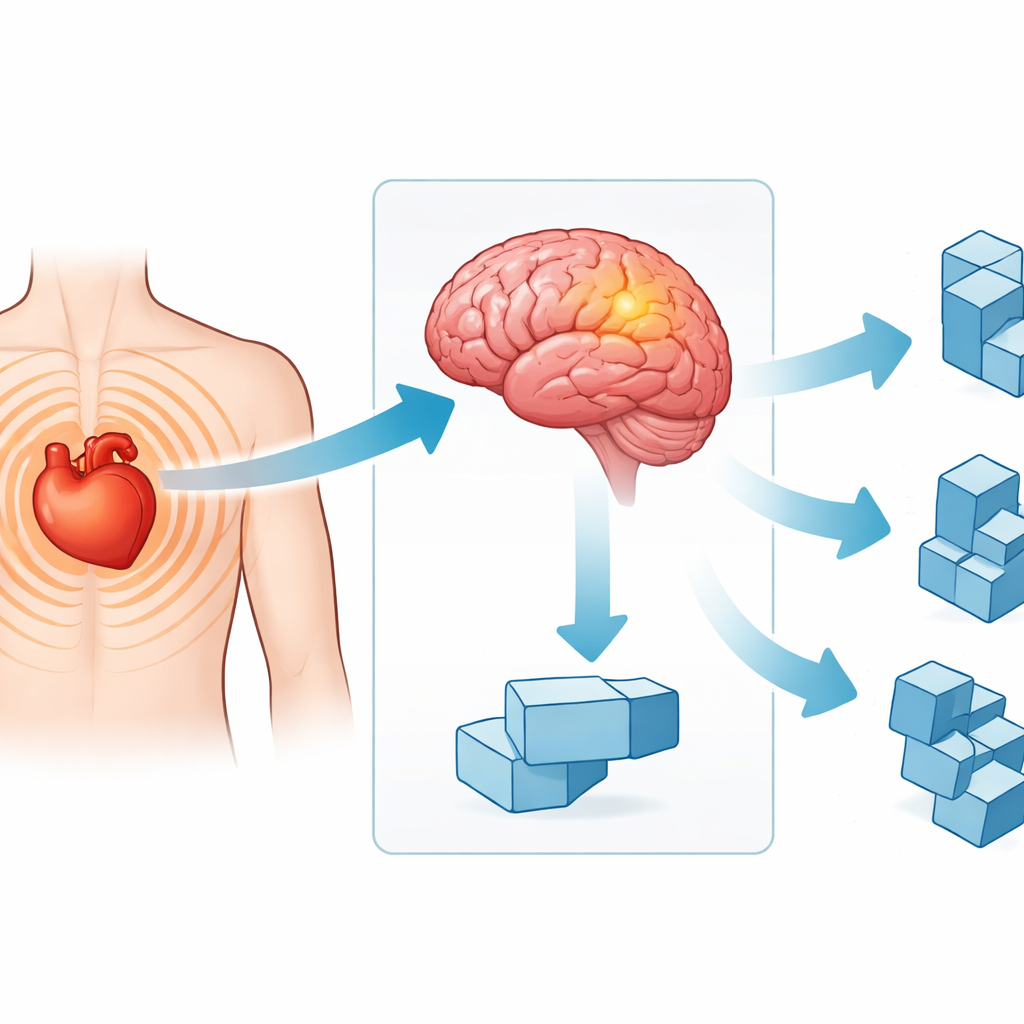
From Body Arousal to Inner Movies
A closer look suggested that bodily arousal itself may matter for how intense our inner scenes feel. Higher resting pulse—an indicator of stronger autonomic activation—was associated with more vivid imagery reports. The authors propose that when the body is more active, the brain receives stronger incoming signals about the heart and other organs. These internal signals may be woven into mental images, making them feel more lifelike and emotionally charged. At the same time, self-reported body awareness was linked to both deliberate imagery and spontaneous flashbacks of personal events, hinting that conscious attention to bodily feelings helps ground a wide range of inner experiences in a felt sense of self.
What This Means for Our Sense of Self
Taken together, the findings suggest that our inner pictures are not free-floating cartoons inside the head. Instead, they are anchored in the body. Different aspects of heartbeat sensing support different facets of imagery: timing-sensitive heartbeat judgments help with actively rotating shapes in the mind, while simple heartbeat awareness and trusting one’s bodily signals relate to how vivid our mental scenes appear. Because these relationships were specific to imagery and not to general memory performance, the study supports the idea that bodily signals play a special role in shaping conscious, picture-like experiences. In everyday life, this means that how well we feel our own bodies may influence not just how we feel, but how clearly we can imagine, remember, and mentally rehearse the events that make up our lives.
Citation: Nagai, Y., Arooj, S., Futeran-Blake, T.R. et al. Interoception predicts mental imagery vividness: exploring a key relationship. Sci Rep 16, 14181 (2026). https://doi.org/10.1038/s41598-026-43805-0
Keywords: interoception, mental imagery, heartbeat awareness, body–mind connection, visualisation