Clear Sky Science · en
Small-scale phreatic explosions from a low-enthalpy hydrothermal system caused the abandonment of Milos Island (Greece) in Roman times
Hidden blasts beneath a holiday island
Milos, a sunlit Greek island now known for beaches and blue water, once became so dangerous that its Roman inhabitants walked away. This study explains how small but powerful steam explosions, triggered deep in the ground by shifting faults and earthquakes, repeatedly tore open the surface, damaged valuable hot springs and mineral deposits, and likely helped drive people to abandon the island for decades.
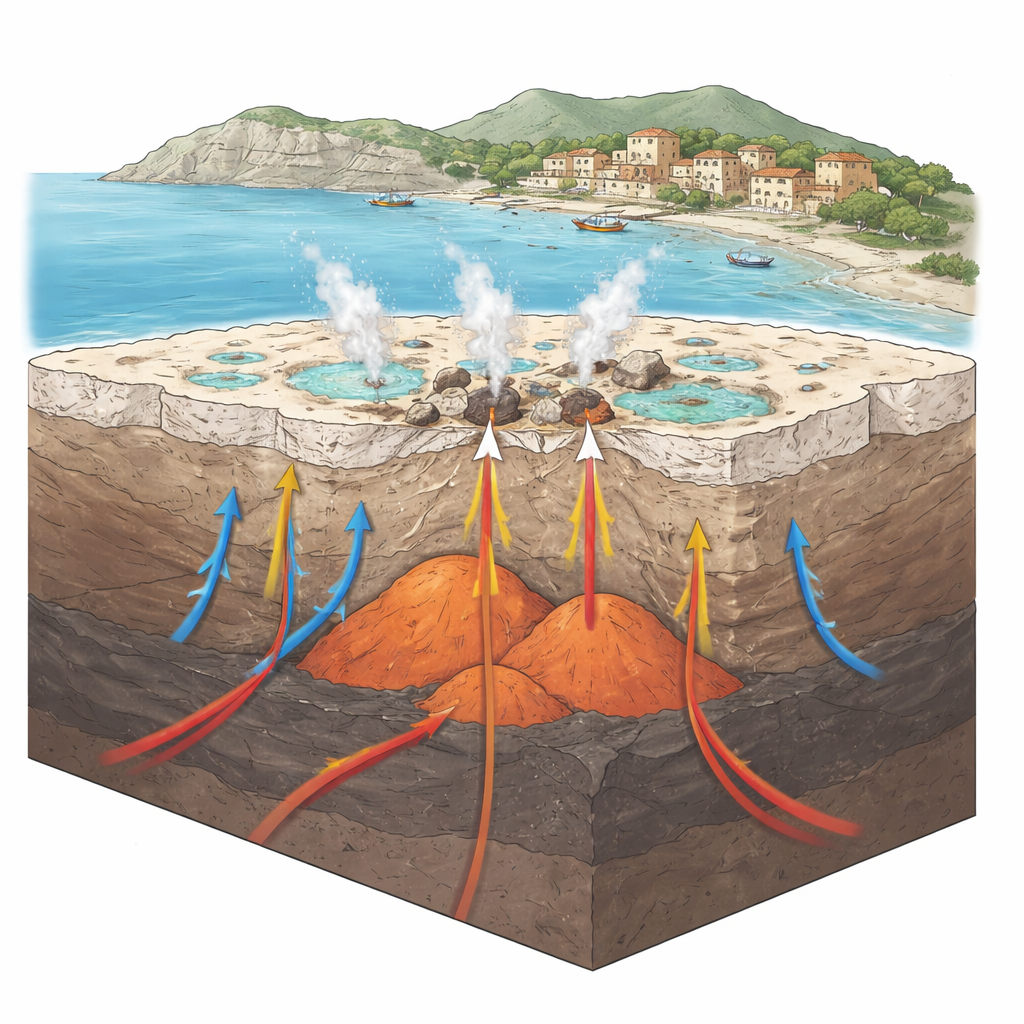
Steam explosions without lava
The work focuses on “phreatic” explosions—sudden blasts powered by water turning to steam, not by fresh molten rock. These events give little warning and can be deadly, as modern tragedies in New Zealand and Japan have shown. On eastern Milos, the authors mapped more than 290 small craters, many only a few tens of meters across, cut into a field of ancient lava domes and ash deposits. Using drone-based elevation models and careful measurements, they showed that most craters formed where a shallow hot-water system lay just a few meters below the surface, making the area especially prone to explosive boiling.
A fragile skin over boiling ground
Beneath the soil of Milos lies a long‑lived hydrothermal system: rain and seawater circulate through fractured rock, are heated at depth, and return to the surface as hot springs and fumaroles. Over time, these fluids deposited a hard, silica‑rich crust just under the ground, sitting atop altered rhyolitic lava and older metamorphic rocks. Laboratory analyses of crater deposits revealed abundant quartz, opaline silica, and clay minerals, but no fresh volcanic glass, confirming that recent magma was not directly involved. Microscopic “crack‑and‑seal” textures—fractures repeatedly opened by pressurized fluids and then healed by new mineral growth—show that the subsurface was already stressed and close to failure before the final blasts.
Measuring the power of buried blasts
By relating crater diameters to explosion energy, the team estimated that typical blasts released energy comparable to several tons of TNT, at depths mostly between 3 and 20 meters. These pressures were high enough to shatter the rigid silica cap and eject blocks of altered rock tens of centimeters across. Layers of overlapping crater deposits, separated in places by thin soil horizons and carbonized plant roots, reveal that explosions did not occur as a single outburst but recurred over months to years. Each event chewed away more of the hydrothermal field, gradually exhausting the shallow system that had fed hot springs and supported mineral extraction.
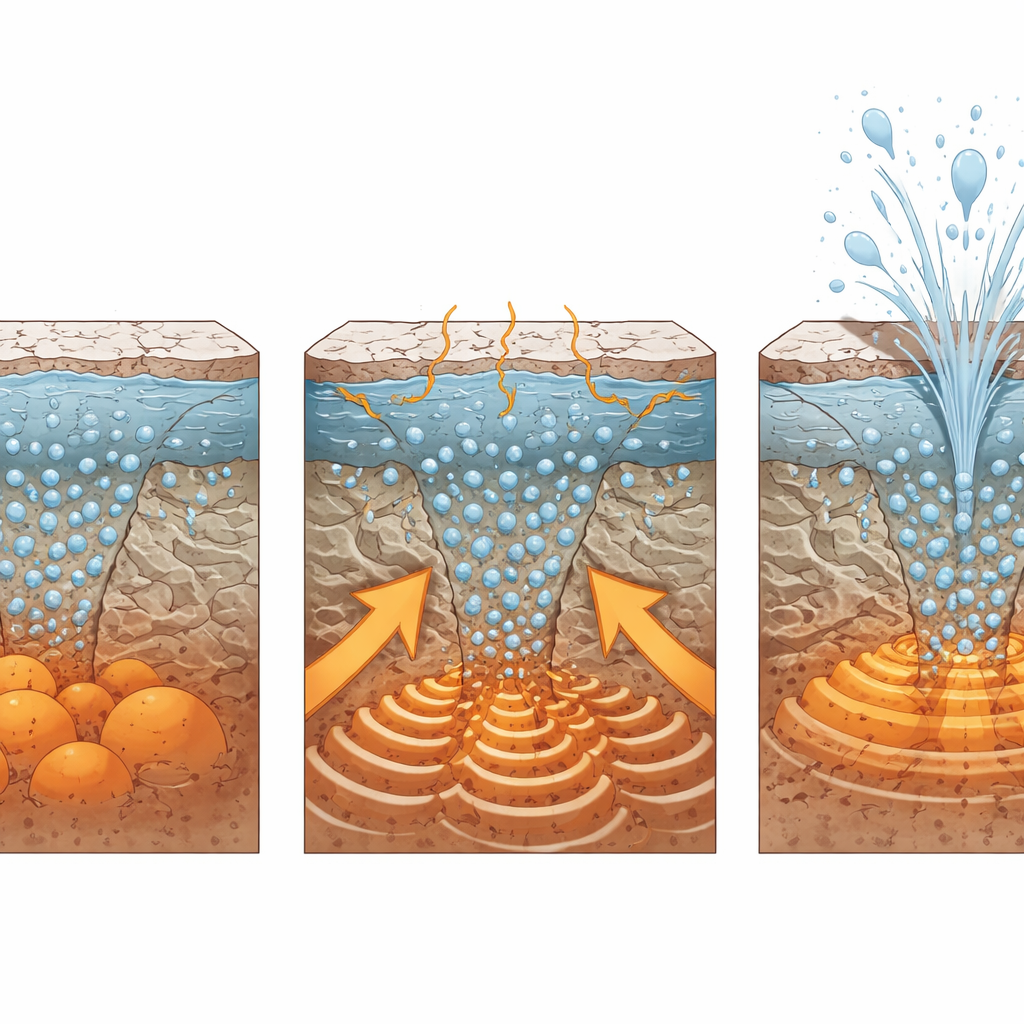
How earthquakes turn hot water into a weapon
The key puzzle is what suddenly pushed this already fragile system into violent disequilibrium. The authors argue that rapid pressure drops, most likely triggered by earthquakes, forced hot water into a highly unstable state where bubbles form and collapse almost instantly—a process called cavitation. When seismic waves pass through fractured, fluid‑filled rocks, they can generate sharp swings in pressure. In the Milos system, such swings would have driven water into a “forbidden” region of its pressure‑temperature behavior, making explosive boiling unavoidable. Calculations show that ground shaking from moderate local quakes, or from a distant giant event like the AD 365 earthquake near Crete, could have supplied enough dynamic stress to trigger these cavitation‑driven blasts.
When nature undermines a thriving community
Archaeological clues tie this geologic violence directly to human history. Roman‑era pottery fragments appear at the very base of many explosion deposits, showing that people were living and working at the hot‑spring fields until just before the blasts. Milos was prized for sulfur, hot waters, and a famous white pigment used in paints and cosmetics. Yet handmade pottery from the fourth century AD is conspicuously absent, implying that permanent settlement collapsed soon after. The study concludes that repeated, unpredictable steam explosions—likely linked to regional seismic unrest—helped strip the island of its economic lifelines and made everyday life too risky, pushing its Roman inhabitants to abandon a place that had prospered for millennia.
Citation: Sulpizio, R., Lucchi, F., Lucci, F. et al. Small-scale phreatic explosions from a low-enthalpy hydrothermal system caused the abandonment of Milos Island (Greece) in Roman times. Sci Rep 16, 14547 (2026). https://doi.org/10.1038/s41598-026-43334-w
Keywords: phreatic explosions, Milos Island, hydrothermal systems, earthquake triggering, Roman archaeology