Clear Sky Science · en
Change in diurnal temperature range on the Tibetan plateau in the last 40 years and its influencing factors
Why the roof of the world’s daily temperature swing matters
The Tibetan Plateau, often called the “roof of the world,” is warming rapidly and exerts a strong influence on weather across Asia and beyond. This study asks a subtle but important question: not just how much the plateau is warming, but how the difference between daytime and nighttime temperatures is changing. That daily swing, known as the diurnal temperature range, shapes glaciers, water resources, ecosystems, and even human health. Understanding how and why it is shifting helps scientists anticipate future climate risks for hundreds of millions of people downstream.

A closer look at day and night on the plateau
Using records from 115 weather stations together with advanced climate datasets, the researchers examined how maximum (daytime) and minimum (nighttime) temperatures have changed across the Tibetan Plateau since 1980. Both day and night have warmed, but nights have warmed faster. Over the past four decades, daytime temperatures rose by about one third of a degree Celsius per decade, while nighttime temperatures climbed by nearly half a degree per decade. Because nights are catching up more quickly than days, the daily temperature swing has steadily shrunk. This pattern appears in every season and is strongest in summer, suggesting that the character of both warm and cold periods on the plateau is being reshaped.
Where the changes are strongest
The team mapped these trends in space and found that warming is widespread but uneven. Many stations across the plateau show significant increases in both daytime and nighttime temperatures. The daily temperature range generally lies between 10 and 16 degrees Celsius, with higher swings in some interior basins and lower swings in parts of the southeast. Over time, most stations show a modest but persistent narrowing of this range. Analyses of the temperature records indicate that the current pattern—warming days and even faster-warming nights, with a declining daily swing—is likely to continue for years, rather than being a short-lived fluctuation.
How clouds, moisture, and radiation shape the daily swing
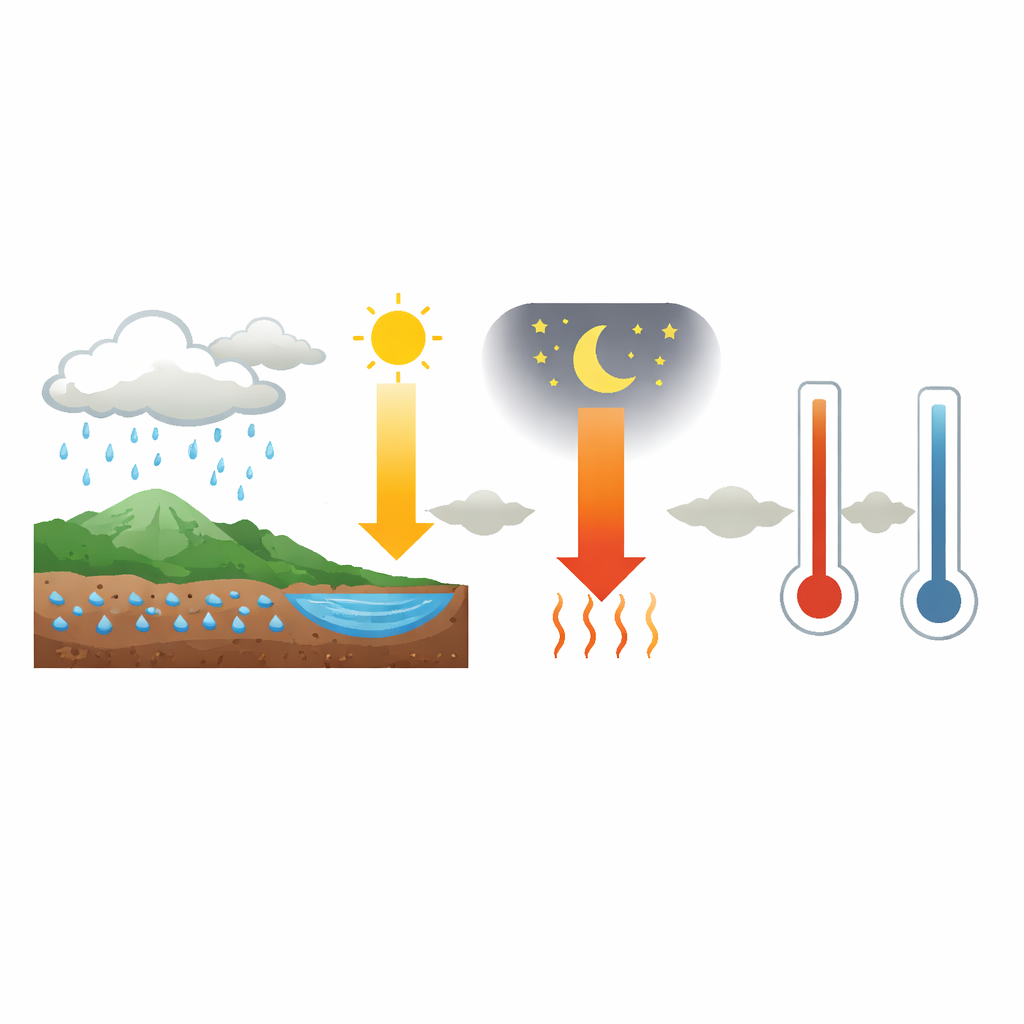
To understand what drives these changes, the study examined four key ingredients of the plateau’s climate: cloud cover, soil moisture, and the flows of energy leaving and entering the surface as invisible infrared and sunlight. In simple terms, more clouds and wetter soils tend to cool days and keep nights warmer, squeezing the gap between daily highs and lows. The researchers found that, over recent decades, cloudiness, soil wetness, and outgoing infrared energy have generally increased in the western plateau, while incoming sunlight has risen more in the east. Statistical analyses show that higher cloud cover, wetter ground, and stronger infrared loss are usually linked to lower daily temperature swings, while more incoming sunlight tends to widen the swing by heating days more than nights.
What computer simulations reveal
Because weather stations are sparse, especially in the remote west, the authors also used a high‑resolution computer simulation tailored for the Tibetan Plateau. This model reproduces broad patterns of warming but tends to underestimate actual temperatures, a known challenge over such rugged, high terrain. Even so, it confirms several key messages: across much of the plateau, particularly in grassland areas of the south and east, daytime and nighttime temperatures are rising while the daily temperature range is shrinking, most sharply in summer. The simulations further suggest that underlying land types matter: grasslands tend to see a stronger narrowing of the daily swing than bare or sparsely vegetated ground, reflecting how vegetation and soil moisture interact with sunlight and infrared energy.
What this means for people and ecosystems
Put simply, the Tibetan Plateau is not only getting warmer; its days and nights are becoming more alike. Rising nighttime temperatures and a smaller daily temperature swing can influence snow and glacier melt, plant growth, disease risks, and the comfort and safety of people and livestock living at high altitude. By tying these changes to shifts in clouds, soil moisture, and surface energy flows, this study improves our understanding of how climate change is reshaping one of Earth’s most climate‑sensitive regions and provides clues about how those changes may ripple through the wider Asian climate system.
Citation: Chen, M., Wen, X., Li, M. et al. Change in diurnal temperature range on the Tibetan plateau in the last 40 years and its influencing factors. Sci Rep 16, 13433 (2026). https://doi.org/10.1038/s41598-026-43200-9
Keywords: Tibetan Plateau, diurnal temperature range, cloud cover, soil moisture, surface radiation