Clear Sky Science · en
Application of PoseConv3D algorithm in cheerleading training action recognition
Smarter Coaching for a Fast-Moving Sport
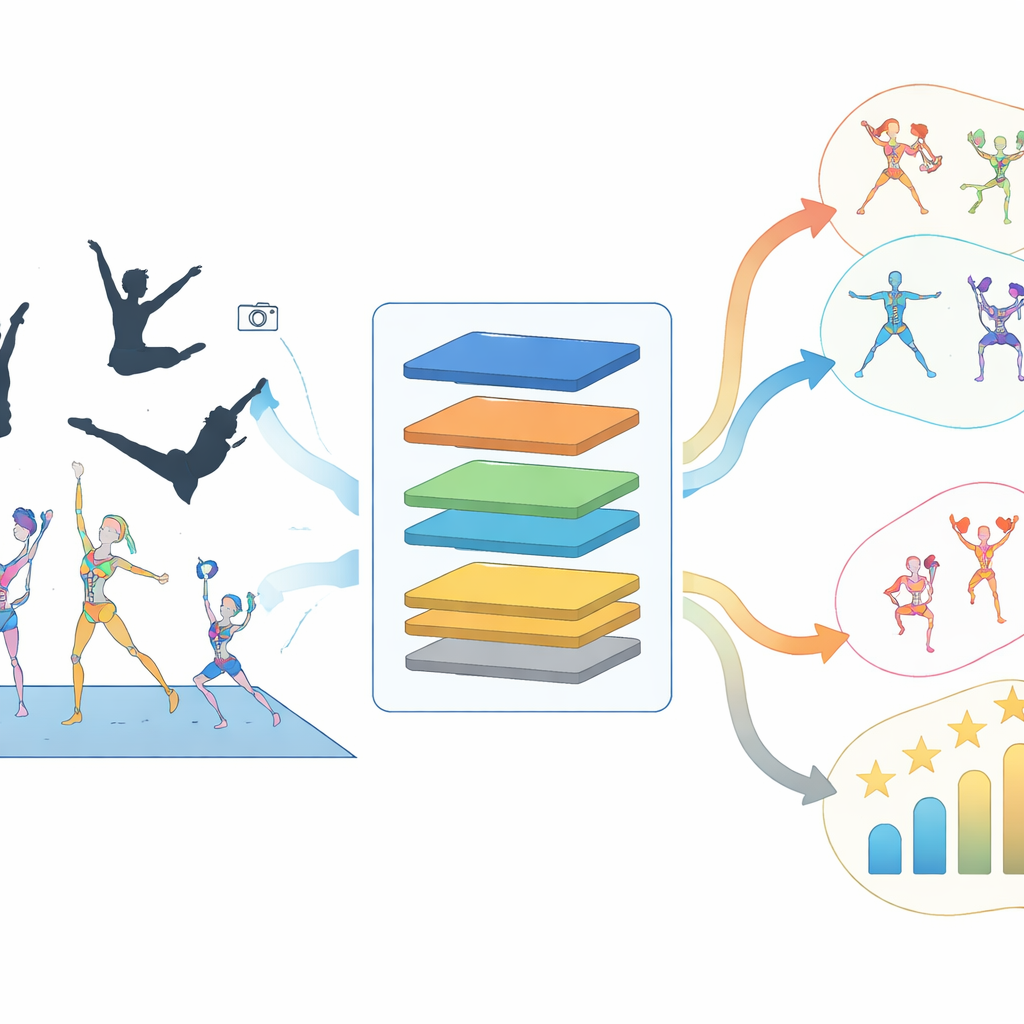
Cheerleading today is far more than sideline enthusiasm; it is a demanding acrobatic team sport where tiny mistakes in timing or posture can mean the difference between a clean stunt and a dangerous fall. Yet most coaching still relies on the naked eye and slow video replays. This paper introduces an artificial intelligence system that can watch cheerleading routines frame by frame, understand the athletes’ body positions, and automatically recognize both what move is being performed and how difficult it is, opening the door to safer, more precise, and more personalized training.
Why Cheerleading Poses a Special Challenge
Many sports and daily activities have already been studied with computer vision, but cheerleading pushes existing methods to their limits. Athletes spin several times per second, flip through the air, and build multi‑person pyramids where bodies overlap and block the camera’s view. Movements that look similar in space—like arm waves and high kicks—can differ mainly in their rhythm, something standard algorithms largely ignore. As a result, common action-recognition systems misread key joint locations, lose track of individuals in group stunts, and confuse moves that share similar motion paths, leading to low accuracy and unreliable feedback in real training halls.
Turning Videos into Clean Digital Skeletons
The new system builds on a pose-based 3D convolutional network called PoseConv3D, which works not on raw pixels but on simplified “stick figure” skeletons extracted from video. The first innovation is a dynamic correction step that cleans up these skeletons. When the underlying pose detector is uncertain about a joint—say, a wrist that blurs during a spin—the system predicts its most likely path over time using smooth curves that respect how neighboring frames move. This reduces jitter and drift of joint positions by more than 40%, giving the learning algorithm a much clearer picture of how each athlete’s body truly moves during rapid rotations and aerial transitions.
Seeing Both Tiny Details and Big Team Patterns
Once the skeletons are cleaned, the system analyzes movement at multiple scales at the same time. One processing branch focuses on fine details such as a quick wrist flick or ankle push-off, while another looks at broader patterns like the sweeping arc of a leg or the coordinated rise of several athletes in a lift. By fusing these views, the model better understands how small adjustments contribute to large, team-level formations. Tests on a dedicated University of Central Florida cheerleading dataset—over 500 high-definition training and competition clips with carefully labeled moves and difficulty levels—show that this multi-scale approach notably improves recognition of complex, highly coordinated stunts.
Teaching the System to Hear the Beat
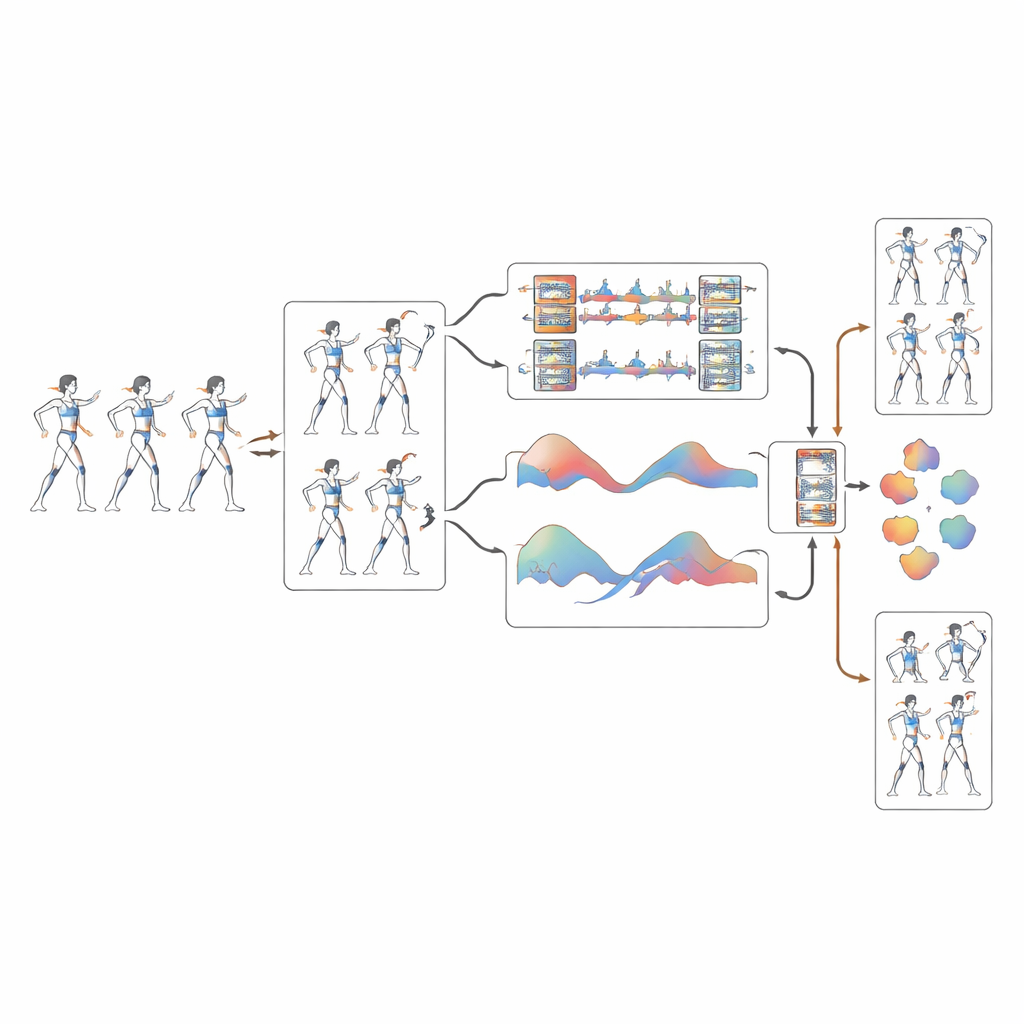
A standout feature of the work is that the algorithm does not just watch how athletes move in space; it also learns when they move. The researchers compute how fast each joint travels from frame to frame and transform these changes into rhythm patterns, much like turning music into a spectrum of beats. A special attention module then highlights moments in the movement sequence that match key rhythmic signatures. This allows the system to reliably tell apart actions that trace nearly identical paths but unfold at different tempos, slashing the confusion between wave-like motions and synchronized kicks from around one in six attempts to only a few in a hundred.
From Recognition to Real-Time Training Partner
At the end of the pipeline, the system produces two outputs at once: the type of cheerleading move being performed and an estimated difficulty score that aligns with competition rules. Running at nearly 90 frames per second, it comfortably surpasses the speed needed for real-time feedback. Overall accuracy reaches about 93%, outperforming several state-of-the-art methods by wide margins. For athletes and coaches, this means an automated assistant that can flag mis-timed waves, unstable landings, or gaps in team synchronization as they happen, while also tracking progress on increasingly difficult skills—offering a powerful step toward data-driven, safer, and more finely tuned cheerleading training.
Citation: Li, Q. Application of PoseConv3D algorithm in cheerleading training action recognition. Sci Rep 16, 12265 (2026). https://doi.org/10.1038/s41598-026-43019-4
Keywords: cheerleading, action recognition, pose estimation, sports analytics, deep learning