Clear Sky Science · en
Different strategies of bipeds and quadrupeds to maintain postural stability- a comparison of healthy humans and dogs via static posturography
Why standing still is not so simple
Staying upright may feel effortless, but your body is constantly making tiny corrections to keep you from falling. This study asks a surprisingly fun question: do humans and dogs use the same tricks to stay balanced, especially when they cannot see? By comparing healthy young adults and pet dogs quietly standing still, the researchers reveal how a two legged body and a four legged body rely on different senses and body shapes to keep steady.
How people and dogs were tested
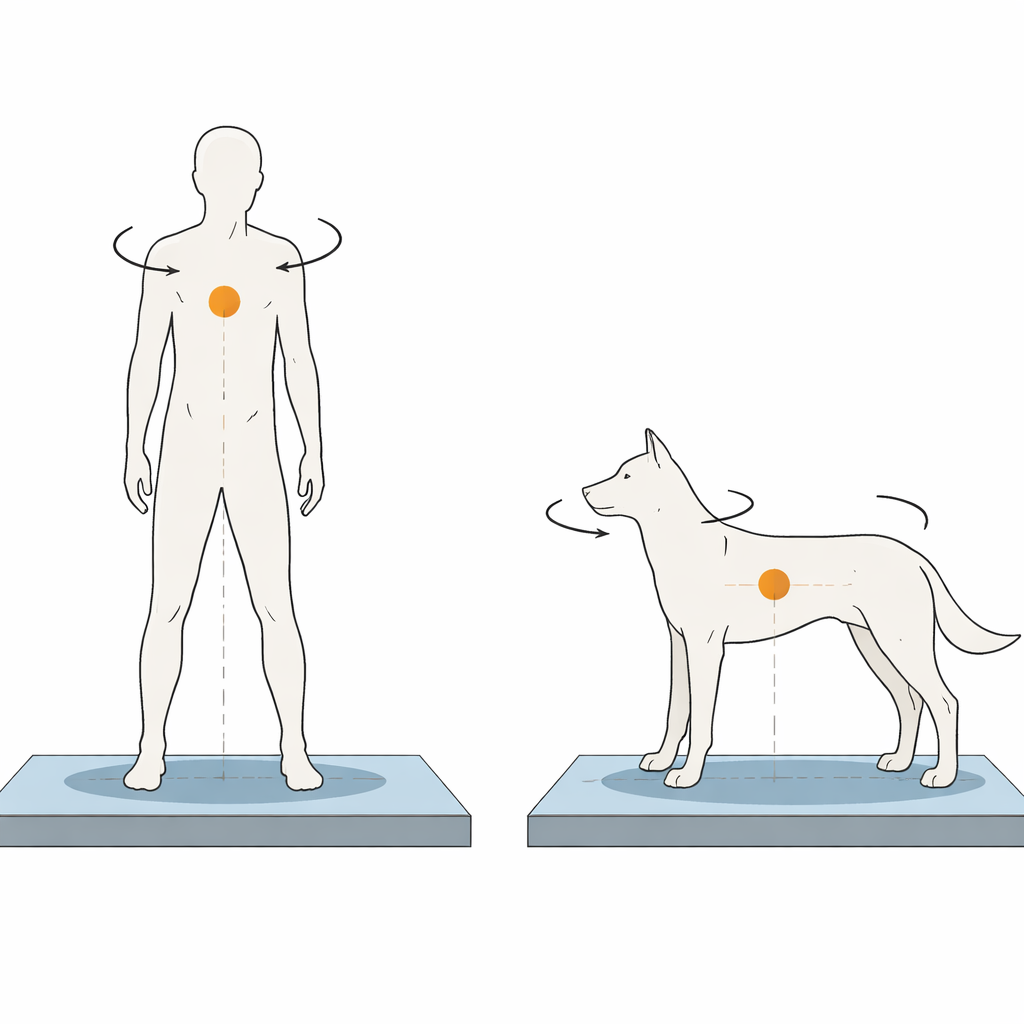
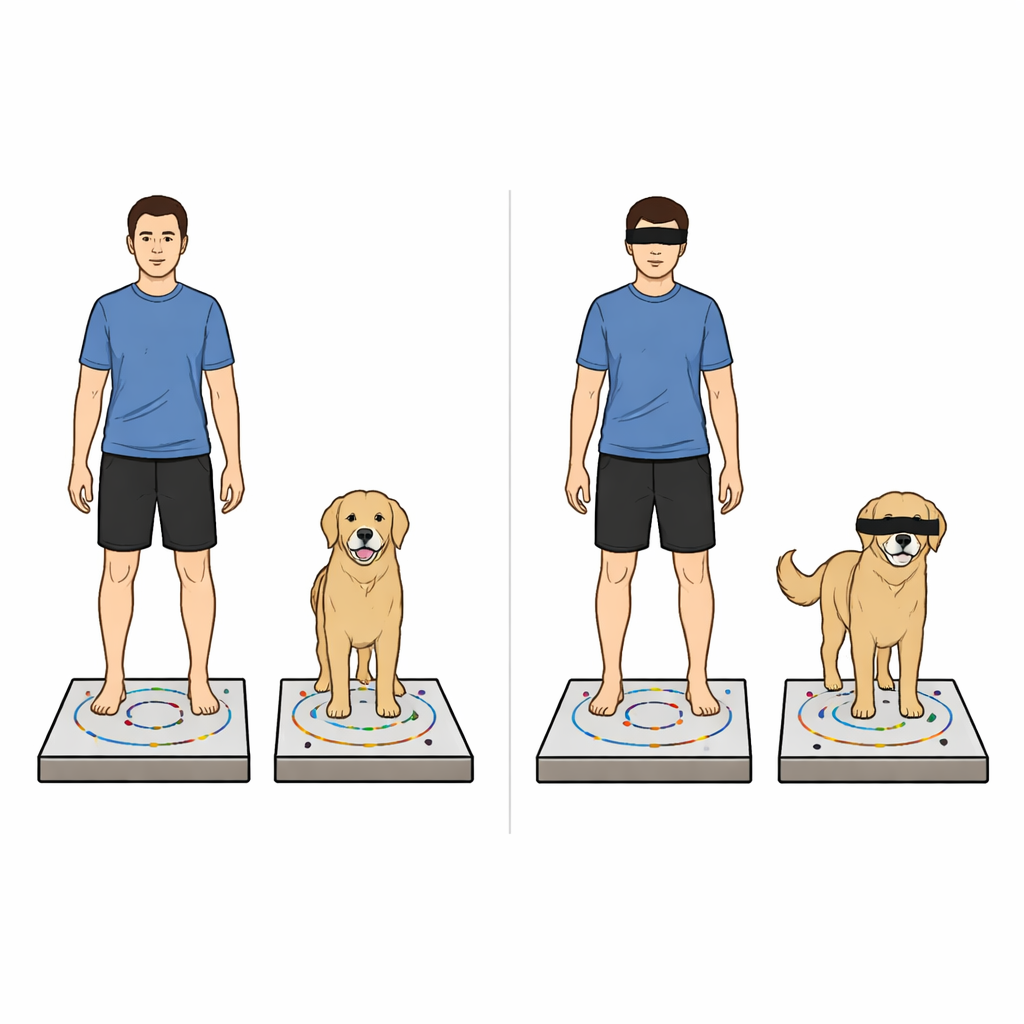
To explore balance, the team had 22 humans and 22 dogs stand very still on a pressure sensing platform. This device detects how weight shifts under the feet or paws and lets scientists track a moving point under the body that reflects how balance is controlled. Each subject was measured twice: once with normal vision and once without useful vision. People simply closed their eyes while still facing a fixed spot, and dogs wore carefully taped safety goggles so they could not see. From these measurements, the researchers calculated a standard score called the Romberg index, which compares how much someone sways with eyes closed versus eyes open.
What the balance numbers mean
When a person or animal stands more steadily, the moving point under their body travels a shorter distance, moves more slowly, and covers a smaller area. The Romberg index takes these features and expresses how much they change when vision is removed. A value around 100 means closing the eyes does not affect balance much, while values clearly above or below 100 show a strong influence of vision. The team examined several such measures, including how far the body swayed front to back and side to side, how long the path of sway was, how fast it moved, and how large an area it covered.
Humans trust their eyes more than dogs do
The clearest pattern was that humans became noticeably less steady when they could not see. For front to back sway, the length of the sway path, and the speed of the movement, human scores rose above 100, signaling that removing vision made them sway more. In dogs, the same scores were all below 100, meaning that their balance changed less or even became a bit more controlled without vision. In plain terms, people depend strongly on their eyes to stand still, while dogs lean more on other senses such as feeling from muscles and joints and signals from the inner ear.
Shared and different balance tricks
Not every measure differed between species. Side to side sway and the overall supported area were similar in humans and dogs when vision was removed. This suggests that both species may recruit comparable backup strategies once they can no longer rely on sight, even though their bodies are built very differently. The authors point to body shape as an important factor: dogs have a long, low rectangular base formed by four legs and a lower center of mass, which favors front to back steadiness but may leave them somewhat more vulnerable sideways. Humans, standing tall on two feet with a smaller support base, show more front to back wobble and rely heavily on vision to keep that under control.
Why this matters beyond the lab
The study concludes that humans and dogs maintain balance using distinct strategies shaped by their anatomy and evolution. Humans have a higher center of mass and depend strongly on visual information, so they sway more when blindfolded. Dogs, with a lower center of mass and a broader base of support, cope better without sight and appear to draw more on non visual senses and limb coordination. Understanding these differences helps veterinarians assess balance problems in dogs, informs therapists who design training or rehab programs, and even offers ideas for engineers building animal inspired robots that need to stay upright on different numbers of legs.
Citation: Aghapour, M., Affenzeller, N., Lutonsky, C. et al. Different strategies of bipeds and quadrupeds to maintain postural stability- a comparison of healthy humans and dogs via static posturography. Sci Rep 16, 14408 (2026). https://doi.org/10.1038/s41598-026-42726-2
Keywords: postural stability, human dog comparison, balance control, static posturography, center of pressure