Clear Sky Science · en
A user behavior inertia based spatio temporal next POI recommendation model
Why your favorite spots keep popping up
Anyone who uses map or review apps has seen the same cafes, gyms, or parks quietly rise to the top of their suggestions. This paper explores why our everyday habits make those recommendations surprisingly predictable and how smarter math can turn scattered check-in data into more helpful, less random next-place suggestions.
Habits behind where we go
The authors start from a simple observation: people rarely pick their next stop at random. Daily life is driven by purposes such as eating, commuting, relaxing, or going out. Over time, repeatedly going to similar places for the same purpose creates what the authors call behavior inertia, a kind of default pull toward familiar spots. At the same time, real life is messy. Time of day, distance, and the urge to try somewhere new can push people away from their usual choices, acting as resistance to this inertia. The challenge is to capture both tendencies so that a recommendation system can guess a user’s next stop more reliably.
Sorting places by everyday purpose
One obstacle is that even popular location-based apps have very sparse data for any single person; each user visits only a tiny fraction of all available venues. To ease this problem, the researchers group points of interest into four broad, intuitive purposes: eat and drink, transport and accommodations, going out entertainment, and outdoor activities. A single venue can fall into more than one group if it serves multiple roles, like a bar that is also a restaurant. From each user’s history, they then build a timeline of purposes instead of raw coordinates. Simple time-series techniques estimate when a user is most likely to pursue each purpose next, which sharply narrows the set of candidate places before any fine-grained scoring is done. 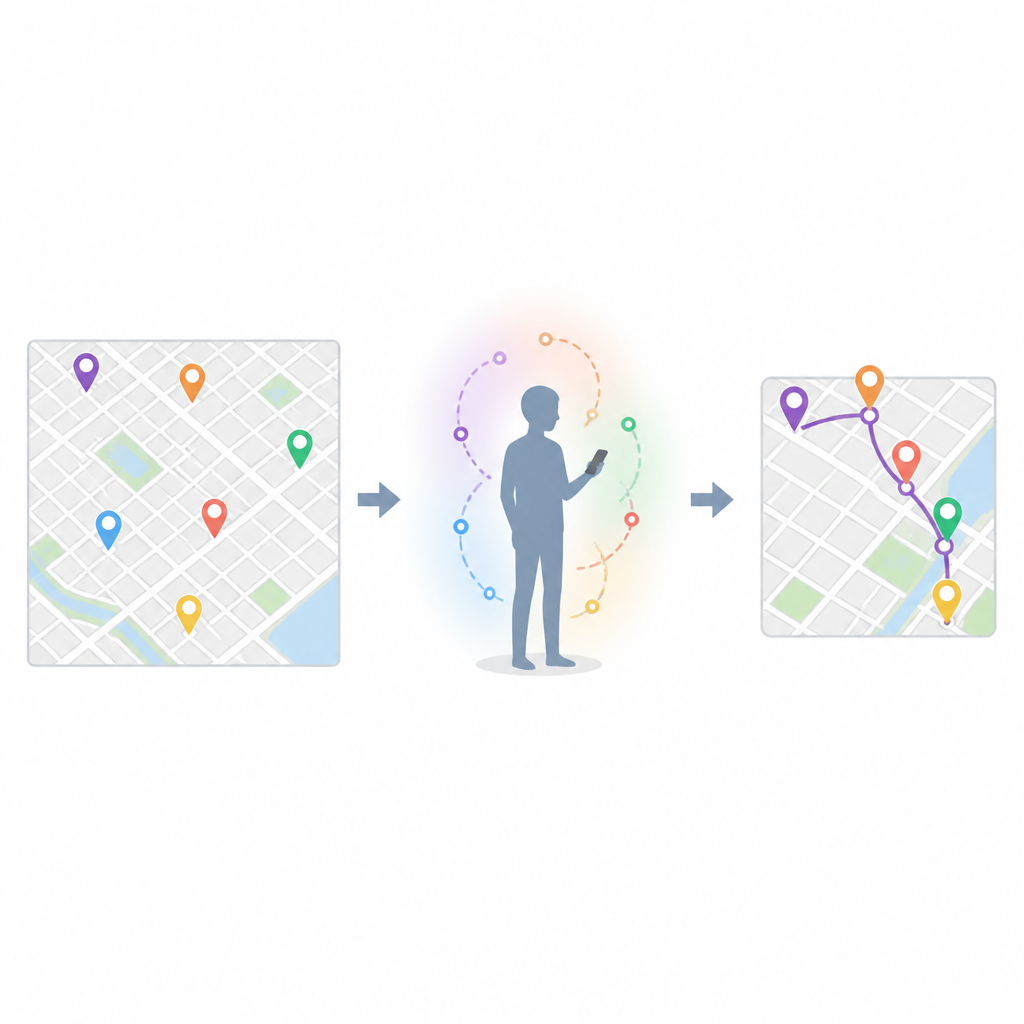
Combining distance and habit strength
After guessing the user’s likely purpose, the model turns to geography and habit. People tend to move within a few familiar zones where key locations, like home or office, act as centers. Using past check-ins, the system learns where these centers are and how often each nearby spot has been visited. Places closer to a user’s frequent stops get a natural boost, reflecting the extra effort required to travel farther. At the same time, the model measures behavior inertia by looking at how regularly someone returns to the same venue and how long the gaps between visits usually are. It also considers how many different venues a person tries for the same purpose: a creature of habit who always dines at the same restaurant behaves differently from someone who constantly experiments, even if both eat out often.
Balancing comfort zones with curiosity
The heart of the approach is to treat inertia and resistance as competing forces. If a user often returns to a place with consistent time gaps, the model assumes a strong pull to go back there, especially when the next predicted visit window is approaching. For rarely visited spots, the system checks whether they are close to the user’s current position and whether they sit within a broader category the user likes to explore. This makes it possible to recommend not just the obvious regular haunts but also plausible new choices in familiar neighborhoods. The final score for each candidate location blends three ingredients: predicted purpose, geographic closeness, and the learned strength of behavior inertia versus resistance. 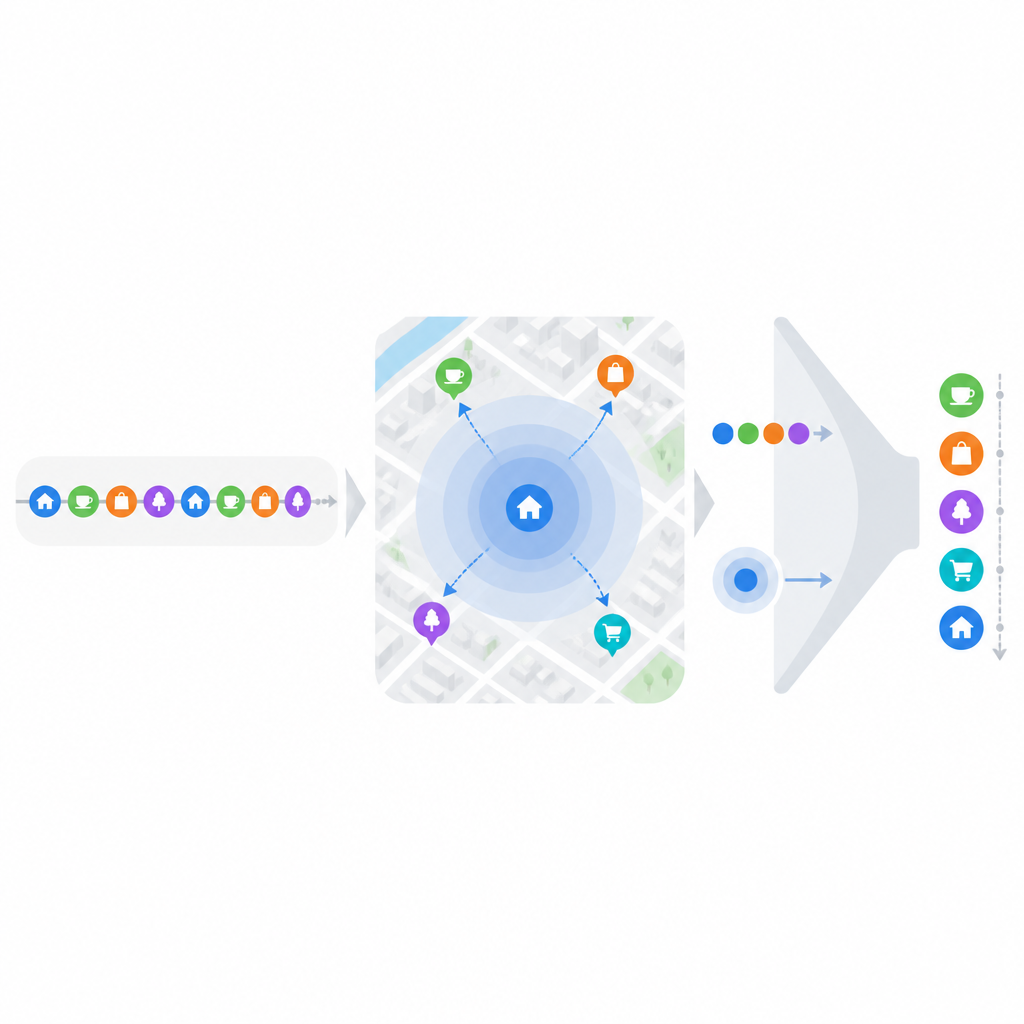
Do these smarter guesses actually work
To test their method, the authors applied it to nearly a year of real-world check-ins from New York City and Tokyo. They compared their model to a long list of existing approaches, including techniques that rely on social networks, deep learning, and detailed sequence modeling. Across both cities, their behavior inertia based model improved key accuracy measures by up to about 15 percent for recall and 20 percent for a ranking measure called MAP. In plain terms, the system not only finds the correct next place more often but also tends to place it higher in the suggested list, where a user is more likely to notice it.
What this means for future recommendations
For everyday users, the takeaway is that better recommendations come from understanding why we go places, not just where and when. By recognizing that people follow loose routines shaped by purpose, habit, and small nudges to explore, this model offers a way to suggest next stops that feel intuitive and timely. The authors suggest that future work could adapt the balance between inertia and resistance as more data arrives, and pair this with modern deep learning, giving location-based services a more human sense of both comfort zones and curiosity.
Citation: Zhang, K., Chu, D., Tu, Z. et al. A user behavior inertia based spatio temporal next POI recommendation model. Sci Rep 16, 15784 (2026). https://doi.org/10.1038/s41598-026-42191-x
Keywords: next POI recommendation, user behavior inertia, location-based services, spatio-temporal modeling, mobility patterns