Clear Sky Science · en
Fractional spatiotemporal Hahnfeldt tumor model with convergence analysis and optimal control
Why cancer’s “memory” matters
Cancer does not simply grow like a plant in a pot. Tumors change shape, spread through tissue, and remember past drugs and immune attacks. Many standard mathematical models of cancer treat growth as a simple, memory‑less process, which can miss slow relapses, periods of dormancy, and uneven spread in real patients. This paper introduces a new way to describe tumors that builds memory and space directly into the math, aiming to better predict how cancers grow and how combination treatments can keep them in check over the long term.
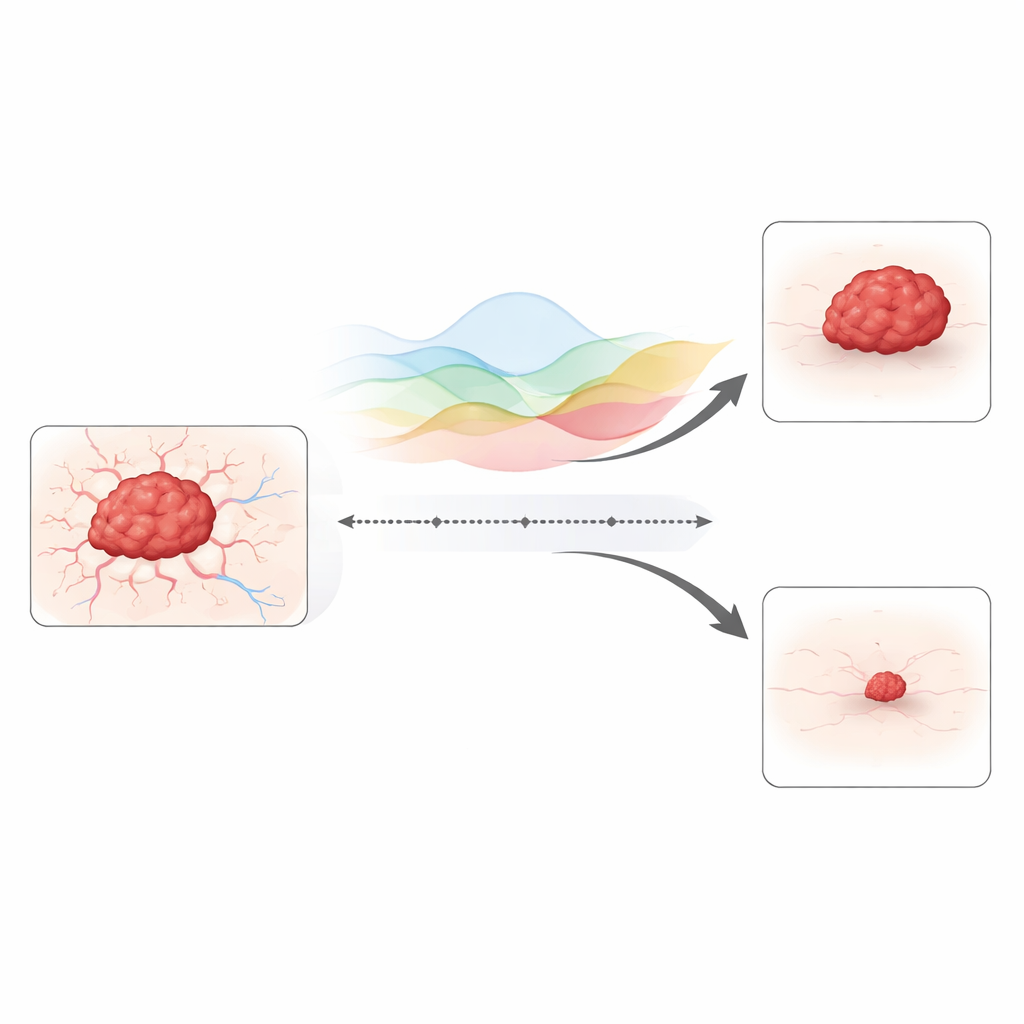
Adding memory to tumor growth
The study builds on a well‑known model that links a tumor’s size to the blood vessels that feed it. In the classical version, changes happen step‑by‑step in time, with no dependence on the distant past. Here, the author replaces those simple time steps with a “fractional” time operator, a mathematical tool that lets today’s behavior depend on everything that came before. In biological terms, this captures drug remnants that linger in tissue, long‑lived damage to blood vessels, and immune cells that stay active after treatment. The model also keeps track of how tumor cells and blood vessels move and spread through space, so it can represent uneven, finger‑like invasion rather than a smooth, uniform ball of cells.
Keeping the math biologically realistic
Any useful cancer model must avoid impossible outcomes such as negative cell numbers or unlimited growth. The paper proves that, with reasonable starting conditions, both tumor cells and blood vessels in this framework stay non‑negative and remain within a biologically plausible range. The author then analyzes a specific numerical scheme—a predictor–corrector method—for solving the underlying equations on a computer. By establishing bounds on the error and conditions for stability, the work shows that simulations based on this method are not just visually convincing but mathematically trustworthy, even when the model includes long‑range memory and spatial spread.
What the simulations reveal
Using this framework, the paper compares traditional, memory‑free dynamics with their fractional, memory‑rich counterparts. When the “memory strength” is high (close to the classical case), tumors grow quickly and then level off, and they tend to rebound rapidly after treatment stops. As the memory effect is increased (corresponding to lower fractional order), growth slows, responses to therapy are delayed, and the tumor can enter long periods of near‑dormancy. The model also produces irregular invasion fronts as cancer cells and supporting blood vessels diffuse through tissue, a pattern closer to what imaging and pathology studies show in real tumors.
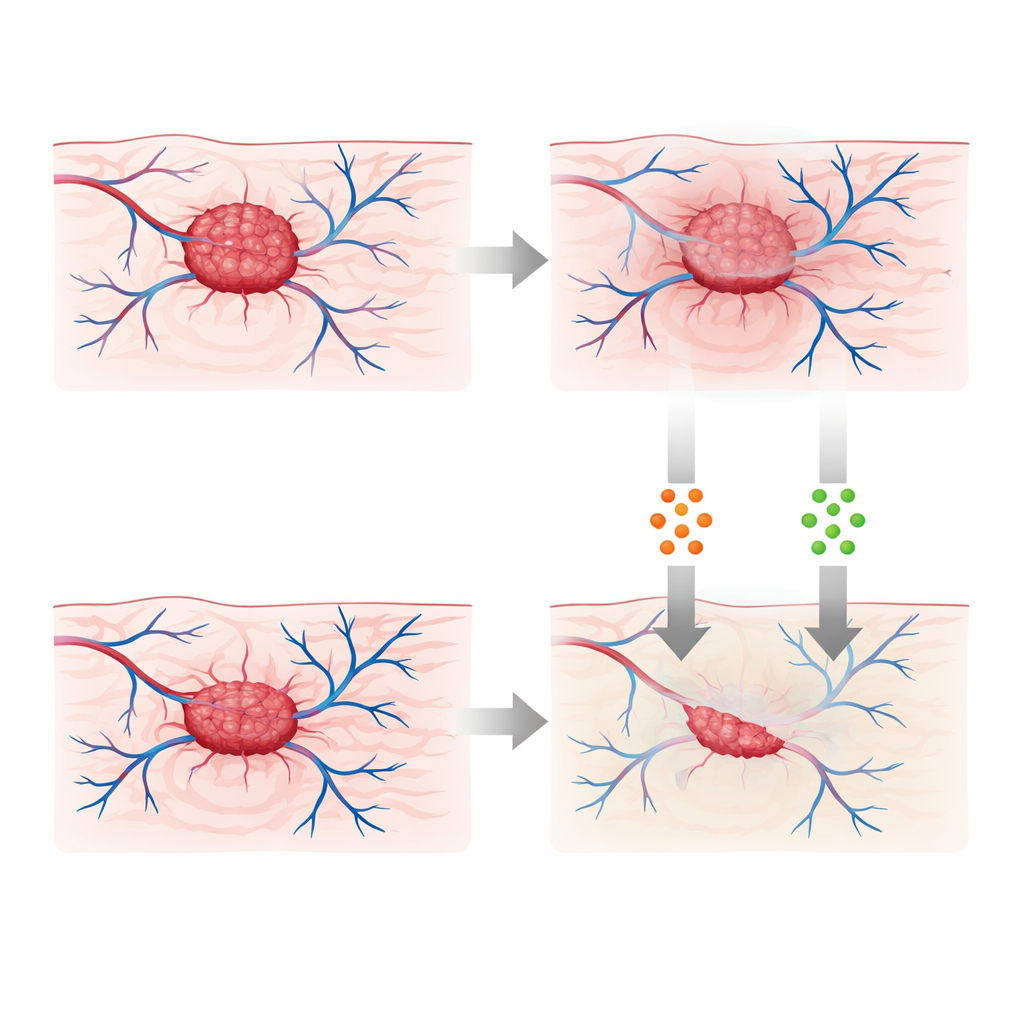
Designing smarter combination therapies
The study goes beyond passive prediction and asks how to use this memory to plan treatments. It introduces two control knobs representing chemotherapy and immunotherapy and formulates an optimization problem: reduce the tumor while limiting drug burden. Using a fractional version of standard control theory, the author derives rules for how these treatments should vary over time when the system has memory. Simulations of three scenarios—chemotherapy alone, immunotherapy alone, and a combined schedule—indicate that the combination leads to the deepest and most persistent tumor suppression. In the fractional setting, the benefits of treatment linger even after drugs are stopped, reflecting biological memory in both tissue and immune response.
What this means for future cancer care
In plain terms, the paper shows that taking a tumor’s memory and patchy spread seriously changes how we think about its future. Memory‑aware models naturally reproduce slow relapses, long quiet phases, and uneven invasion—features often seen in the clinic but missed by simpler equations. They also suggest that carefully timed combinations of chemotherapy and immunotherapy can harness these memory effects to keep tumors suppressed longer, without constant high‑dose treatment. While this work remains theoretical, it offers a more faithful mathematical “sandbox” for testing treatment ideas and could help guide truly personalized schedules that respect how each patient’s tumor grows, spreads, and remembers.
Citation: Can, E. Fractional spatiotemporal Hahnfeldt tumor model with convergence analysis and optimal control. Sci Rep 16, 12549 (2026). https://doi.org/10.1038/s41598-026-41810-x
Keywords: tumor growth modeling, fractional calculus, chemo-immunotherapy, spatiotemporal cancer dynamics, optimal treatment control