Clear Sky Science · en
Fungal extracts influence lifespan and immune responses in the Carniolan honey bee (Apis mellifera carnica, Pollmann 1879)
Why Mushrooms Matter for Honey Bees
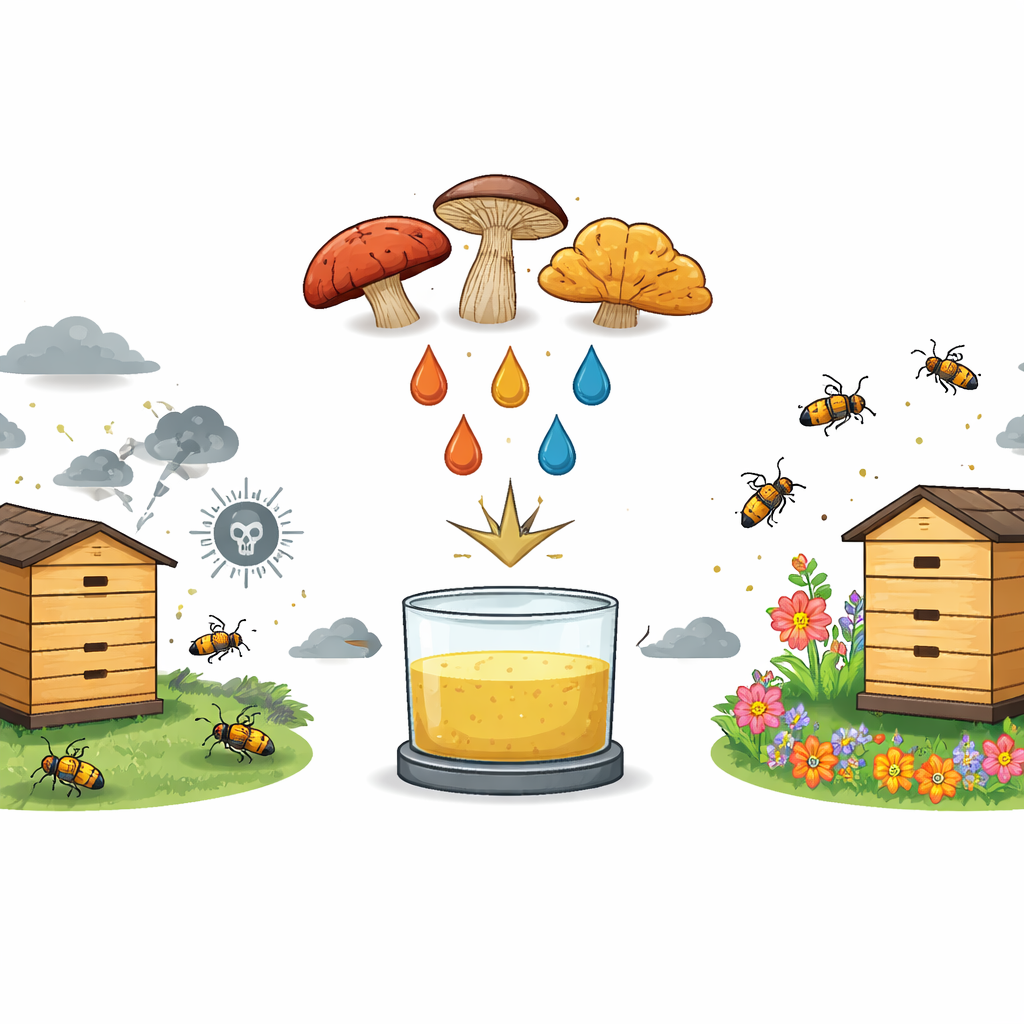
Honey bees are vital for pollinating crops and wild plants, yet many colonies are struggling with disease, pesticides, and poor nutrition. This study explores an intriguing ally from the forest floor: medicinal mushrooms. The researchers tested whether adding extracts from four common “healing” fungi to the diet of Carniolan honey bees could help them live longer and strengthen their natural defences, offering beekeepers a simple, natural supplement to support colony health.
A New Kind of Bee Supplement
The team focused on four well-known medicinal fungi: Ganoderma lucidum, Hericium erinaceus, Inonotus obliquus, and Trametes versicolor. These mushrooms are rich in bioactive compounds already studied in humans and other animals for antioxidant, antimicrobial, and immune-boosting effects. To see whether bees might benefit too, the researchers prepared alcohol-based extracts from fungal cultures grown on grain. They mixed each extract into sugar syrup at a modest concentration and fed it either to caged forager bees in the lab (to track survival) or to full colonies in the field (to measure changes inside the bees’ bodies).
Testing Bee Lifespan in the Lab
In the laboratory, groups of forager bees received syrup containing one of the four mushroom extracts or plain syrup as a control. The bees had constant access to food, and their survival was followed for 46 days. One mushroom stood out: Ganoderma lucidum increased average bee lifespan by about 16 percent compared with bees that only received sugar syrup. Bees given Inonotus obliquus also tended to live longer than controls, although the difference was not statistically firm. The other two mushroom species did not change survival noticeably, but importantly, none of the extracts shortened lifespan, suggesting they were safe at the tested dose.
Looking Inside: Blood Markers of Health
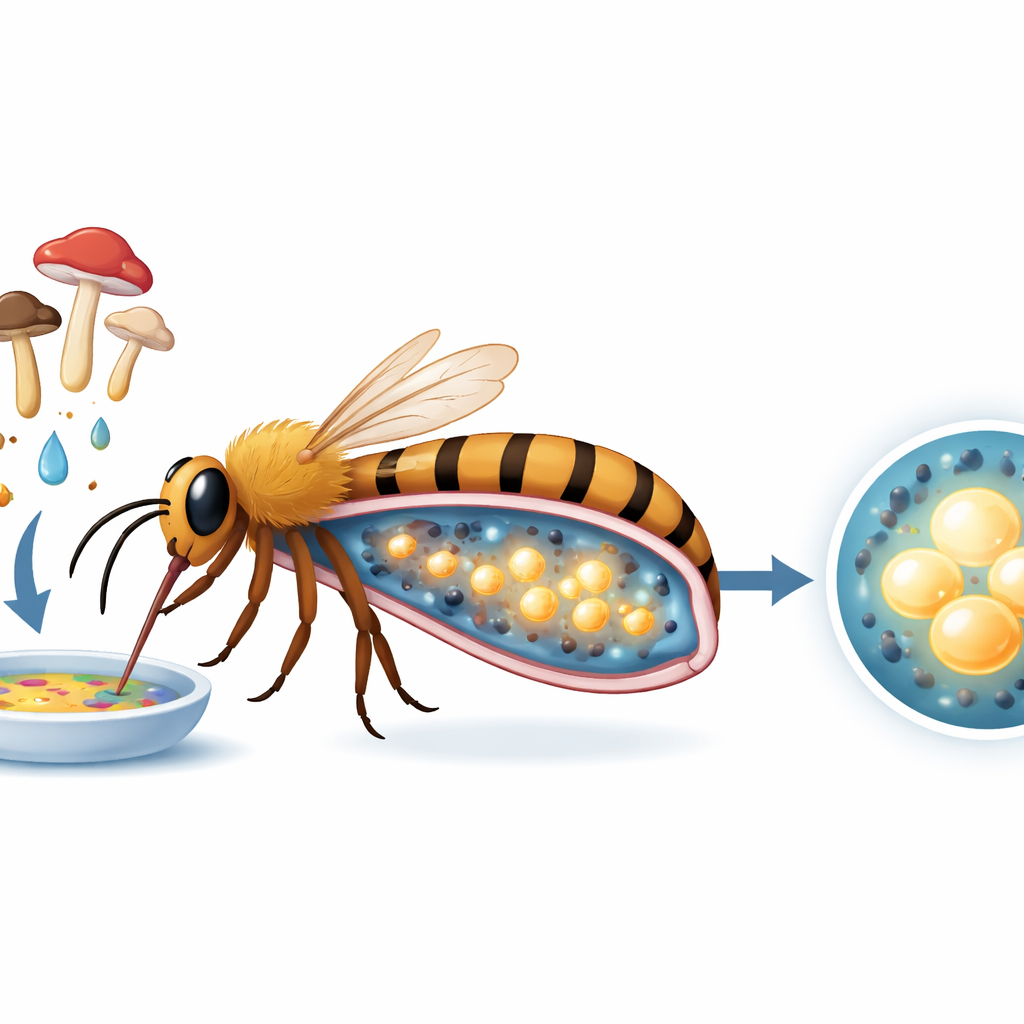
To understand what was happening under the surface, the researchers turned to the bees’ haemolymph, the insect equivalent of blood. In a field experiment, whole colonies were fed syrup with or without mushroom extracts for three weeks. On days 7, 14, and 21, bees were collected and their haemolymph analysed. The scientists measured a set of enzymes that act as “metabolic markers” and detox helpers, as well as key antioxidant enzymes and overall antioxidant capacity. Across almost all measures, bees that consumed mushroom-enriched syrup had higher enzyme activities than bees given plain syrup, especially after two and three weeks of feeding.
Mushrooms and the Bees’ Inner Shield
The most striking pattern appeared in bees fed Inonotus obliquus, which consistently showed the highest levels of detox and antioxidant enzymes among all groups. These enzymes help neutralise reactive molecules produced during stress, breakdown toxins, and protect vital cell components. Total antioxidant capacity, a broad indicator of the body’s “buffer” against oxidative damage, was also higher in all mushroom-fed bees at every time point than in controls. As bees aged during the experiment, enzyme activities naturally increased, but the rise was steeper when mushrooms were present, hinting that the extracts primed or reinforced the bees’ internal shield against stress.
What This Means for Beekeepers and Beyond
To a non-specialist, the message is straightforward: certain medicinal mushrooms can act like a nutritional “booster shot” for honey bees. In this study, Ganoderma lucidum helped bees live longer, while all four tested fungi improved biochemical indicators linked to detoxification and antioxidant defence, with Inonotus obliquus giving the strongest internal response. Although more work is needed to see how this translates to full colony performance, disease resistance, and long-term safety, the findings suggest that carefully formulated mushroom extracts could become part of sustainable beekeeping, supporting bee immunity without relying solely on synthetic chemicals.
Citation: Ansaloni, L.S., Videčnik, V., Staniszewska, P. et al. Fungal extracts influence lifespan and immune responses in the Carniolan honey bee (Apis mellifera carnica, Pollmann 1879). Sci Rep 16, 9970 (2026). https://doi.org/10.1038/s41598-026-40846-3
Keywords: honey bee health, medicinal mushrooms, antioxidant defence, bee nutrition, pollinator conservation