Clear Sky Science · en
Focusing performance of Fibonacci tiling-based zone plates
Light shaped by patterns from nature
Many natural patterns, from sunflower seeds to seashells, follow the famous Fibonacci sequence. This study takes that same mathematical pattern and uses it to design a new kind of tiny optical device that can bend and focus light in a highly controlled way. These structures, called Fibonacci tiling-based zone plates, could help build sharper microscopes, better imaging systems, and tools for precisely steering laser beams, all by arranging transparent and opaque squares in a carefully designed grid.
Why patterned plates matter for modern optics
Modern optics increasingly relies on flat components that sculpt light by diffraction rather than by bending it through thick glass lenses. These devices, known as diffractive optical elements, can be made very small and tailored to produce complex light patterns. A classic example is the Fresnel zone plate, a series of concentric rings that alternates between transparent and opaque regions to focus light. However, traditional designs often waste light into unwanted secondary spots, creating a noisy background that reduces image contrast and precision. Researchers have turned to mathematical sequences such as Fibonacci and other aperiodic patterns to improve how these elements focus light in space.
From a simple sequence to a tiled light shaper
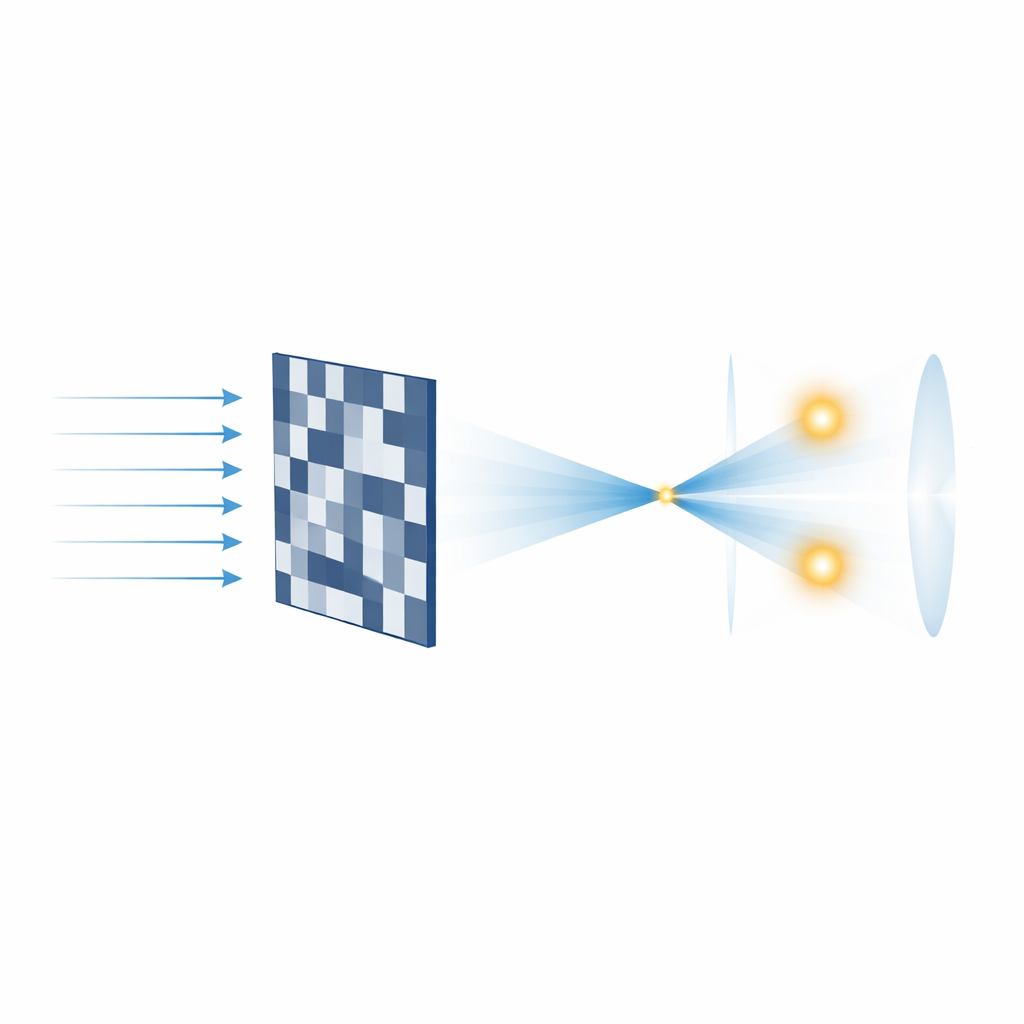
The Fibonacci sequence starts with 0 and 1, and each new number is the sum of the previous two. From this simple rule, the authors build a binary sequence of zeros and ones, which they then extend into two dimensions using a clever tiling scheme. Instead of concentric rings, their design is a square grid made of many small rectangles that are either transparent or opaque. The arrangement is not purely regular like a checkerboard, nor completely random. Each row and column follows either a Fibonacci-based sequence or its logical opposite, producing a quasiperiodic pattern: ordered enough to show structure, but never exactly repeating. This tiled grid defines how much light is allowed through at each point of the plate.
How the new plate focuses light
To predict how this tiled plate focuses light, the team used standard wave optics equations to compute the intensity of light along and across the optical axis. They compared three designs: a conventional Fresnel zone plate, a previously known Fibonacci zone plate made of concentric rings, and their new Fibonacci tiling-based zone plate. Both types of Fibonacci-based plates naturally create two main focal spots along the axis, whose positions are closely linked by the golden ratio, reflecting the underlying sequence. The crucial difference is that the new tiled design strongly suppresses many of the weaker, unwanted secondary focal spots. The result is a cleaner energy distribution: one primary focus, a weaker secondary one, and far less clutter elsewhere.
Putting the design to the test
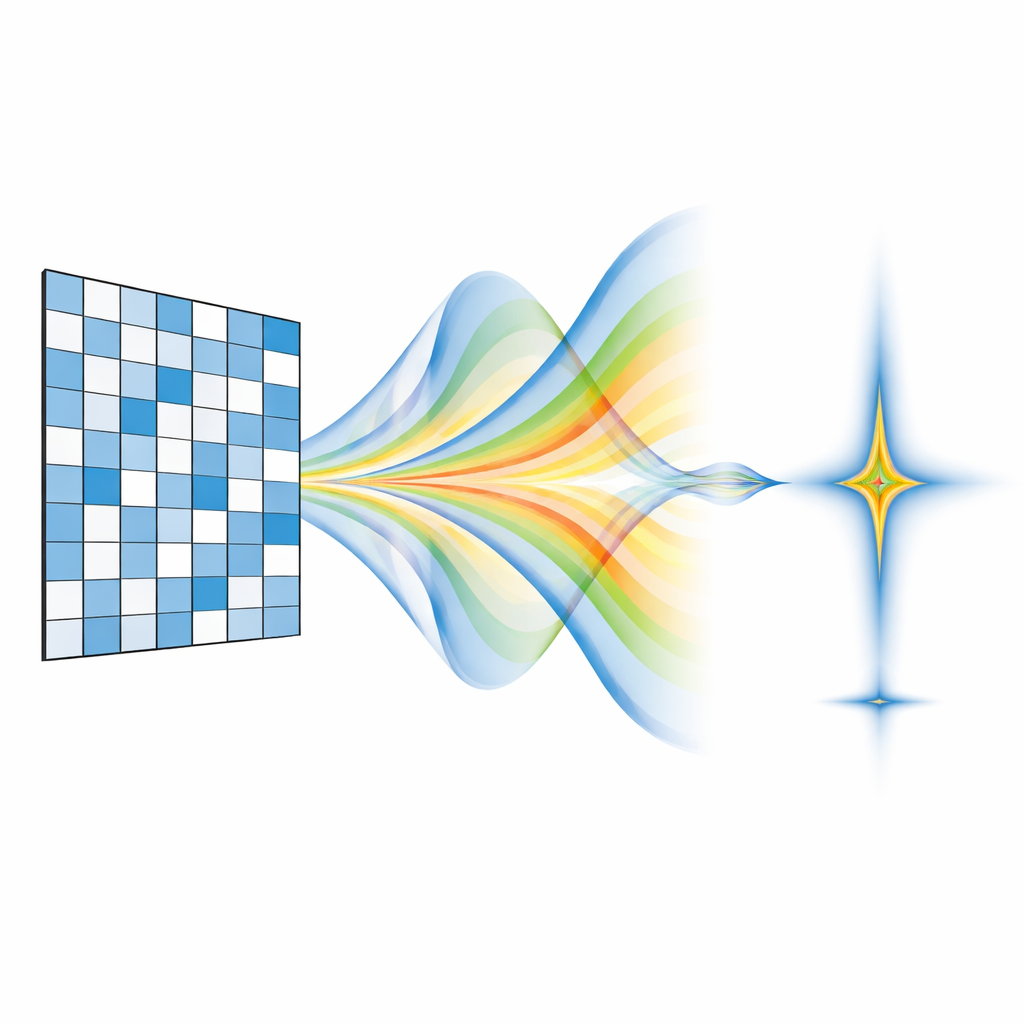
The authors then tested their design in the lab using a red laser and a programmable spatial light modulator, which can display the tiled pattern electronically. By capturing the light intensity along the axis with a camera that moves on a motorized stage, they confirmed that the measured focal positions and intensities closely match the theoretical predictions, with only a few percent difference. The ratio of the two main focal distances again approached the golden ratio, showing how the mathematics of Fibonacci tiling is imprinted directly into the way the light is focused. At the main focus, the transverse light pattern forms a characteristic two-armed cross, another fingerprint of the underlying quasiperiodic grid.
Where this new plate can be useful
Because the Fibonacci tiling-based zone plate reduces background light while preserving a controllable pair of main foci, it is especially attractive for applications where contrast and precise energy placement are more important than having two equally strong focal spots. Its square, grid-based geometry is naturally suited to devices like spatial light modulators, which already operate on rectangular pixels, and the distinctive cross-shaped pattern at the main focus can serve as a built-in alignment mark or calibration feature. In short, by embedding the Fibonacci sequence into a two-dimensional tiling, the authors have created a flat optical element that offers cleaner focusing and useful structural signatures, promising benefits for high-precision imaging, beam shaping, and optical metrology.
Citation: Garmendía-Martínez, A., Pérez, F.M.M., Palacio, J.C.C. et al. Focusing performance of Fibonacci tiling-based zone plates. Sci Rep 16, 11061 (2026). https://doi.org/10.1038/s41598-026-40652-x
Keywords: diffractive optics, Fibonacci sequence, zone plates, beam shaping, quasicrystals