Clear Sky Science · en
Social encapsulation of parasite eggs by honeybee colonies
How Honeybees Fight Hidden Invaders
Honeybee colonies face a constant onslaught from tiny parasites that can quietly undermine a hive from within. One such pest, the small hive beetle, lays its eggs in narrow cracks where the emerging larvae can destroy honey, pollen, and brood, sometimes collapsing the whole nest. This study explores a surprising and subtle defense: instead of always digging out the eggs, honeybee colonies can choose to wall them in with a natural resin called propolis, effectively entombing the threat before it hatches.
A Silent Battle Inside the Hive
To watch this hidden struggle, researchers offered honeybee colonies artificial hiding places stocked with small hive beetle eggs. These were made from two glass slides separated by a tiny gap, mimicking the crevices beetles use in a real hive. Some slides contained egg clusters, others were empty controls. After a day inside ten field colonies of European-derived honeybees, the slides were removed and carefully examined for how many eggs remained and how much of the gap had been sealed with propolis. 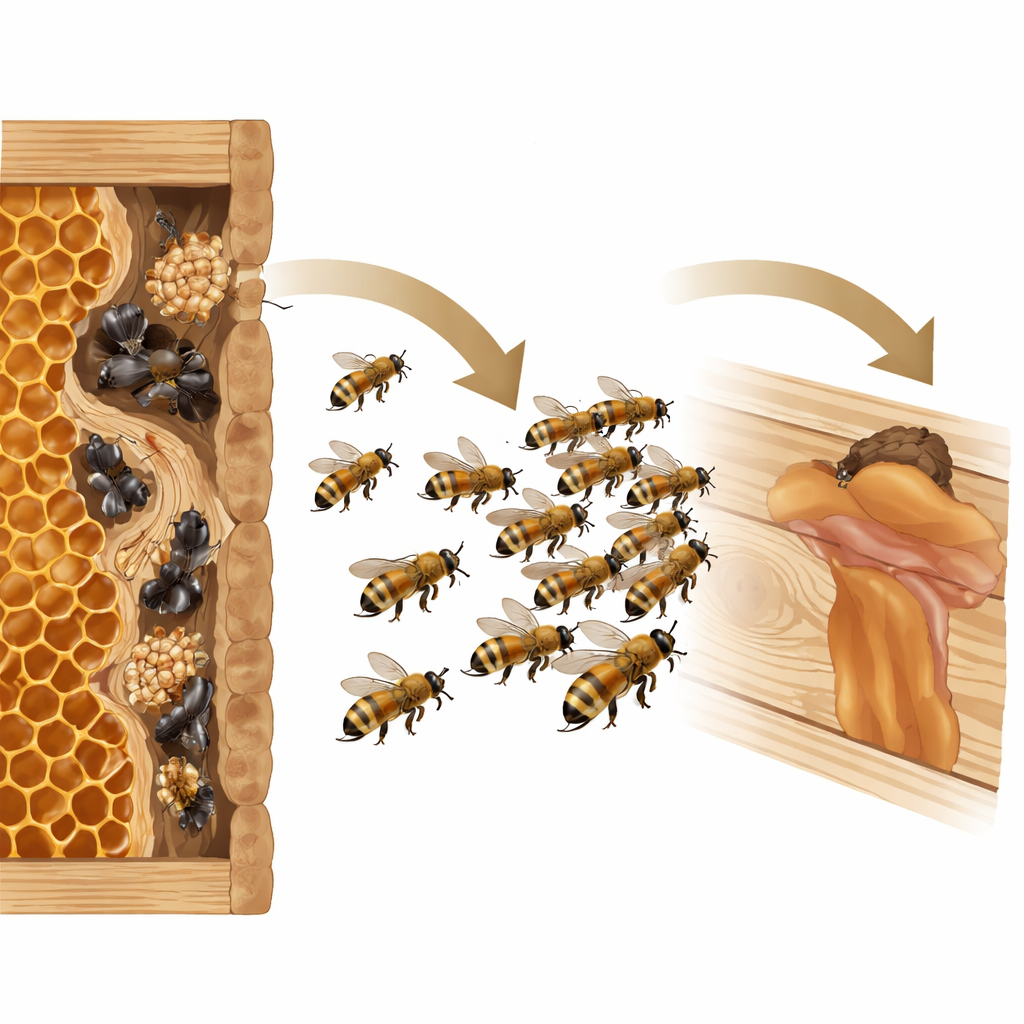
When Reaching Is Not Enough
To understand what bees could physically do, the team compared the length and thickness of worker bees’ mouthparts with how deeply the beetles could hide their eggs. The bees’ proboscis, the straw-like tongue they use to reach into cracks, was much longer than the beetles’ egg-laying organ and longer than the depth of even the deepest egg clusters. On paper, the bees should have been able to reach the eggs. However, the proboscis thickens toward its base, and only the thinnest tip could fit into the narrow gap used in the experiment. Measurements showed that this tight space limited how far into the crack the bees could actually maneuver their mouthparts, potentially preventing them from removing eggs tucked deepest inside.
Trapping Eggs Instead of Tossing Them
Despite having the reach, almost all small hive beetle eggs were still present after 24 hours. Instead of clearing them out, the bees responded in another way: they used more propolis on sites containing eggs than on empty control slides. The sticky resin filled and sealed the gap, essentially gluing over the concealed eggs. Across the test colonies, the presence of eggs alone significantly predicted a longer propolised area, showing that colonies sensed the threat and actively shifted to a sealing strategy. Colonies also differed in how much propolis they used, and hives with more stored honey tended to apply more resin, hinting that both genetics and available resources shape this defensive choice. 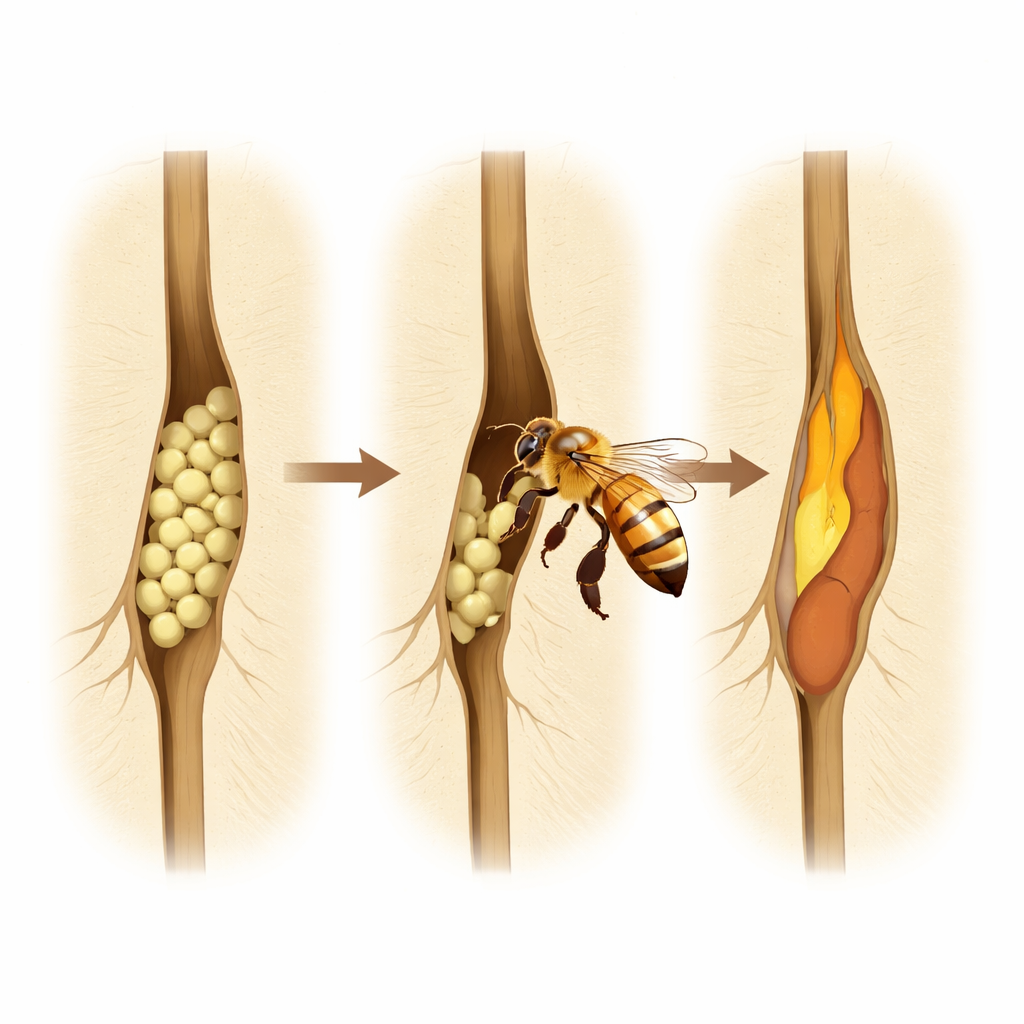
Choices Shaped by Place and Season
Comparing these results with earlier work in African honeybees reveals a striking contrast: African colonies have been observed removing a substantial share of beetle eggs rather than encapsulating them. The authors suggest that local conditions help determine which tactic a colony favors. Propolis gathering is energy intensive and depends on the availability of resin-producing trees, which was high at the forested study site. Seasonal timing also matters; the experiment took place in late summer, when bees often collect more resin. In other environments, or at different infestation levels, bees may rely more on egg removal or even abandon the nest entirely. This flexibility suggests that honeybee colonies do not follow a single script but switch strategies as circumstances change.
What This Means for Bee Health
For beekeepers and ecologists, the work highlights that a hive’s defense is not just about killing or throwing out parasites; sometimes the smarter option is to lock them away. By showing that honeybee colonies can encapsulate small hive beetle eggs as an alternative to removing them, the study adds a new piece to the puzzle of “social immunity” — the collective disease and parasite defenses of insect societies. Understanding when and why colonies choose one strategy over another could help in breeding or managing bees that are better able to withstand invasive pests, ultimately supporting the resilience of these vital pollinators.
Citation: Grech, F.M., Papach, A., Palonen, A.K. et al. Social encapsulation of parasite eggs by honeybee colonies. Sci Rep 16, 12542 (2026). https://doi.org/10.1038/s41598-026-40183-5
Keywords: honeybee defenses, small hive beetle, propolis, social immunity, parasite eggs