Clear Sky Science · en
Fuzzy-based multi-objective scheduling for human–robot manufacturing systems
Why people and robots must plan together
Factories today juggle short product lifetimes, picky customers, and fast-changing orders. Many now mix human workers with collaborative robots to stay flexible. But deciding how much to produce, when to produce it, and which tasks should go to people or robots is no longer a simple spreadsheet exercise—especially when future orders and task times are uncertain. This study tackles that tangle head‑on, proposing a way to plan production and schedule human–robot work so that money, speed, and delivery reliability are balanced at the same time.
The challenge of guessing the future
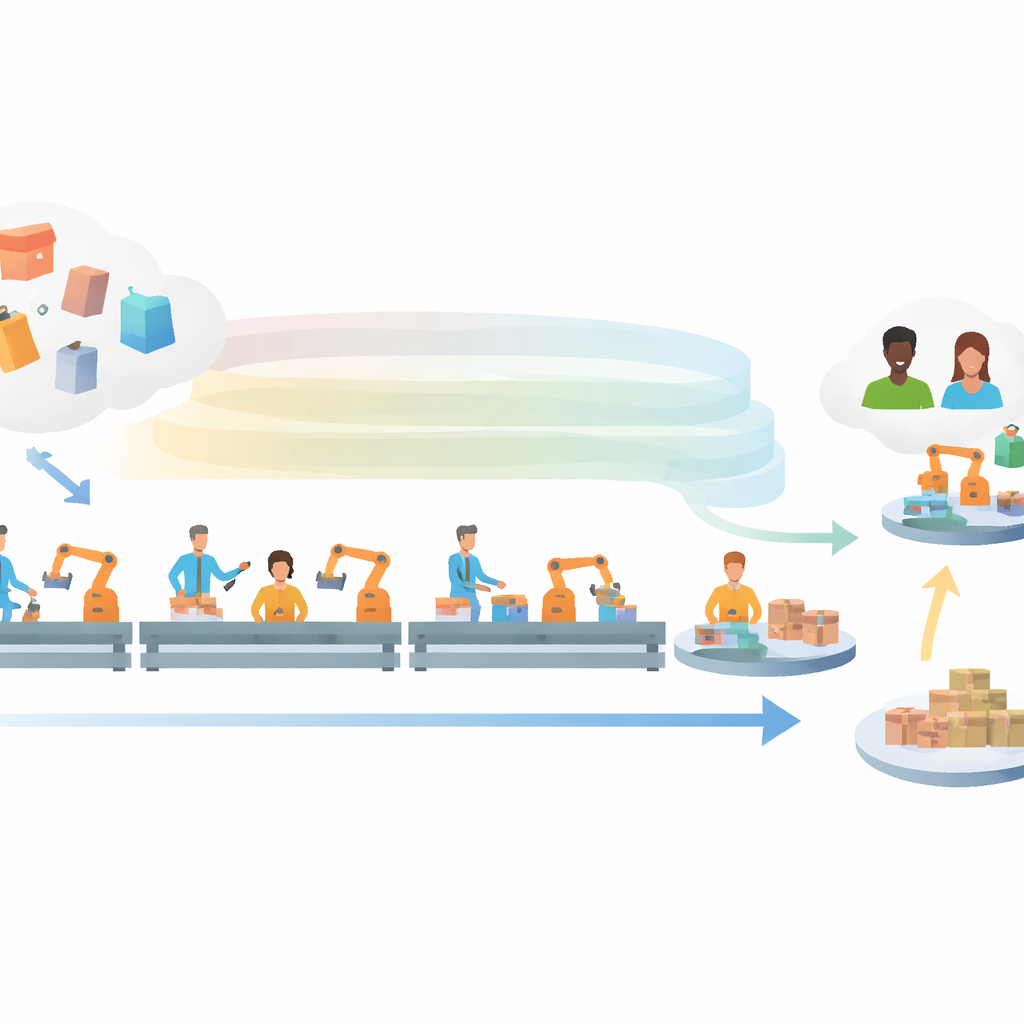
Manufacturers rarely know exactly how many units customers will order or how long each job will take, particularly in customized, low‑volume production. A task may be quicker on a robot but more flexible with a person, and real cycle times shift with product mix, worker experience, and technical hiccups. Traditional planning tools often assume fixed, known numbers or rely on long historical records to build probability models. In many human–robot lines, those records simply do not exist. As a result, companies risk either overproducing and paying for excess inventory, or underproducing and facing shortages, late deliveries, and penalty costs.
A single plan that sees the whole factory
The authors build an integrated model that looks at the factory at two levels at once. At the mid‑term planning level, it decides how many units of each product to make in each time period, how much to store, and how much shortage to tolerate and backorder. At the shop‑floor level, it determines which operations are done by humans or robots at each workstation and in what sequence. Every product must pass through multiple stations, and each station can be run either by a human or a robot with different speeds and costs. By treating production quantities, inventory, shortages, task assignment, and job order as one combined problem, the model captures trade‑offs that are usually missed when planning and scheduling are handled separately.
Making sense of fuzzy information
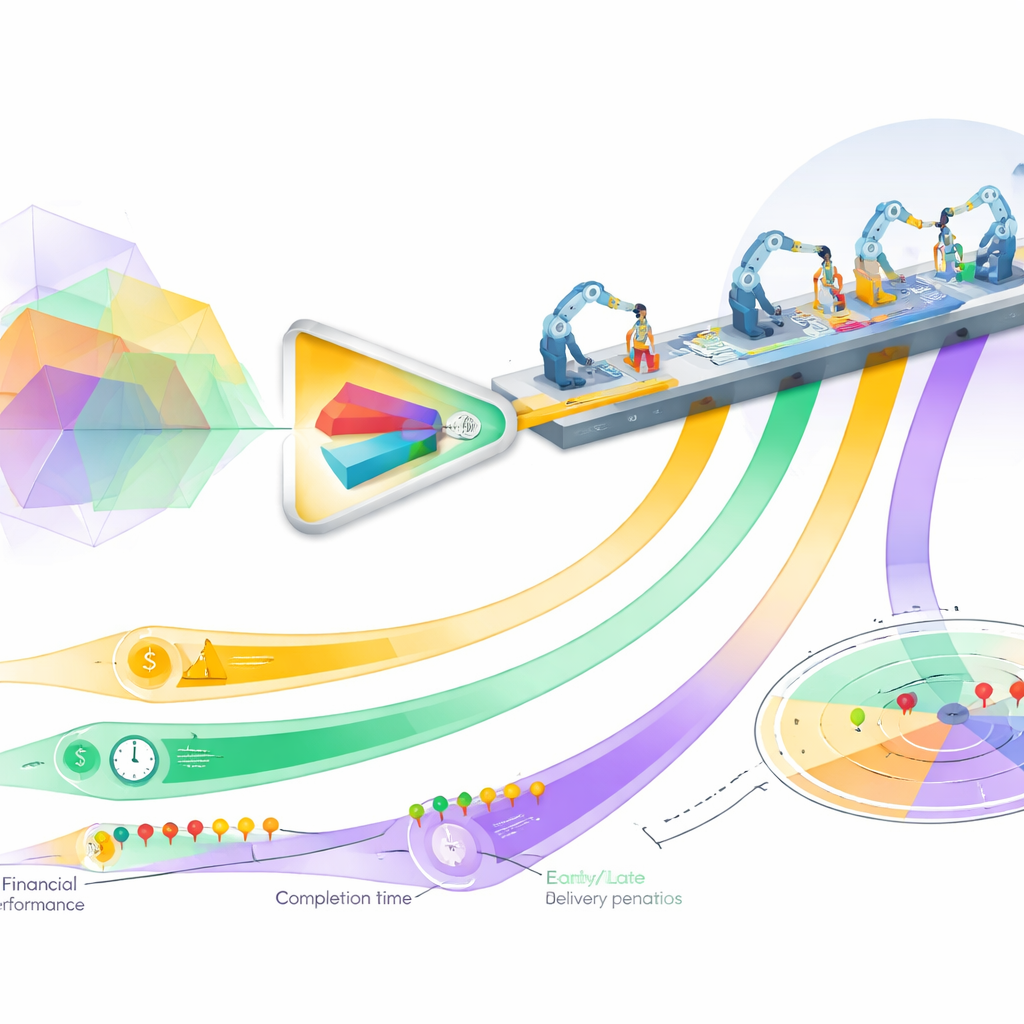
Instead of pretending that demand and processing times are precise, the study describes them as ranges with more or less plausible values—so‑called fuzzy numbers. The authors then apply a risk‑averse scheme that, in effect, leans toward the more pessimistic side of those ranges. This “credibility‑constrained” approach requires plans to remain feasible with a chosen level of belief, such as 80 percent, without resorting to full-blown probability distributions. Fuzzy demand and task times are translated into cautious crisp values, and the resulting mathematical model seeks three goals at once: to maximize the overall financial return (net present value), to minimize the time until all jobs are finished (makespan), and to minimize the sum of how early or late products are delivered.
Searching for good compromises
Because the combined human–robot planning problem is extremely complex and grows quickly with the number of products, stations, and periods, exact methods work only for small toy cases. The authors first validate their model on small examples using a precise mathematical technique called the epsilon‑constraint method. For realistic, large factories, they then turn to three nature‑inspired search strategies: NSGA‑II (a genetic algorithm), MOPSO (particle swarm optimization), and MOWOA (a whale‑inspired algorithm). All three produce sets of “Pareto” solutions—different compromises where no objective can be improved without worsening another. Across 15 test problems and a real packaging plant in China, the whale‑based approach consistently finds more diverse and better‑balanced options, coming closer to the ideal mix of profit, speed, and delivery performance.
What the trade‑offs mean in practice
The solutions reveal clear patterns that matter to managers. Relying more heavily on robots shortens completion times and reduces early or late deliveries, but robot purchase and deployment costs push down net present value. Higher uncertainty in demand or task times tends to lengthen production, raise shortages, and lower financial performance. Interestingly, changes in bank interest rates strongly affect net present value through discounting of future cash flows but have almost no impact on the actual schedules—who does what, when, and on which station. Overall, the study shows that integrating planning with human–robot scheduling under uncertainty can uncover more efficient and realistic operating scenarios than handling these decisions separately.
Big picture takeaway for non‑specialists
For a lay reader, the message is straightforward: when people and robots share a production line and the future is hazy, companies need tools that plan everything together—how much to make, where to store it, and who should perform each step—while acknowledging that key numbers are only approximate. By combining a cautious way of handling uncertainty with advanced search algorithms, this work offers factory managers a menu of smart, explainable schedules. Each option shows the trade‑off between earning more money, finishing work faster, and keeping deliveries close to promised dates, helping them choose the level of risk and robot use that best fits their strategy and budget.
Citation: Deng, Y., Huang, B. & Lai, S. Fuzzy-based multi-objective scheduling for human–robot manufacturing systems. Sci Rep 16, 11253 (2026). https://doi.org/10.1038/s41598-026-40004-9
Keywords: human–robot collaboration, production scheduling, fuzzy optimization, multi-objective planning, manufacturing systems