Clear Sky Science · en
Social safety nets, women’s economic achievements and agency in 45 countries: a systematic review and meta-analysis
Why Helping Hands for Women Matter
Across the globe, millions of women carry the main responsibility for putting food on the table, caring for family members and keeping households afloat, often with little financial security of their own. Governments and aid agencies have responded with social safety nets—programs that provide support such as cash, food or public jobs. This article asks a simple but crucial question: when these programs are put in place, do they actually help women earn more, build up resources and gain a stronger say in their homes and communities?
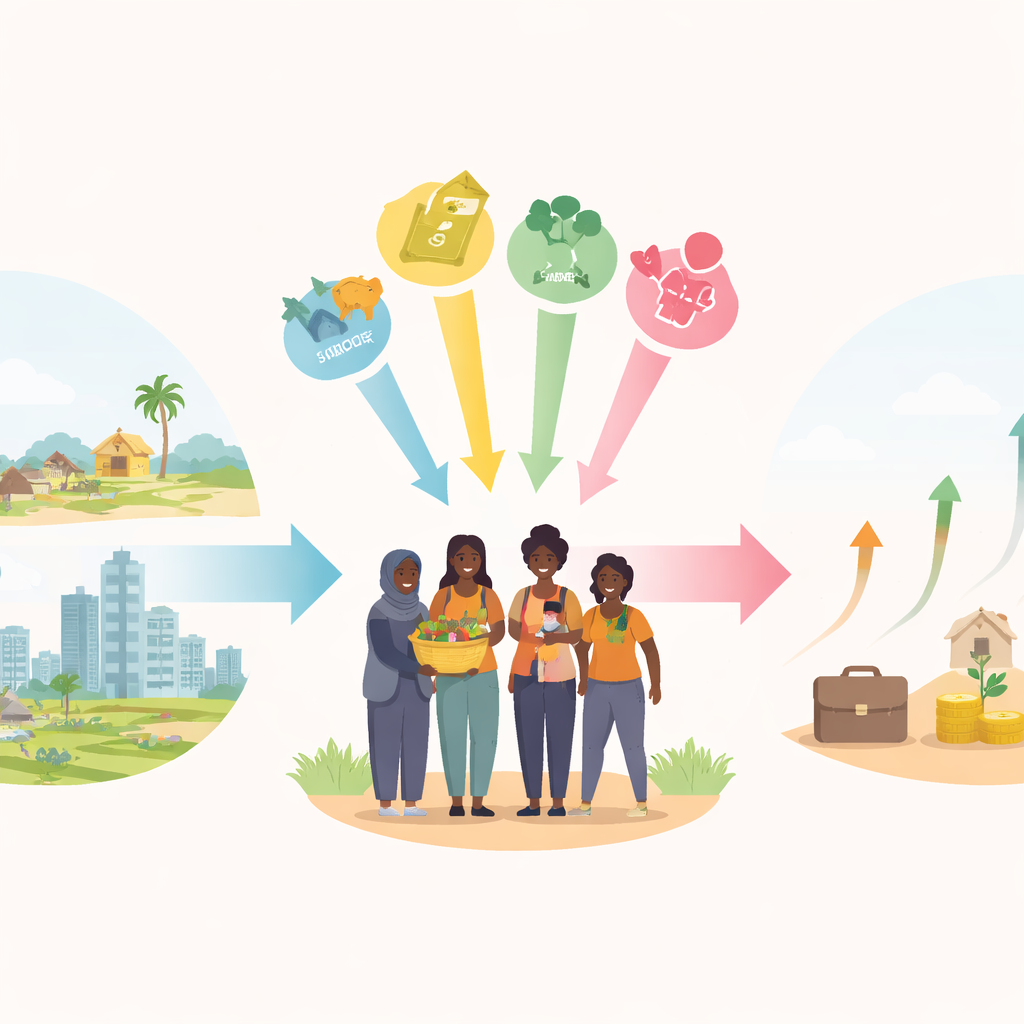
Looking Across Many Countries at Once
To answer this question, the researchers pulled together results from 93 high-quality experiments carried out in 45 low- and middle-income countries, covering more than 218,000 women. Rather than focusing on a single program or nation, they combined 1,307 separate impact estimates using a statistical approach that allows patterns to emerge from very different settings. The safety net programs they examined ranged from direct cash transfers and food support to public work schemes, asset grants and social care services such as subsidized childcare or eldercare.
What Counts as Progress for Women
The team defined women’s progress in two broad ways. First, they looked at economic achievements—whether women were more likely to engage in paid or productive work, how many hours they worked, and whether they increased their savings, assets and spending on themselves or their businesses. Second, they examined agency—women’s ability to make decisions about money, move freely, feel confident and speak up in household and community matters. Only measures that clearly referred to women themselves, rather than entire households, were included, ensuring the focus stayed on women’s own outcomes.
What the Numbers Reveal
Overall, social safety nets led to small but consistent gains for women. On average, women who benefited from these programs were more likely to work, worked slightly more hours, held more assets, saved more and spent more on goods and activities that support their livelihoods. They also reported greater say in decisions, more control over their lives and stronger voices in group or public settings. Importantly, the study found no sign that receiving support made women more “dependent” or less likely to work; instead, assistance tended to boost their participation in the labor force.

Which Types of Support Work Best
Not all safety nets were equally effective. Unconditional cash transfers—payments that come with no strings attached—stood out as especially helpful, as did asset transfers, public work programs and social care services. These interventions were linked to clear improvements in both women’s economic situations and their sense of control. Conditional cash transfers, which require recipients to meet certain rules such as attending trainings or ensuring children visit clinics, showed smaller gains. Food or other in-kind support did not show strong or reliable effects for women on their own. One concern is that conditions can pile extra responsibilities onto women, such as time-consuming health visits or meetings, leaving them with less time and flexibility to pursue paid work or education.
Money Matters, but Design Still Lags Behind
In addition to program type, the researchers explored whether design choices—such as targeting women directly, adding training or other “plus” components, or offering larger benefit amounts—systematically changed outcomes. Surprisingly, they found few strong patterns, in part because studies differed widely and often lacked detailed reporting. Cost–benefit analyses, when they existed, suggested that many programs were good investments. Yet very few of these calculations explicitly counted women’s gains in income or decision-making, meaning current assessments probably underestimate how much women benefit.
What This Means for Real Lives
For readers, the core message is that well-designed safety nets can do more than keep families from falling into extreme hardship—they can nudge women toward greater financial independence and a stronger voice at home and in society. While the improvements for any single woman may be modest, taken across millions of program participants they add up to meaningful change. The study suggests that flexible forms of support, especially unconditional cash, asset grants and affordable care services, give women the breathing room and choices they need to build more secure and self-directed lives. At the same time, it highlights the need to refine program design and to measure success through a clear gender lens, so that safety nets truly help close, rather than quietly reproduce, the gap between women and men.
Citation: Peterman, A., Wang, J., Kamto Sonke, K. et al. Social safety nets, women’s economic achievements and agency in 45 countries: a systematic review and meta-analysis. Nat Hum Behav 10, 698–714 (2026). https://doi.org/10.1038/s41562-025-02394-0
Keywords: social safety nets, women’s economic empowerment, cash transfer programs, gender equality, low- and middle-income countries