Clear Sky Science · en
Gaps and drivers of global marine animal biodiversity from the surface to abyss
Why the hidden life of the ocean matters
The ocean covers most of our planet and supports food, climate control, and livelihoods, yet we still know surprisingly little about the animals that live there. This study asks a simple but far reaching question: where in the global ocean do we truly understand marine life, and where are we still almost blind? By stitching together tens of millions of records from international databases, the author shows how uneven our view is, especially in deep and tropical seas, and why filling these gaps is vital for conservation and future ocean planning.
Taking stock of life from the surface to the abyss
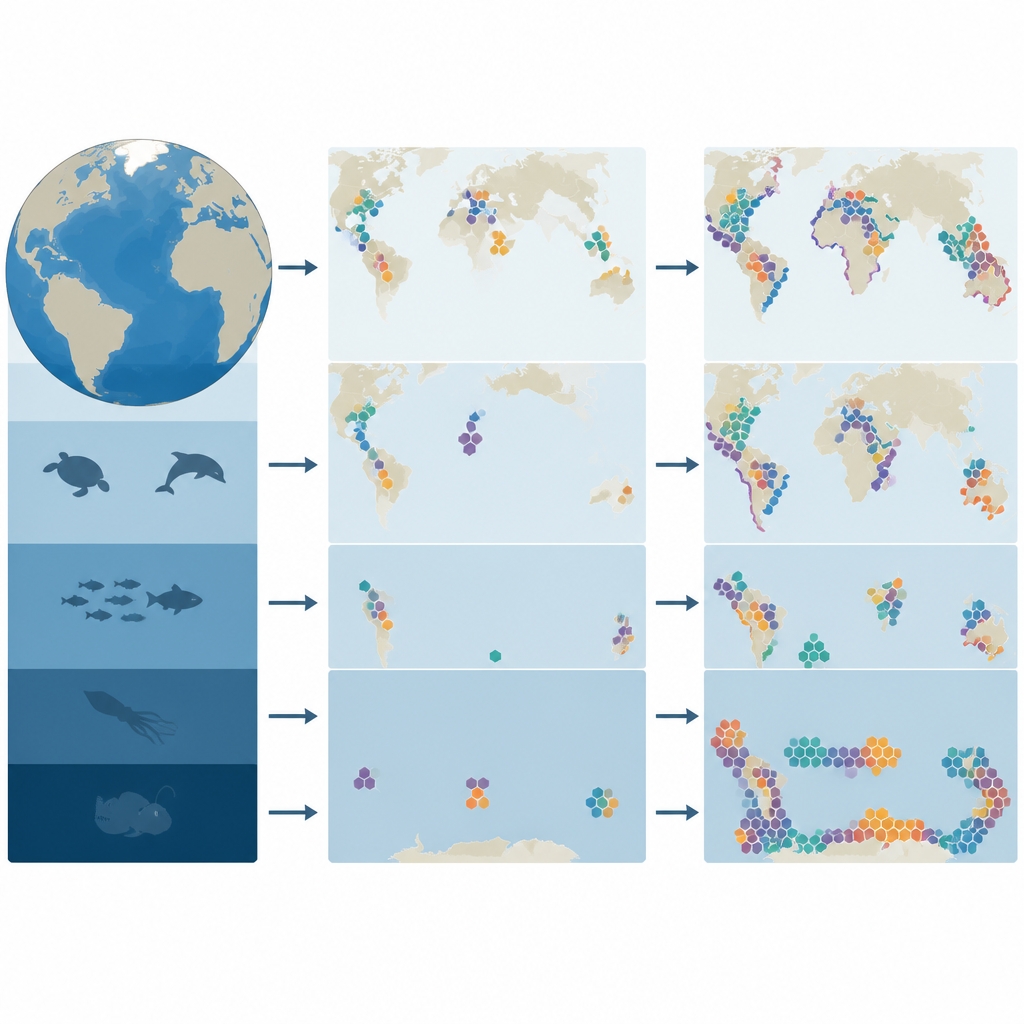
Using two major open databases of marine life, the researcher assembled a carefully cleaned record of about 48 million sightings of marine animals, covering more than 184,000 species. These records were grouped into three depth zones: shallow waters near the surface, the dim middle zone, and the deep sea down to 11,000 meters. The global ocean was divided into large hexagon shaped grid cells so that different regions could be compared fairly. Species counts and several measures of diversity were then estimated for each cell while adjusting for how many samples had actually been collected.
Where we look and where we do not
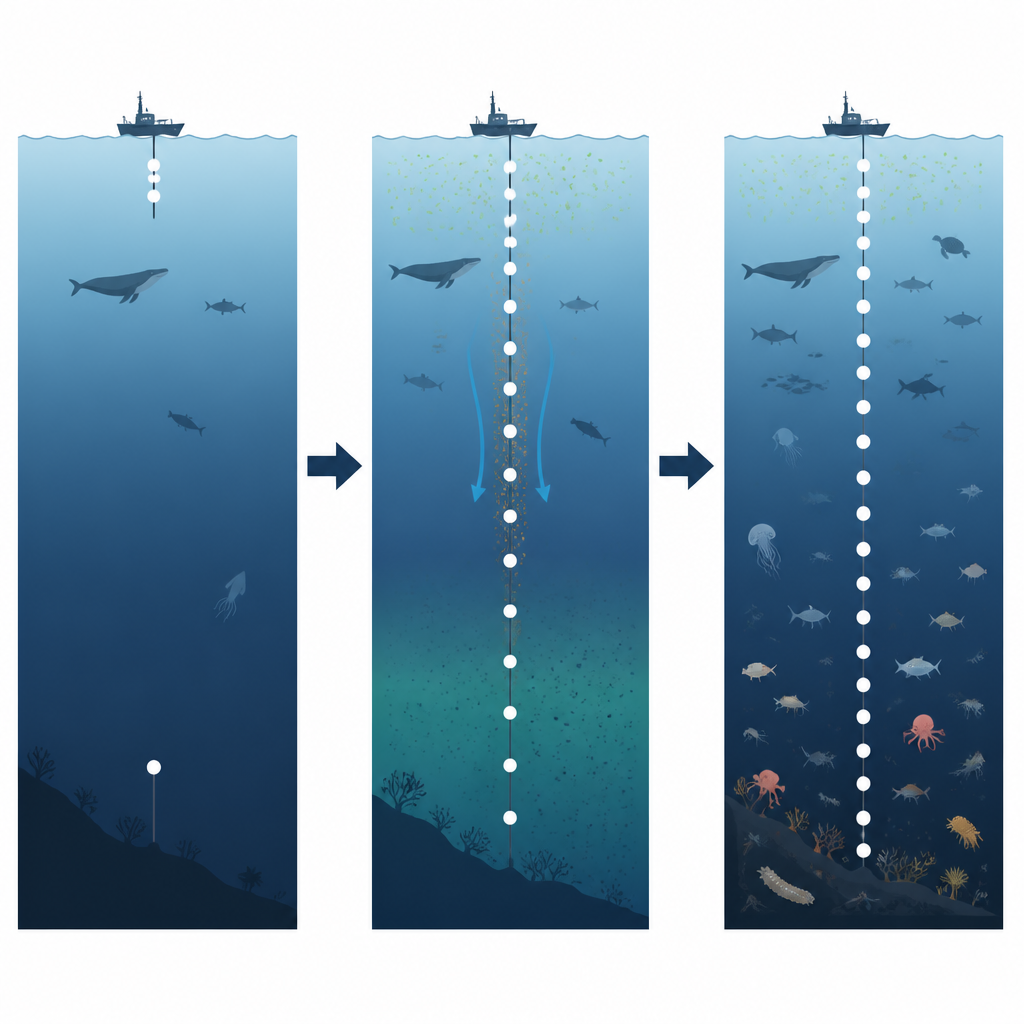
The maps reveal that roughly half of the world ocean has been sampled so little that fewer than 50 animal records exist per grid cell. Sampling is strongly concentrated in the waters of wealthy countries, such as the North Atlantic and parts of the North Pacific, while huge stretches of the equatorial Atlantic, Indian, and Pacific Oceans remain sparse in data. Central tropical waters around the equator contribute less than 2.5 percent of global records, even though these regions are thought to host very high biodiversity. Deep waters below 200 meters are especially poorly known, with more than 160 million square kilometers lacking basic occurrence data.
Rethinking patterns of richness with bias in mind
When raw species counts are plotted by latitude, they seem to form a double peak pattern: higher numbers of species in mid latitudes and a dip at the equator. However, once the analysis corrects for uneven sampling using a standardised richness measure, this bimodal pattern largely disappears and is not statistically different from a simple single peak. The results suggest that apparent low diversity at the equator and in polar and deep regions mainly reflects where scientists have looked, not where life actually thrives. In fact, after accounting for effort, deep sea regions can be as rich in species as shallow coastal waters, and areas like the Gulf of Mexico, New Caledonia, and northern New Zealand emerge as consistent hotspots.
What shapes life in shallow and deep waters
The study also explores which environmental and human factors are linked with species richness at different depths. In shallow waters, sea surface temperature and primary productivity show the strongest associations with how many species are present, echoing long standing ideas that warmth and food supply support diversity. In the deep ocean, patterns of richness are more closely tied to nitrate, a nutrient linked to the breakdown of sinking organic matter, hinting that the recycling of surface production fuels deep communities. In the middle depths, measures of human influence, which often track where ships and research activity are concentrated, best explain the number of recorded species, underscoring how strongly our view is shaped by where people operate.
Why closing the blue data gaps is urgent
For a lay reader, the main message is that our picture of ocean life is still highly incomplete and uneven, especially in deep and tropical waters where many species likely remain undiscovered. Because conservation plans, protected areas, and global biodiversity targets rely on shared data, these blind spots can mislead decisions about which regions most need protection. The author argues that coordinated international efforts to expand sampling, share data openly, and track key ocean variables across depths are essential. Only by filling these gaps can we gain a truer sense of how marine life is distributed and how it is changing in a rapidly warming and increasingly stressed ocean.
Citation: Saeedi, H. Gaps and drivers of global marine animal biodiversity from the surface to abyss. Nat Commun 17, 4553 (2026). https://doi.org/10.1038/s41467-026-73613-z
Keywords: marine biodiversity, deep sea, sampling bias, ocean data gaps, species richness