Clear Sky Science · en
Frequent floods in the Yangtze River basin linked to a shifted Indian Ocean wave regime
Why faraway oceans matter for river floods
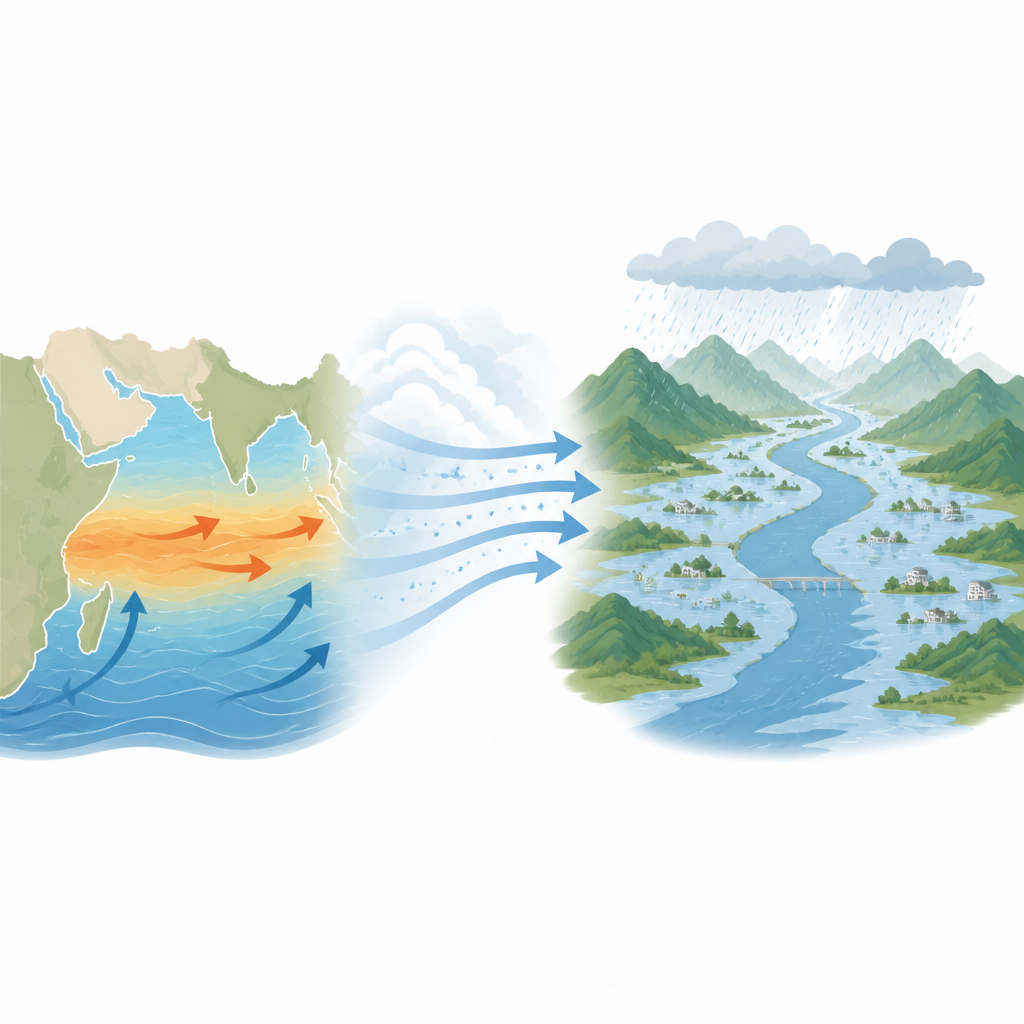
People living along the Yangtze River have seen more damaging summer floods in recent decades, but the cause is not only local rain or nearby weather. This study shows that slow moving waves and warm waters in the distant Indian Ocean can help set the stage for both severe floods and droughts along the Yangtze, by nudging the Asian summer monsoon into wetter or drier moods every couple of years.
A sharp rise in big Yangtze floods
The researchers first looked at long records of how much water flows past Datong, a key station near the mouth of the Yangtze River, from 1960 to 2024. Between 1960 and 1991 there was only one summer with truly extreme discharge. From 1992 to 2024 there were six such summers, including 1995, 1996, 1998, 1999, 2016, and 2020, when widespread flooding affected millions of people. Years of very low summer flow also became more common. This shows that the river has become more erratic, with bigger swings between high and low water.
A two year rhythm in rain and river flow
To understand this shift, the team focused on changes that repeat roughly every one to three years, known here simply as a two year rhythm. They found that this rhythm in summer rain over the Yangtze Basin and in river discharge became about 50 percent stronger after the early 1990s. At the same time, a matching rhythm grew stronger in the height of the sea surface in the tropical Indian Ocean, a sign of more energetic internal waves in the ocean. These linked ups and downs hinted that distant ocean motions might be helping to drive swings in East Asian summer rainfall.
Hidden waves and warmer seas in the Indian Ocean
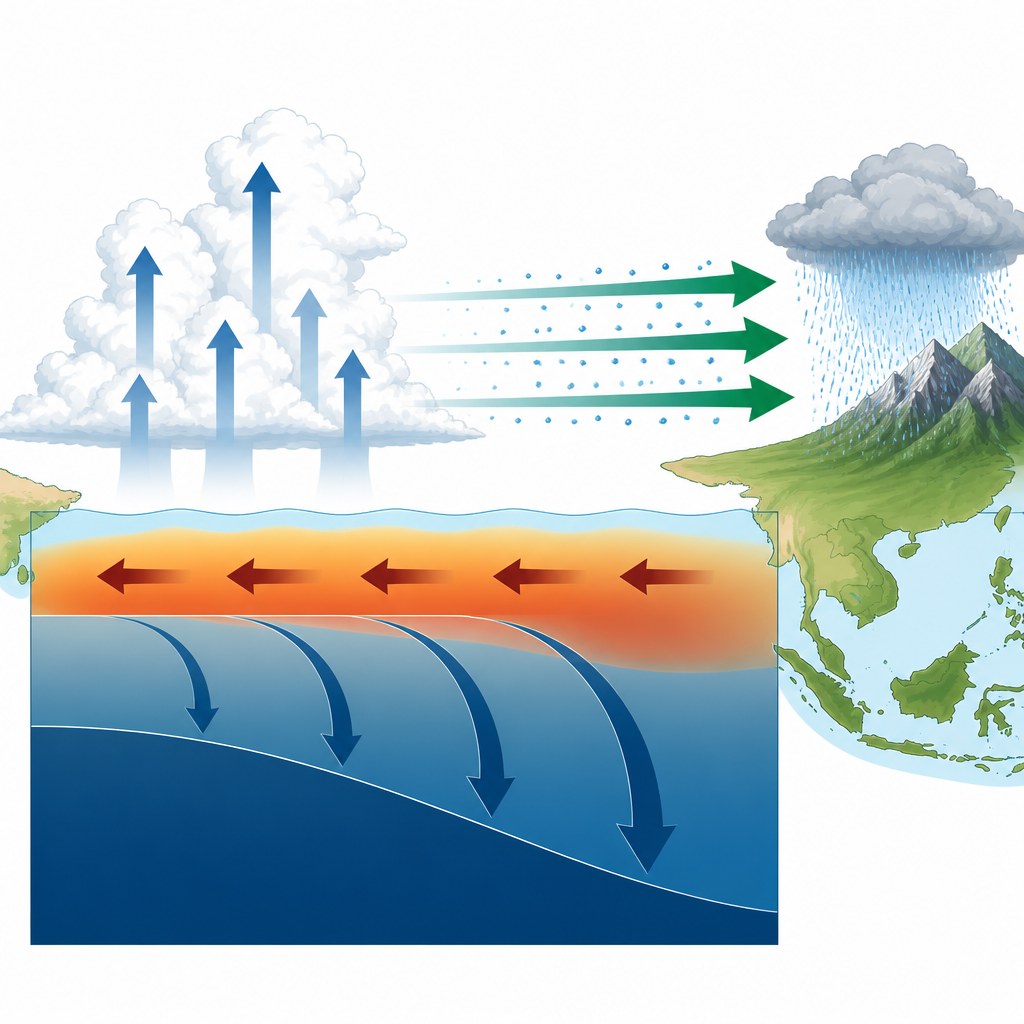
Inside the tropical Indian Ocean, large slow waves slosh westward below the surface, while faster waves race along the equator and nearby coasts. Together they form a repeating cycle. The study shows that since the 1990s, the slow westward waves in a key region called the Seychelles–Chagos Thermocline Ridge have become stronger, longer, and about 70 percent faster. As these waves deepen the layer that separates warm surface water from cooler water below, they reduce the mixing that normally cools the surface. This helps maintain broad patches of unusually warm water that can persist into late spring and summer.
From warm ocean pools to heavy inland rain
When the western and central Indian Ocean stay warmer than usual, towering clouds and strong upward motion form more easily above them. This extra heating in the atmosphere sends out wave like disturbances that can strengthen and shift the western Pacific subtropical high, a large high pressure system that helps steer moist air toward East Asia. In the later decades of the record, these patterns line up more neatly with the East Asian summer monsoon season, so that the warm ocean pool and the monsoon often peak together. The result is stronger moisture flows toward the Yangtze Basin and heavier summer rains there, while the opposite phase of the ocean pattern tends to favor drought.
A new view of what drives Yangtze extremes
In summary, the study argues that more frequent and intense Yangtze floods since the early 1990s are closely tied to a stronger two year rhythm in the Indian and Pacific Oceans. Faster and more powerful internal waves in the Indian Ocean help lock in warm surface waters at just the right time to boost the East Asian summer monsoon, feeding extreme rainfall and river discharge. Understanding and simulating these ocean wave patterns more accurately could improve seasonal outlooks of flood and drought risk for the Yangtze and other monsoon fed rivers.
Citation: Dasgupta, P., Nam, S., McPhaden, M.J. et al. Frequent floods in the Yangtze River basin linked to a shifted Indian Ocean wave regime. Nat Commun 17, 4423 (2026). https://doi.org/10.1038/s41467-026-70940-z
Keywords: Yangtze River floods, Indian Ocean waves, East Asian summer monsoon, Indian Ocean Dipole, ENSO variability