Clear Sky Science · en
Specialised and persistent raw material procurement by humans in the Middle Pleistocene
Why Ancient Stone Shopping Matters Today
Long before supermarkets and supply chains, our ancestors still had to plan how to get the raw materials they needed. This study looks at a remarkable site in eastern South Africa where early Homo sapiens repeatedly visited the same place over more than 100,000 years for one purpose only: to collect and shape a special kind of rock for making stone tools. By uncovering exactly how and why they did this, the research opens a window onto the planning skills, flexibility, and landscape knowledge of some of the earliest members of our species.
A Hidden Workshop in the Eroded Hills
The site, called Jojosi, lies in a network of deep erosion gullies cut into grassland hills above the Jojosi River. Today the ground is paved with millions of broken stone pieces, but careful geological work showed that many of these artefacts originally formed thin, buried layers that were later exposed by natural erosion. Archaeologists located several of these layers—called lenses—and excavated them in detail. They found that each lens was a tight band of stone fragments with extremely high densities, surrounded above and below by almost stone-free sediments, indicating that people had worked in these exact spots and that the material had not been heavily disturbed afterward. 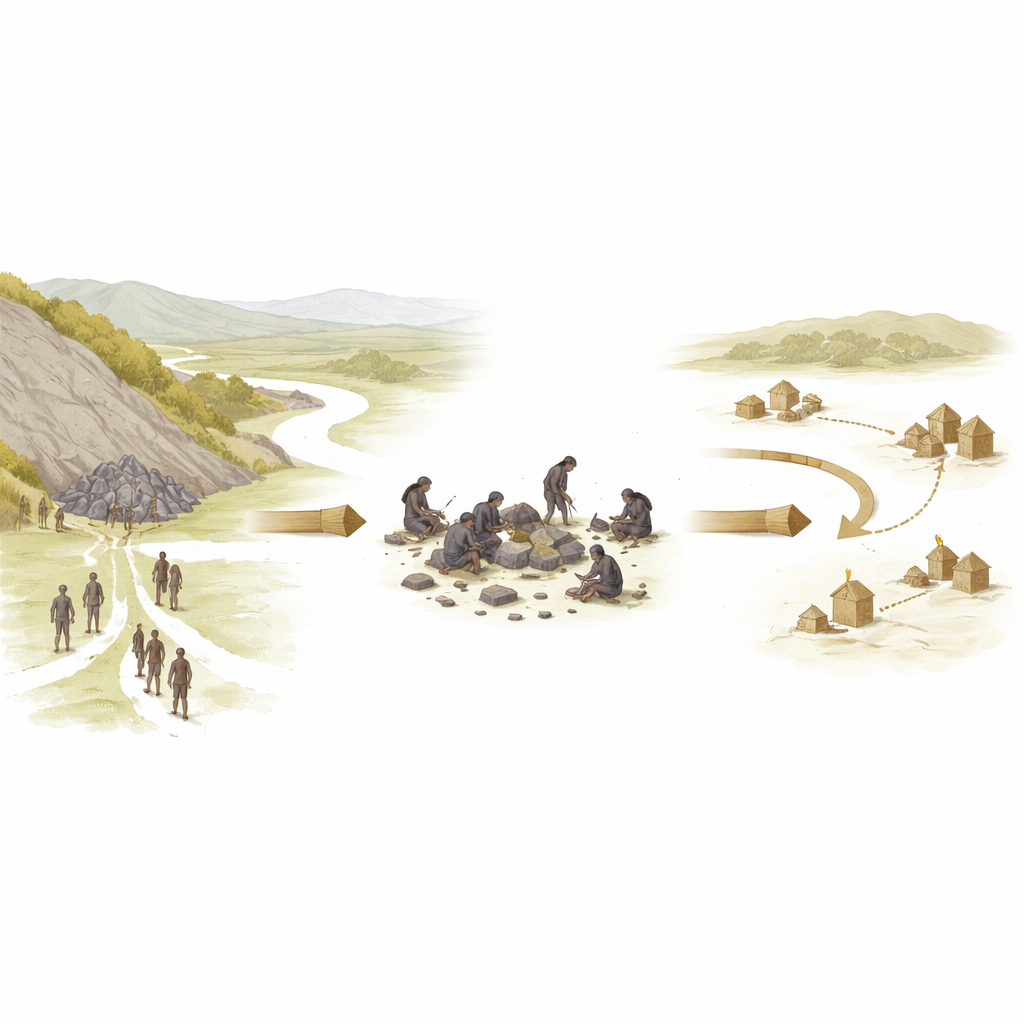
Pinpointing Visits Across Deep Time
To find out when people were using Jojosi, the team used luminescence dating, which measures how long mineral grains have been buried since their last exposure to sunlight. Samples taken just above and below the artefact layers show that visits to the site began around 220,000 years ago and continued at intervals until roughly 110,000 years ago. This places Jojosi among the earliest known Middle Stone Age sites in the region, contemporaneous with some of the oldest Homo sapiens fossils in southern Africa. Over this vast span of time, different groups returned to the same small landscape, using it in broadly the same way.
One Rock Type, One Main Task
Despite the presence of several other usable stones nearby, almost every worked piece at Jojosi is made from hornfels, a fine-grained, dark rock that fractures cleanly and is ideal for toolmaking. The excavated layers are dominated by tiny flakes and chips, along with larger chunks and cores, but contain very few finished blades or shaped tools. Detailed refitting of broken pieces shows long, continuous sequences of reduction: large hornfels blocks were broken down, their outer surfaces removed, and their cores carefully prepared. The most useful flakes and blades, however, are almost entirely missing from the lenses, and use-wear studies detected almost no signs of actual cutting or scraping on the pieces left behind.
Short Visits, Long-Term Planning
Taken together, these clues tell a clear story. People came to Jojosi for brief, repeated visits focused on a single activity: acquiring hornfels and turning it into portable, unshaped blanks that could be carried away and transformed into tools elsewhere. The site functioned as a specialized extraction and workshop area rather than a camp or living space—there is almost no animal bone, nearly no retouching of tools, and no evidence of long stays. The fact that other suitable stones in the same valley were ignored highlights the deliberate, informed choice of hornfels for its superior qualities, and suggests detailed knowledge of the wider resource landscape and the ability to plan for future needs far from the source. 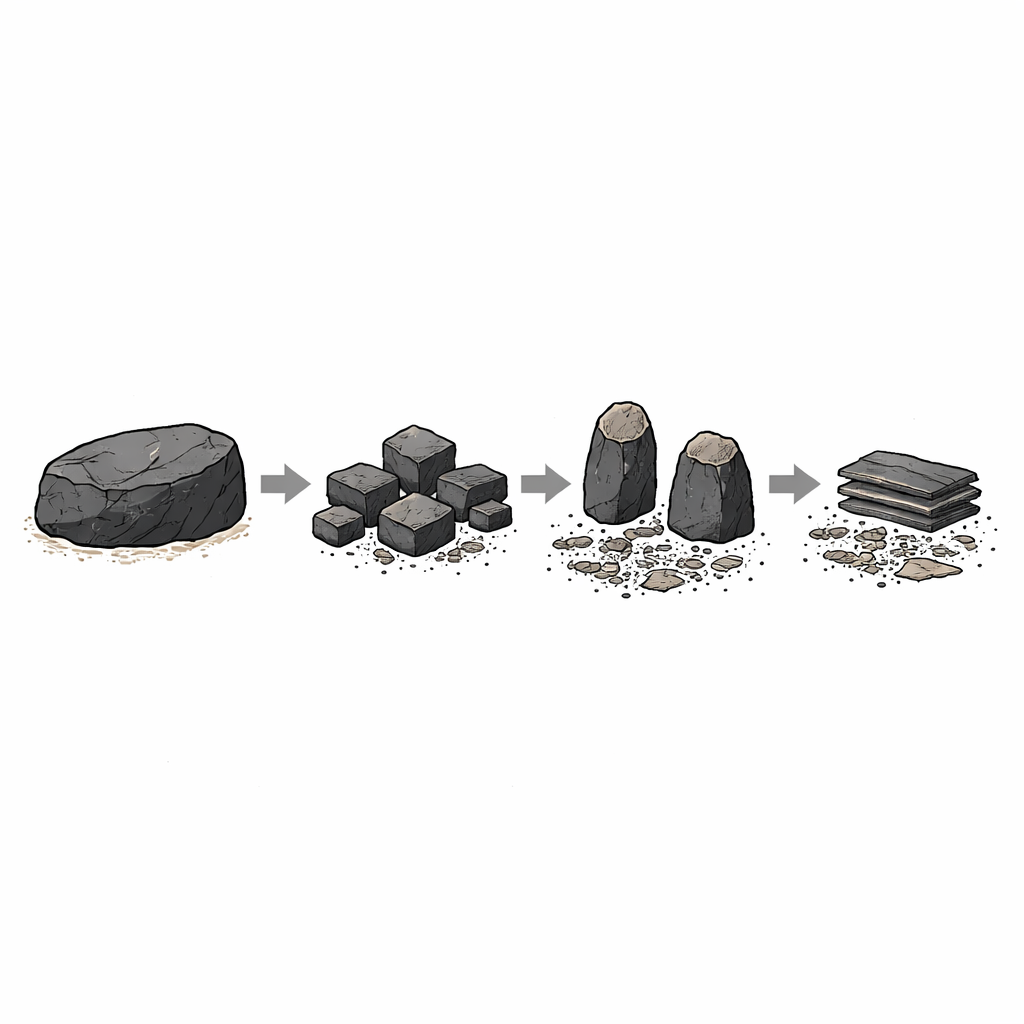
Early Signs of Flexible, Future-Oriented Minds
The Jojosi evidence challenges the long-held idea that Pleistocene hunter-gatherers mostly picked up stone as they happened to encounter it while doing other tasks. Instead, it shows that by at least 220,000 years ago, early Homo sapiens in southern Africa were already organizing dedicated trips to a particular place solely to obtain a favored material. Across tens of thousands of years, these repeated visits reshaped the local landscape into a human-made "stone field" and turned Jojosi into a persistent focal point of technological activity. This kind of specialized, long-term raw material procurement reveals not just skilled craftsmanship, but a capacity for forward planning, environmental awareness, and flexible behavior that is a hallmark of our species.
Citation: Will, M., Sommer, C., Möller, G.H.D. et al. Specialised and persistent raw material procurement by humans in the Middle Pleistocene. Nat Commun 17, 2702 (2026). https://doi.org/10.1038/s41467-026-70783-8
Keywords: Middle Stone Age, Homo sapiens origins, stone tool technology, raw material procurement, South African archaeology