Clear Sky Science · en
AcrIIA7 hijacks tracrRNA to block CRISPR-Cas system
How Viruses Outsmart a Powerful Gene-Editing Tool
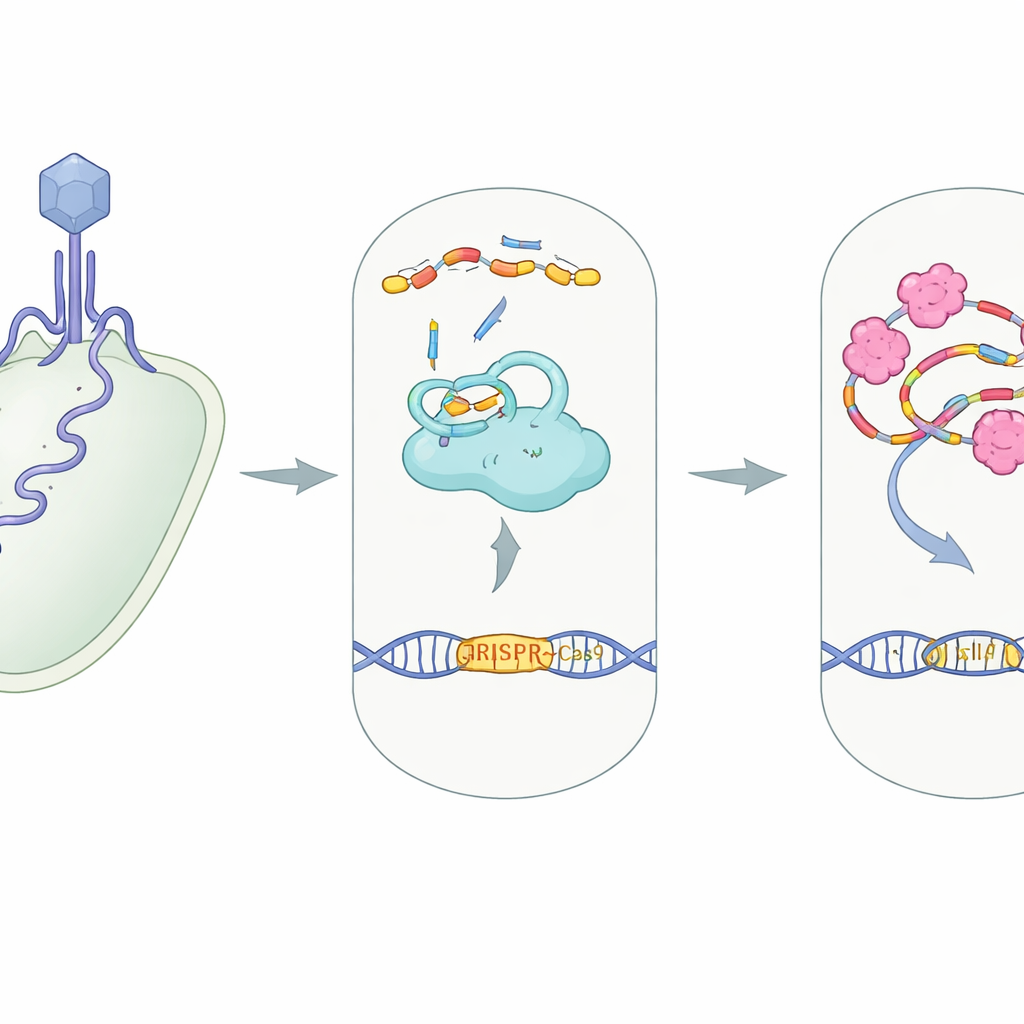
CRISPR–Cas9 is famous as a gene-editing tool, but in nature it serves as a security system that bacteria use to slice up invading viral DNA. This study reveals how a viral counter‑weapon, a small protein called AcrIIA7, shuts down that bacterial defense in an unexpected way. Understanding this viral trick not only deepens our grasp of the microscopic arms race between bacteria and viruses, it also points to new ways to switch CRISPR tools on and off in the lab and clinic.
The Usual Role of CRISPR as Cellular Security
In many bacteria, CRISPR–Cas9 works like a molecular surveillance camera paired with scissors. A large protein, Cas9, teams up with two small RNA strands—crRNA and tracrRNA—that snap together into a guide complex. This complex steers Cas9 to any DNA sequence that matches the guide, often the genetic material of an invading virus, so Cas9 can cut and neutralize it. Building this protein–RNA machine, known as an RNP complex, is an essential step: without the guide RNAs fitting correctly into Cas9, the system cannot recognize or cut the intruder’s DNA.
Viral Saboteurs Aimed at CRISPR
Viruses that infect bacteria, called bacteriophages, have evolved “anti‑CRISPR” proteins that sabotage this defense at almost every stage, from blocking DNA binding to jamming Cas9’s cutting sites. AcrIIA7 belongs to a family known to target Cas9, but exactly how it worked was not clear. The authors focused on AcrIIA7 from a gut bacterium, Phocaeicola dorei, determining its three‑dimensional structure and testing how it behaved in solution. They discovered that four AcrIIA7 molecules join into a compact tetramer made of three domains, including a flexible “head” region. The surface of this tetramer features a deep, positively charged groove—an inviting pocket for negatively charged nucleic acids such as RNA.
A Protein That Grabs RNA Instead of Cas9
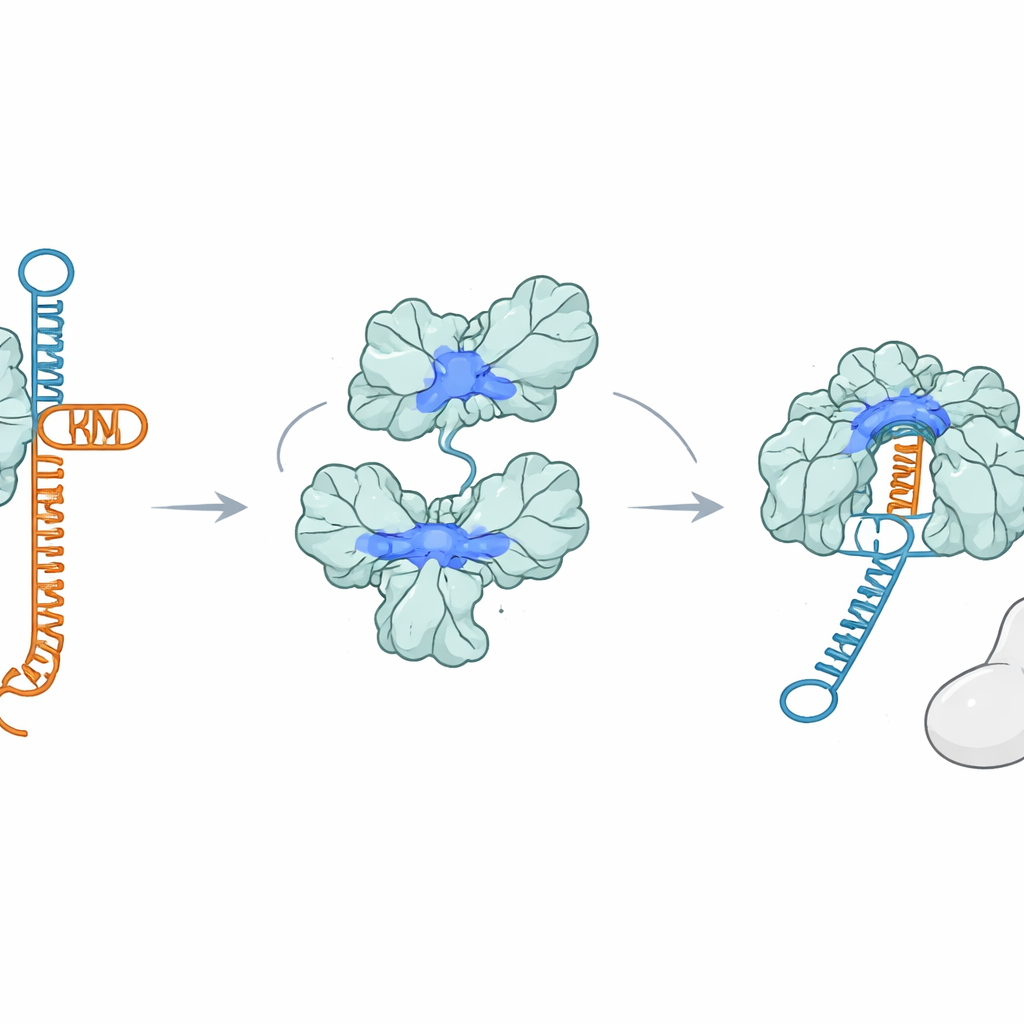
Surprisingly, AcrIIA7 does not latch onto Cas9 at all. Using several binding tests, the researchers saw no stable interaction between AcrIIA7 and Cas9, nor with any of Cas9’s individual parts. Instead, they found that AcrIIA7 binds RNA directly and selectively. It ignored single‑ and double‑stranded DNA, but attached strongly to tracrRNA, one of the two RNAs that normally pair to form the guide. AcrIIA7 recognized not the exact RNA letters but a specific folded shape made of two adjacent hairpin loops. If those loops were removed or the overall stem‑loop architecture was changed, binding weakened or vanished. This showed that AcrIIA7 reads the RNA’s structure more than its sequence.
Hijacking the Guide Before It Forms
By clamping onto tracrRNA, AcrIIA7 prevents tracrRNA from pairing with crRNA to assemble the guide needed by Cas9. Experiments in test tubes showed that when AcrIIA7 meets tracrRNA before Cas9 does, the downstream steps stall: the full guide RNA forms poorly, and Cas9 cannot efficiently cut target DNA. Once a complete Cas9–RNA complex is assembled, however, AcrIIA7 can no longer dislodge it, underscoring that its main action occurs early, at guide formation. Mutating positively charged amino acids lining the tetramer’s groove crippled both RNA binding and Cas9 inhibition, supporting the idea that tracrRNA nestles into this groove when hijacked by AcrIIA7.
Two Versions of the Same Saboteur
The team also compared full‑length AcrIIA7, which includes the flexible head domain, with a shorter, naturally occurring version that lacks this region. Both forms assemble as tetramers and can bind tracrRNA and even small cyclic signaling molecules used in other immune pathways. But only the head‑less variant strongly blocks Cas9 when a fully formed guide RNA is present, suggesting that the head region partly obstructs access to longer RNA structures. As a result, the full‑length protein mainly interferes with the earliest step—sequestering free tracrRNA—while the shorter form can also bind and block the mature guide complex more effectively.
What This Means for Biology and Gene Editing
To a non‑specialist, the key message is that this viral protein disables CRISPR not by attacking the famous Cas9 “scissor” directly, but by stealing its RNA scaffold before the cutting machine is built. This reveals a new weak point in CRISPR defenses: the RNA–RNA and RNA–protein contacts required to assemble a working complex. In nature, such a strategy helps viruses slip past bacterial immunity. In the lab, molecules inspired by AcrIIA7 could offer precise, reversible ways to shut down CRISPR tools by targeting their RNA guides, improving the safety and control of future genome‑editing therapies.
Citation: Lee, S.Y., Park, H.H. AcrIIA7 hijacks tracrRNA to block CRISPR-Cas system. Nat Commun 17, 3959 (2026). https://doi.org/10.1038/s41467-026-70749-w
Keywords: CRISPR-Cas9, anti-CRISPR proteins, tracrRNA, bacteriophage, gene editing control