Clear Sky Science · en
Assessing the effectiveness of riparian buffers in protecting biodiversity: a meta-analysis
Why tree-lined streams matter to everyday life
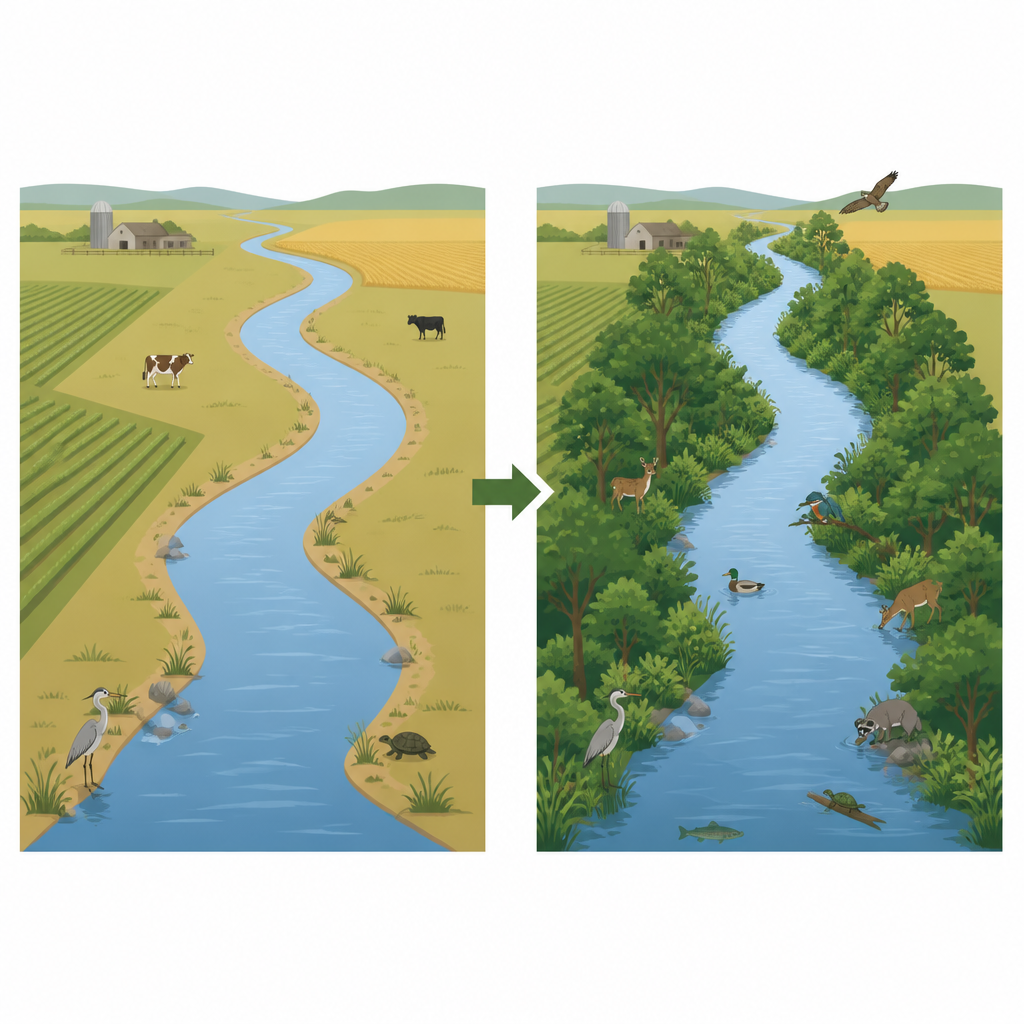
Across much of the world, fields, pastures, and towns now press right up against rivers and streams. Yet narrow ribbons of trees and shrubs still cling to many banks. These strips, known as riparian buffers, are usually protected to keep water clean and soil in place. This study asks a broader question that matters for anyone who cares about nature: how well do these green ribbons also protect the many animals that depend on riverside habitats?
Green ribbons in a human-shaped world
The authors pulled together data from 63 studies in 22 countries, spanning tropical, temperate, and boreal forests. They compared rivers and streams that still had forest along their banks, called forested riparian buffers, with nearby stretches where the riversides had been cleared or converted to crops, pasture, logging areas, plantations, or urban land. By using this global “study of studies,” known as a meta-analysis, they could see whether a consistent pattern emerged across very different landscapes and animal groups.
More species where the banks stay wild
Across forested regions worldwide, streams with forested banks supported more kinds of animals than streams with bare or heavily altered banks. This was true close up, at the scale of individual sites, and across whole landscapes made up of many sites. On average, local species richness was nearly half a standard deviation higher in forested buffers, and total species counts across landscapes were about one fifth higher. Forested banks were especially important for species that also occur in intact, continuous forests, which the authors treated as a reference set. Streams with forested buffers held about 32 percent more of these reference species than converted riversides did.
Different places, different creatures, same message
The benefits of tree-lined banks showed up in both tropical and temperate regions and for most major animal groups, including insects, amphibians, birds, and mammals, in and around the water. Fish were an exception: their total number of species did not clearly differ between forested and cleared banks, perhaps because fish also depend strongly on conditions across the wider watershed or because sensitive fish species are replaced by more tolerant ones. Even when overall diversity measures looked similar, the mix of species often differed. On average, more than half of the species present in forested and cleared banks did not overlap, meaning that clearing banks tends to swap out one community of animals for another.
How wide a strip of trees is enough
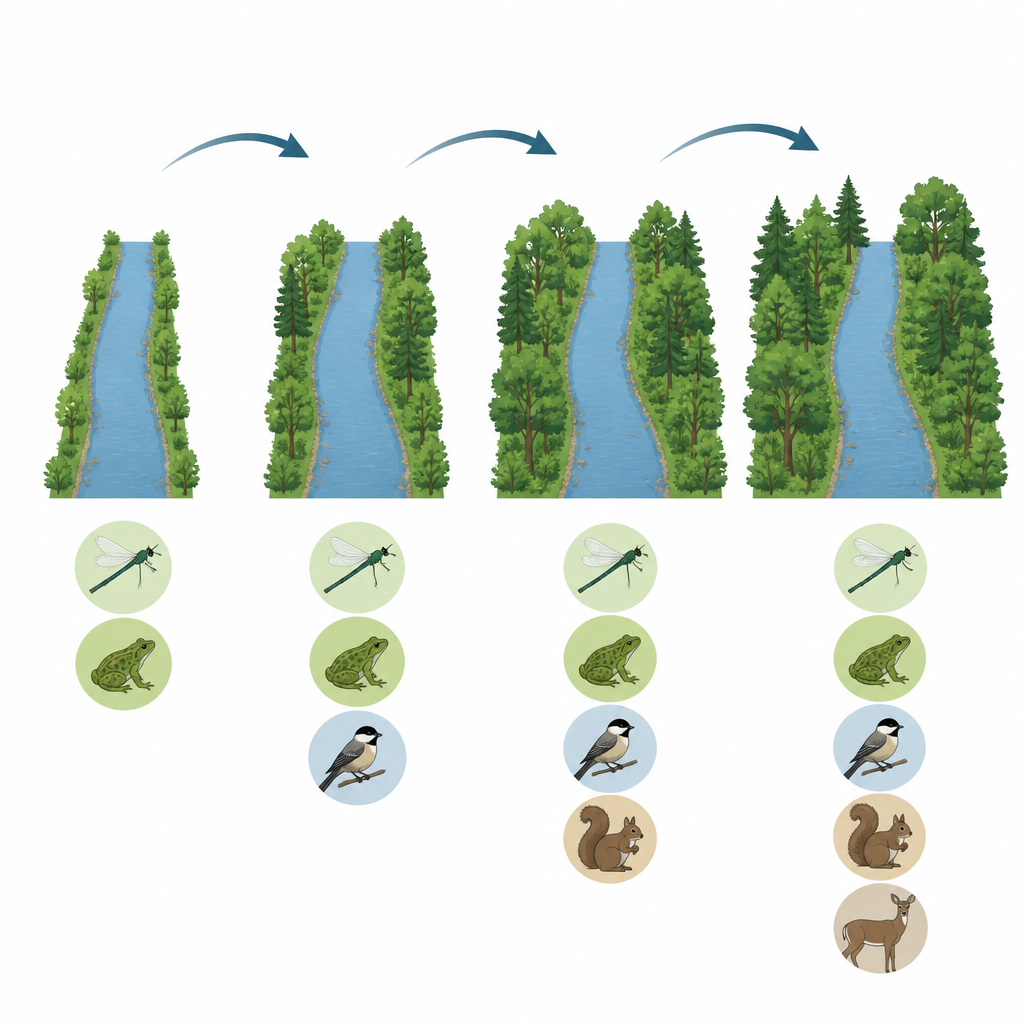
Policy makers often ask how wide riparian buffers should be. Using a subset of studies that reported buffer width, the authors modeled how quickly new species are added as forest strips get wider. They found that the widths needed to capture most of the species typical of intact forest vary by animal group. Birds and mammals generally required wide buffers, on the order of 200 to 380 meters on each side of the river, to approach their maximum diversity. Amphibians needed around 20 to 50 meters, and invertebrates such as insects and other small creatures needed as little as 6 to 50 meters. Narrow buffers still helped, but wider strips consistently supported more forest-dependent and river-specialist species.
What this means for rivers and people
For forest regions where farming, logging, and development are already widespread, the study delivers a clear message in plain terms: keeping or restoring forest along rivers is an effective way to protect a wide range of animals while still using the surrounding land. Riparian buffers do not replace large protected forests, but they are often the only remaining natural habitat in heavily altered landscapes and can act as refuges and corridors for wildlife. Wider buffers give more protection, especially for birds and mammals, yet even modest strips provide meaningful benefits where space is limited. Because these same buffers also improve water quality and reduce erosion, they offer a practical tool for governments and landowners seeking solutions that support both nature and human needs.
Citation: Dala-Corte, R.B., Giam, X. & Wilcove, D.S. Assessing the effectiveness of riparian buffers in protecting biodiversity: a meta-analysis. Nat Commun 17, 4155 (2026). https://doi.org/10.1038/s41467-026-70191-y
Keywords: riparian buffers, river biodiversity, forested streams, land use, wildlife conservation