Clear Sky Science · en
Sulfur vacancy-confined Co-Mo sites in MoS2 for high-efficiency CO2 hydrogenation to formate
Turning a Problem Gas into a Useful Ingredient
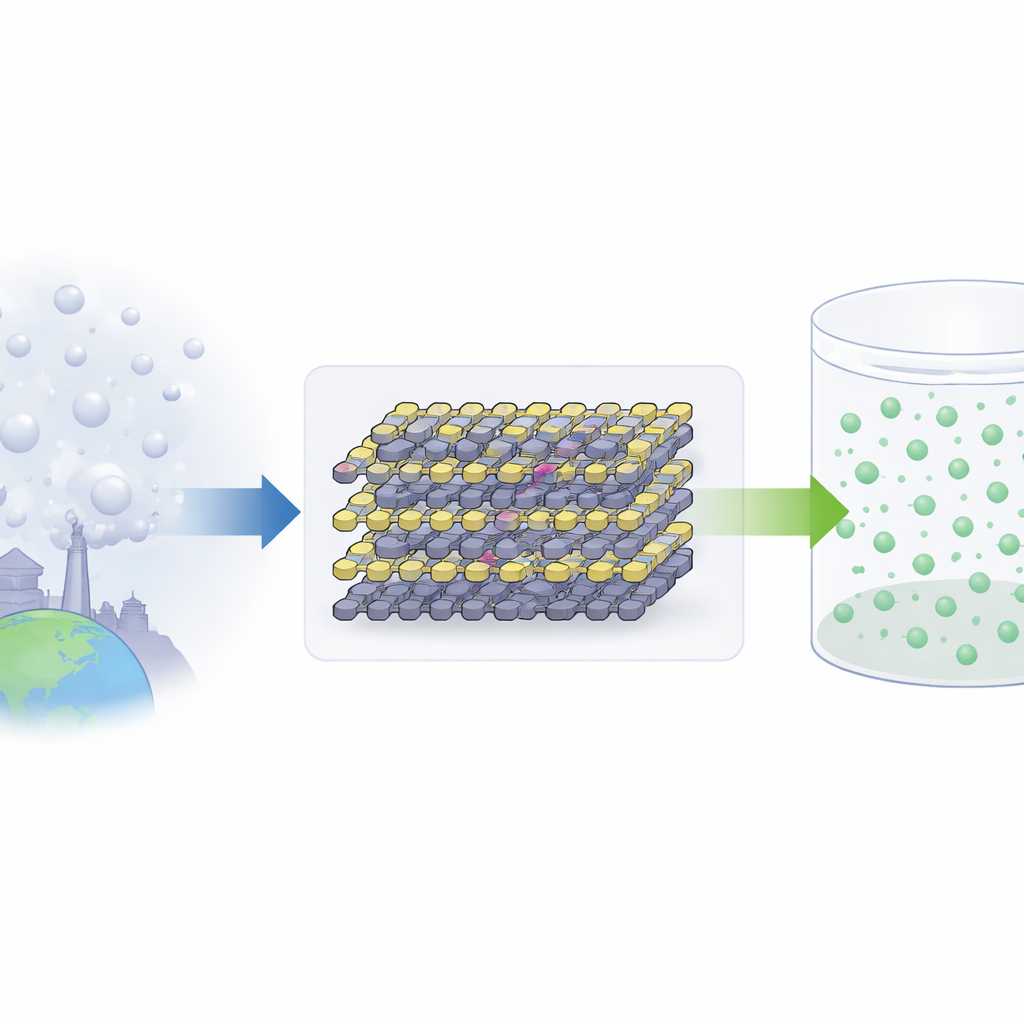
Carbon dioxide (CO2) is a major greenhouse gas, but it is also a carbon-rich raw material. If we can turn CO2 into useful products efficiently and cheaply, we can both cut emissions and create new value. This study introduces a low-cost catalyst based on molybdenum disulfide (MoS2) that, when subtly modified with cobalt atoms, converts CO2 and hydrogen into formate—a simple carbon-based chemical used in textiles, leather processing, and as a potential hydrogen carrier for clean energy. The work shows how tiny, atomic-level tweaks in a material’s structure can dramatically boost performance and stability under realistic conditions.
Why Formate and Why Low-Cost Catalysts Matter
Formate (a close relative of formic acid) is an important industrial building block and a promising liquid for storing hydrogen. Today, making formate from CO2 usually requires catalysts that contain precious metals such as palladium, gold, iridium, or ruthenium. These metals are scarce and expensive, which limits large-scale deployment. Earth-abundant alternatives based on more common metals have been explored, but they often lack the activity or selectivity needed for practical use. MoS2, a layered material already known from electronics and lubrication, recently emerged as a promising candidate because specific “defect” sites in its structure—spots where sulfur atoms are missing—can speed up CO2 hydrogenation. However, creating enough of these highly active sites and keeping them from being deactivated by oxygen in air has been a major challenge.
Building Better Active Sites with Cobalt Atoms
The authors tackled this challenge by inserting individual cobalt atoms into the MoS2 lattice, replacing some molybdenum atoms to form what they call Co–MoS2. Using electron microscopy and a suite of X-ray techniques, they showed that the cobalt is not clustered into particles but is instead dispersed as single atoms locked into the MoS2 layers. These embedded cobalt atoms subtly change the local bonding in the lattice. In particular, they weaken the bonds between nearby metal atoms and surrounding sulfur or oxygen. Under hydrogen-rich reaction conditions, this weaker bonding makes it easier to remove sulfur or oxygen atoms from the surface, thereby creating or regenerating the sulfur vacancies that serve as the true catalytic “hot spots.” As a result, Co–MoS2 exposes far more active sites than pristine MoS2, both along the edges of the layers and across their broad flat surfaces.
From Structural Tweaks to Better Performance
When tested in a pressurized reactor with CO2 and hydrogen dissolved in a bicarbonate solution, the cobalt-modified catalyst produced formate at a rate of 17.0 millimoles per gram of catalyst per hour, with over 99% selectivity toward formate at 200 °C. This rate is nearly three times higher than that of unmodified MoS2 and exceeds the performance of other non-precious-metal catalysts reported for the same reaction. Importantly, the catalyst maintained its activity over at least eight reaction cycles spanning 80 hours, and its nanosheet structure and crystal phase remained intact. Measurements of how much nitric oxide could bind to the sulfur vacancies revealed that Co–MoS2 hosts roughly three to four times more of these key sites than pristine MoS2 after in-situ treatment in hydrogen, directly linking the structural modification to the jump in activity.
How the Atomic-Level Mechanism Works
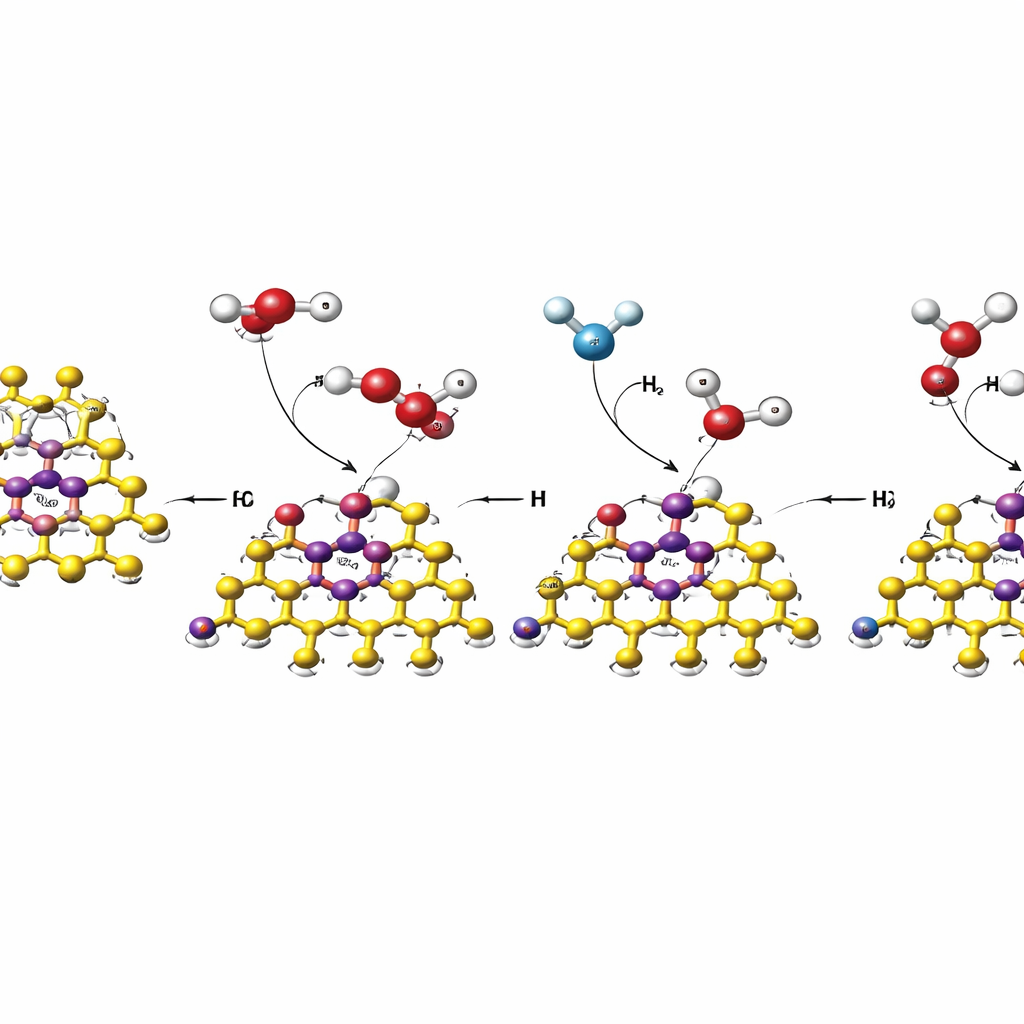
To understand the chemistry in more detail, the team used computer simulations based on density functional theory. These calculations showed that both edge and in-plane sulfur-vacancy sites tend to grab oxygen strongly, which explains why exposure to air quickly blocks them. However, when cobalt replaces molybdenum near a vacancy, the interaction between the metal atoms and the bound oxygen becomes weaker, lowering the energy barrier for hydrogen to remove that oxygen and reopen the site. The simulations also traced the likely reaction pathway for CO2: at the cobalt–molybdenum vacancy sites, CO2 binds with moderate strength and prefers to be hydrogenated through a so-called carboxyl (COOH) intermediate rather than breaking its carbon–oxygen bond completely. This pathway favors the selective formation of formate instead of other products such as carbon monoxide or methane, and it works similarly at both edge and basal-plane sites.
What This Means for CO2 Conversion Technologies
In simple terms, this study shows that “smart defects” can turn a common material into a high-performance catalyst for turning waste CO2 into a valuable chemical. By carefully placing cobalt atoms inside the MoS2 lattice, the researchers created many more active sites that can survive contact with air and be reactivated during operation. The result is a robust, non-precious catalyst that efficiently channels CO2 and hydrogen into formate with high selectivity. Beyond this specific system, the work offers a general blueprint: by confining different foreign atoms into host materials to control how easily key atoms are added or removed, scientists can design more durable and oxygen-tolerant catalysts for a wide range of clean-energy and green-chemistry applications.
Citation: Wang, Z., Kang, Y., Chen, G. et al. Sulfur vacancy-confined Co-Mo sites in MoS2 for high-efficiency CO2 hydrogenation to formate. Nat Commun 17, 3121 (2026). https://doi.org/10.1038/s41467-026-69780-8
Keywords: CO2 hydrogenation, formate production, molybdenum disulfide catalyst, single-atom catalysis, greenhouse gas utilization