Clear Sky Science · en
Record-breaking Greenland ice sheet melt events under recent and future climate
Why this matters for all of us
The vast ice sheet covering Greenland holds enough frozen water to raise global sea levels by more than seven meters if it were to melt completely. This study shows that short, intense melt seasons on Greenland’s surface are not only becoming more common, but also far more powerful than anything observed in the 20th century or even in many centuries of past climate. Because these bursts of melting help drive sea-level rise and can disrupt ocean currents that shape weather around the world, their recent and projected changes have consequences far beyond the Arctic.
Recent summers on thin ice
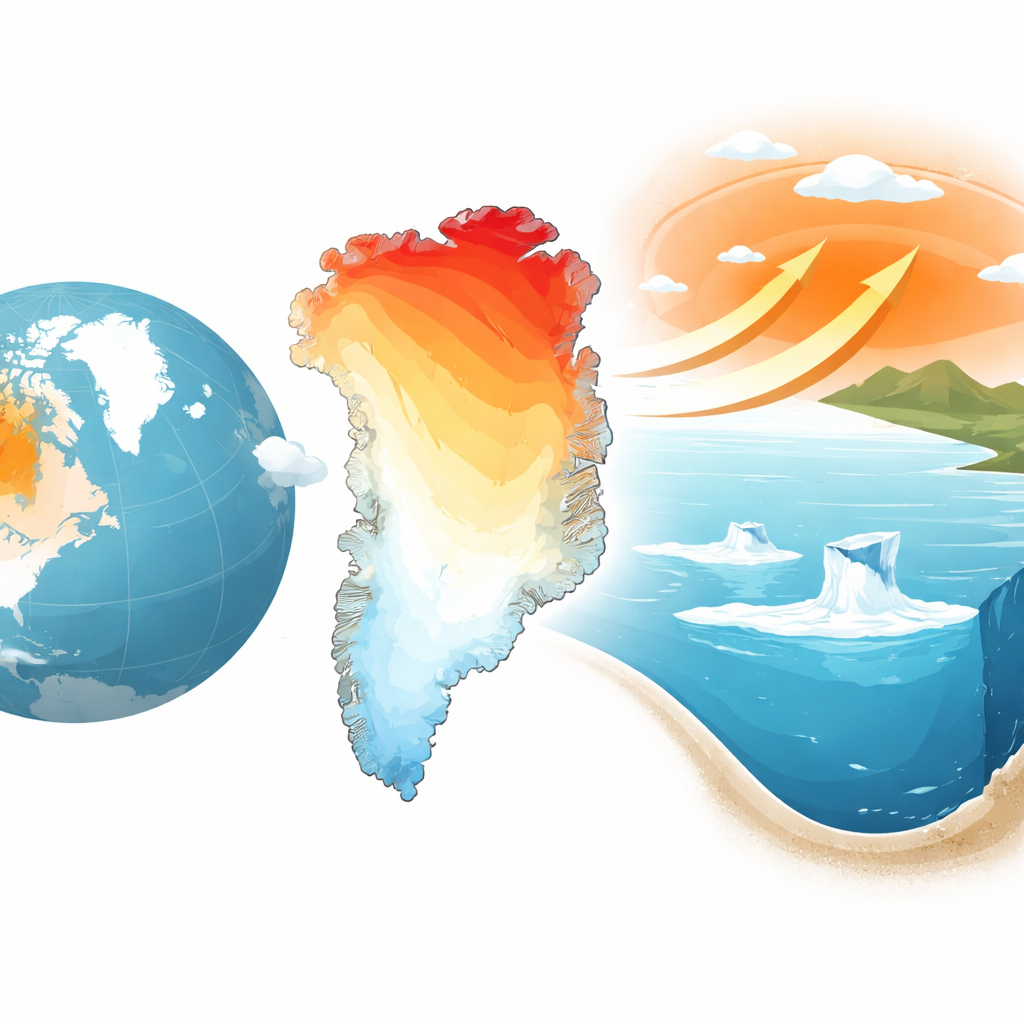
Using a high‑resolution climate model checked against satellite and field measurements, the authors reconstructed Greenland’s summer surface melting from 1950 to 2023. They focused on “extreme” melt seasons—those rare days when meltwater production shoots far above typical summer values. Their analysis shows that these intense episodes have become markedly more frequent, stronger, and more widespread since the 1990s. Compared with 1950–1975, summers since 2000 feature up to eight extra days per year of extreme surface melting, and the total area affected has expanded dramatically onto higher, once‑stable parts of the ice sheet. Seven of the ten most severe events in terms of daily melt, duration, and total water volume have all occurred since the turn of the century.
Unpacking the storm above the ice
Greenland’s extreme melt seasons arise from a combination of the large‑scale weather patterns above the island and the background warmth of the atmosphere and surface. To disentangle these ingredients, the team grouped daily weather over Greenland into circulation “types,” such as high‑pressure and blocking situations known to favor melting. They then used a flow‑analog technique: for each recent extreme event, they searched the historical record for past days with similar air‑pressure patterns but occurring in a cooler climate. Comparing meltwater amounts between the past analogs and today’s events allowed them to separate the role of weather patterns from the extra heat added by long‑term warming. This approach revealed that the most powerful events—like those in 2012, 2019, and 2021—have no true dynamical counterparts in the earlier decades, underlining how unusual recent atmospheric setups have become.
Heat added on top of familiar patterns
Even when the same type of high‑pressure system appears, the modern climate now generates much more melt than it once did. For days with matching circulation patterns from 1950–1975, meltwater production during recent extreme events has risen on average by about one quarter purely because the air, ice, and surrounding environment are warmer. When the full set of top ten events is considered—including those without past analogs—the intensification reaches roughly two‑thirds. This extra melt is strongest in northern and north‑eastern Greenland, regions that historically saw little surface melting. Several reinforcing processes are at work: darker, impurity‑laden and snow‑free surfaces absorb more sunlight; warm, moist air and clouds trap heat near the surface; and repeated extreme seasons build thick, dense ice layers that change how meltwater drains and refreezes within the snowpack.
A glimpse of the century ahead
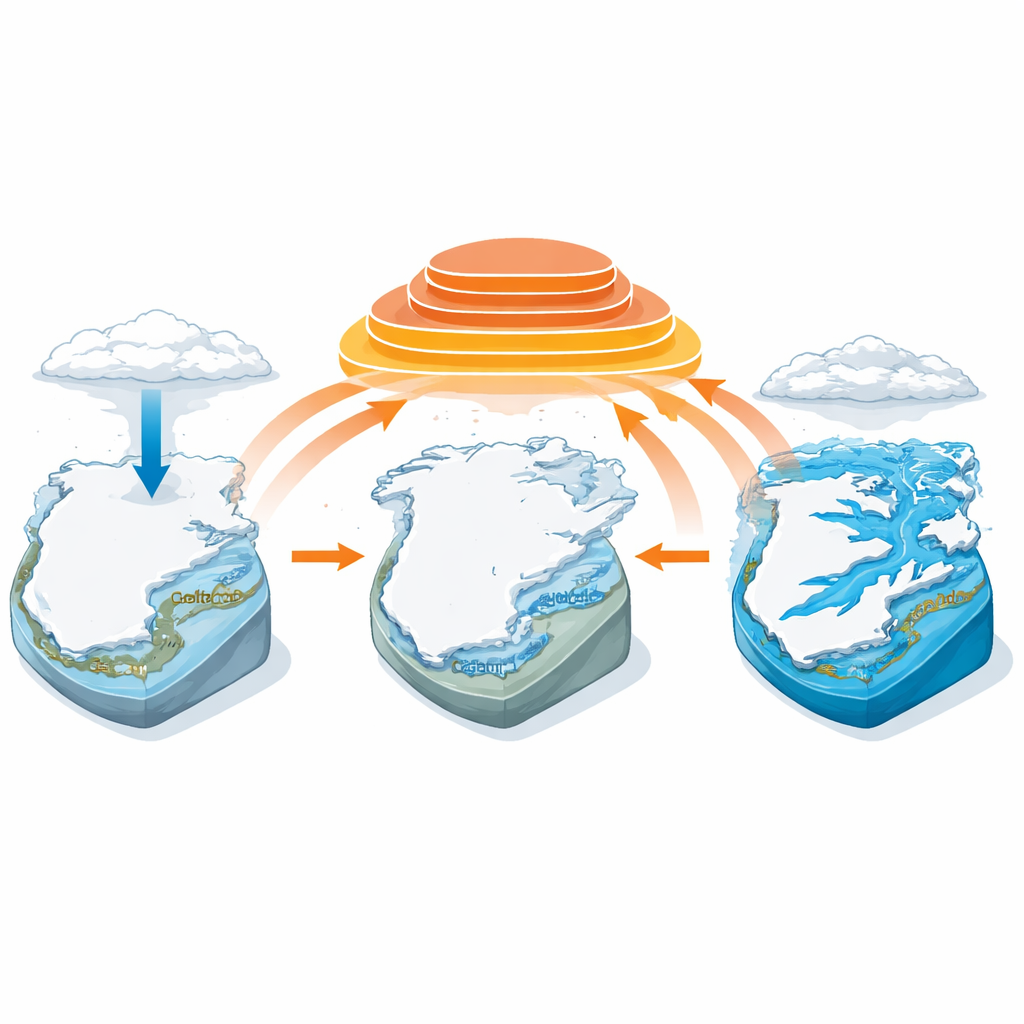
Looking to the future, the researchers combined their regional model with projections from two generations of global climate models under a high‑emissions pathway. They tracked how often melt in July and August exceeds today’s already high thresholds for extremes. The simulations show that, by the late 21st century, the most intense summer melt levels could increase by roughly two to nearly four times, with individual models spanning an even wider range. Northern Greenland stands out as a hotspot, with some areas projected to see many times more extreme melt than in the late 20th century. Although not all of this water will immediately flow to the ocean—some refreezes deeper in the snow—the trend points toward a regime where very strong melt seasons become a recurrent feature rather than rare outliers.
What this means for our future seas
To a non‑specialist, the central message is straightforward: the kinds of exceptional melt seasons that once marked rare climate oddities in Greenland are now happening more often, are more intense, and are expected to grow far stronger this century if greenhouse‑gas emissions remain high. These events already account for a large share of Greenland’s surface mass loss and feed extra freshwater into the North Atlantic, with knock‑on effects for sea‑level rise and ocean circulation that shapes weather patterns in Europe and beyond. By teasing apart the role of shifting weather patterns from the steadily warming background climate, this study underscores that human‑driven warming has made Greenland’s ice sheet far more sensitive to certain atmospheric setups—and that, without significant emissions cuts, record‑breaking melt seasons are likely to become the new normal.
Citation: Bonsoms, J., González-Herrero, S., Fettweis, X. et al. Record-breaking Greenland ice sheet melt events under recent and future climate. Nat Commun 17, 3605 (2026). https://doi.org/10.1038/s41467-026-69543-5
Keywords: Greenland ice sheet, extreme melting, sea-level rise, climate change, Arctic warming