Clear Sky Science · en
Distributional effects of marine conservation on coastal livelihoods in Eastern Indonesia
Why this story about oceans and livelihoods matters
Across the world, new marine parks are being declared to protect fish, coral reefs, and coastal ecosystems. But for families who depend on the sea for food and income, a natural question arises: do these protected areas threaten their livelihoods or help them in the long run? This study follows more than 10,000 households in Eastern Indonesia over several years to see who gains, who loses, and how to make conservation fair for everyone.
Marine parks and coastal communities
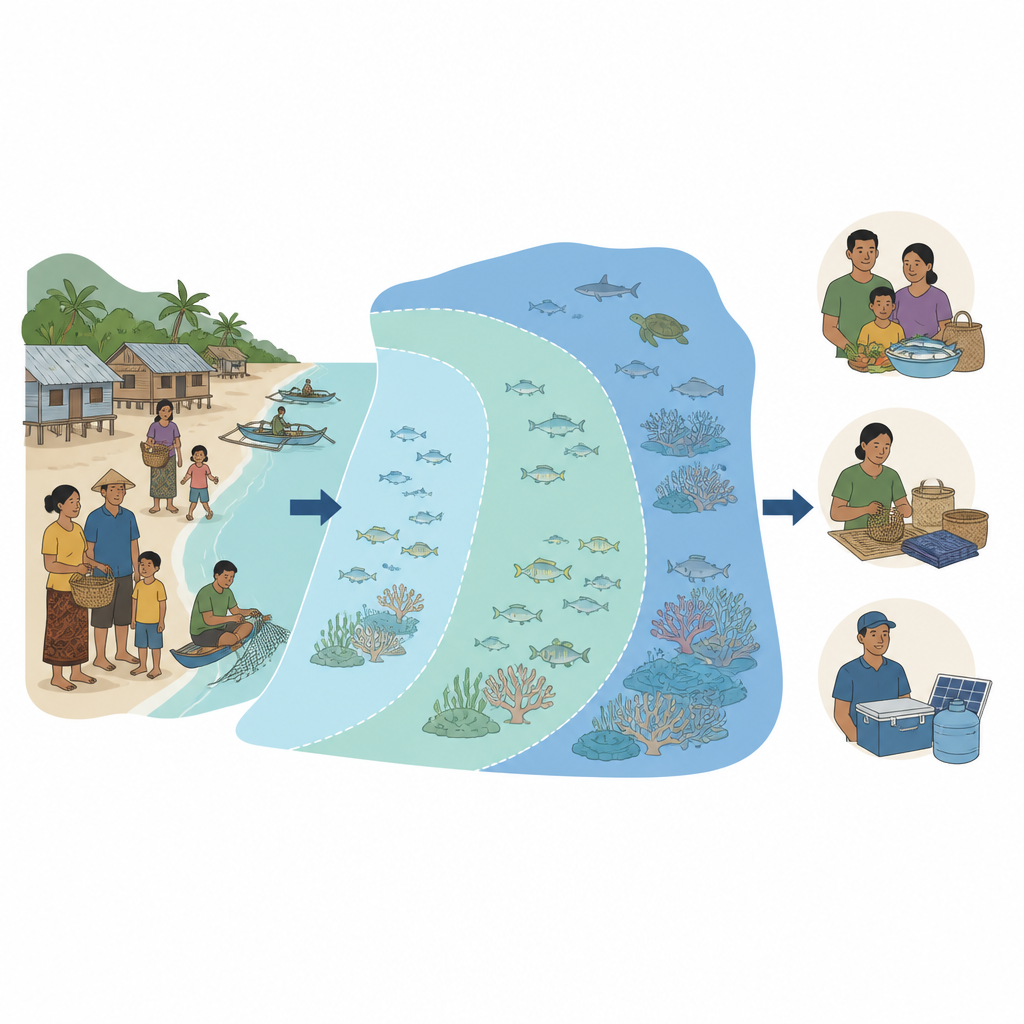
In Eastern Indonesia, the government and partners have created a network of marine protected areas that span tens of thousands of square kilometers. These zones limit certain types of fishing and other activities in order to safeguard the world’s richest coral reefs and reef fish. The same region is home to many poor, sea-dependent villages, where people fish, farm, and gather resources to survive. The research team wanted to know how these protections affected everyday life in these communities, not just on average, but for different groups such as women, older residents, fishers, and people with traditional rights to the sea.
Tracking change in wealth and outlook
To study these questions, researchers used an approach similar to a medical trial. They compared 124 settlements inside marine protected areas with 56 similar settlements outside them, surveyed between 2010 and 2017. Instead of relying on income, which is hard to measure in informal economies, they built an index of household poverty based on basic assets such as boats, bikes, phones, and cooking fuel. They also asked people whether their household’s economic situation had improved, stayed the same, or worsened over the previous year. This allowed the team to examine both material well-being and how people felt about their economic prospects.
Who is left behind
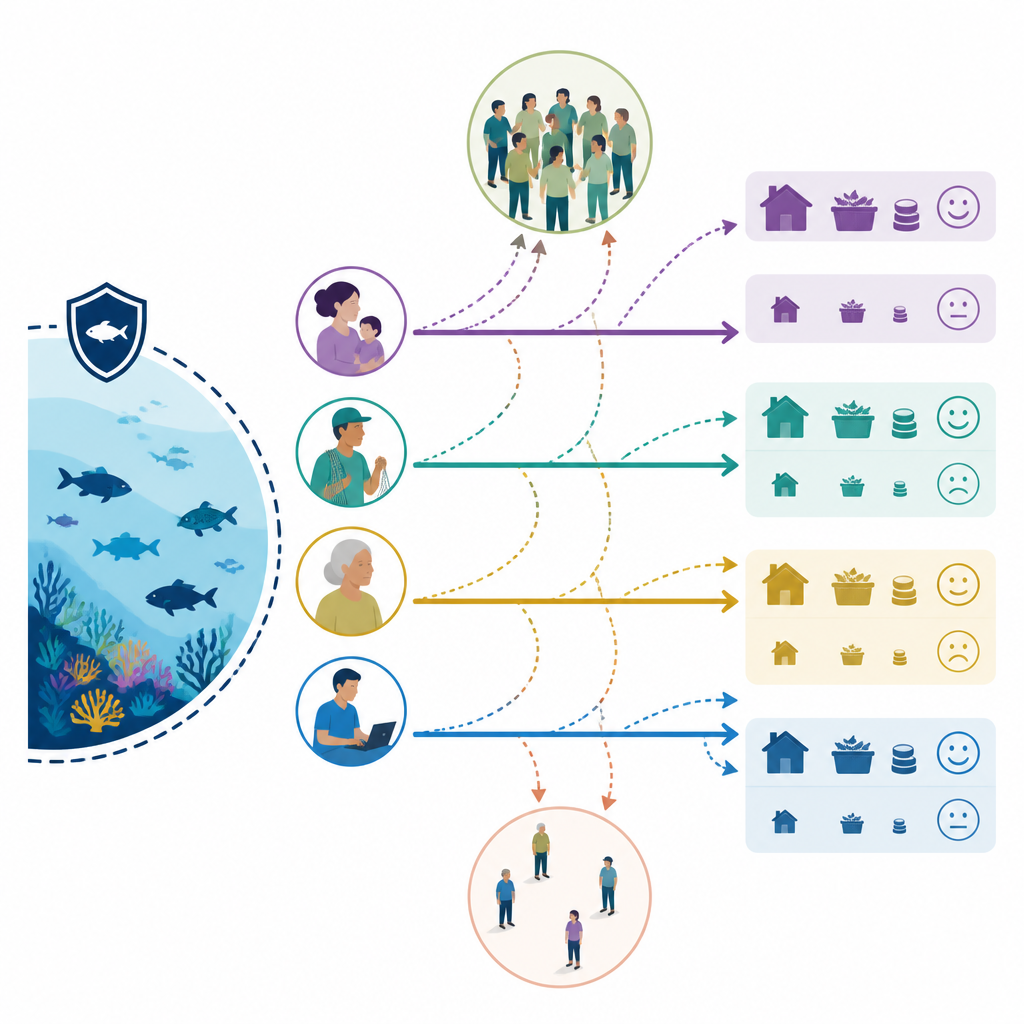
The surveys show that, overall, poverty in the region declined during the study period. Households tended to own more assets, and more people felt that their economic situation was stable or improving. Longstanding gaps, however, were clear. Female-headed households, retired household heads, and those without premium customary rights to local marine resources started out poorer and were less likely to report improvement than their better-off neighbors. When the team looked at the specific impact of marine protected areas, they found little evidence that these zones hurt or helped families in terms of tangible assets. In other words, the protected areas did not deepen or close the material poverty gap between social groups.
Feelings about progress and the role of community
While household assets did not change much because of protection, feelings about economic progress told a different story. Female-headed households and, to a lesser extent, non-fishing households living inside marine protected areas were less likely to feel that their situation was improving than similar households in unprotected villages. This suggests that even if their tangible wealth did not fall, these groups sensed that rules and changes linked to marine protection limited their opportunities. The study also found that community participation made a big difference. In villages where women and other disadvantaged groups were more active in local groups and meetings, the negative effect on perceived economic progress was much weaker than in places where participation was low.
What this means for fair ocean protection
For coastal Indonesia, the study offers some reassurance and a clear warning. On the one hand, creating marine protected areas did not lead to widespread economic losses or greater material inequality among the households studied. On the other hand, certain groups, especially women heading households, felt that their chances to get ahead were constrained when they lived inside protected zones. The research suggests that conservation planners should pay close attention to who has a voice in decisions and who benefits from support programs. By ensuring that women and other vulnerable groups can participate fully in community organizations and planning, marine protection can be steered toward outcomes that are not only good for coral reefs and fish, but also fairer for the people who rely on them.
Citation: Le, D.T., Ahmadia, G.N., Ratih, I.A. et al. Distributional effects of marine conservation on coastal livelihoods in Eastern Indonesia. Nat Commun 17, 4690 (2026). https://doi.org/10.1038/s41467-026-69081-0
Keywords: marine protected areas, coastal livelihoods, poverty and conservation, Eastern Indonesia, community participation