Clear Sky Science · en
Long term administration of selective NMDA GluN2B receptor blocker Ro25-6981 attenuates neurodegeneration in mouse model of spinocerebellar ataxia type 1 (SCA1)
Why this brain disease study matters
Spinocerebellar ataxia type 1 is a rare inherited brain disorder that slowly robs people of balance, coordination, and eventually the ability to swallow and breathe safely. There is currently no cure, and existing drug ideas risk making movement problems worse. This study in mice explores a more targeted way to protect vulnerable brain cells, aiming to calm harmful chemical overactivity without dulling normal brain function.
A closer look at a fragile brain circuit
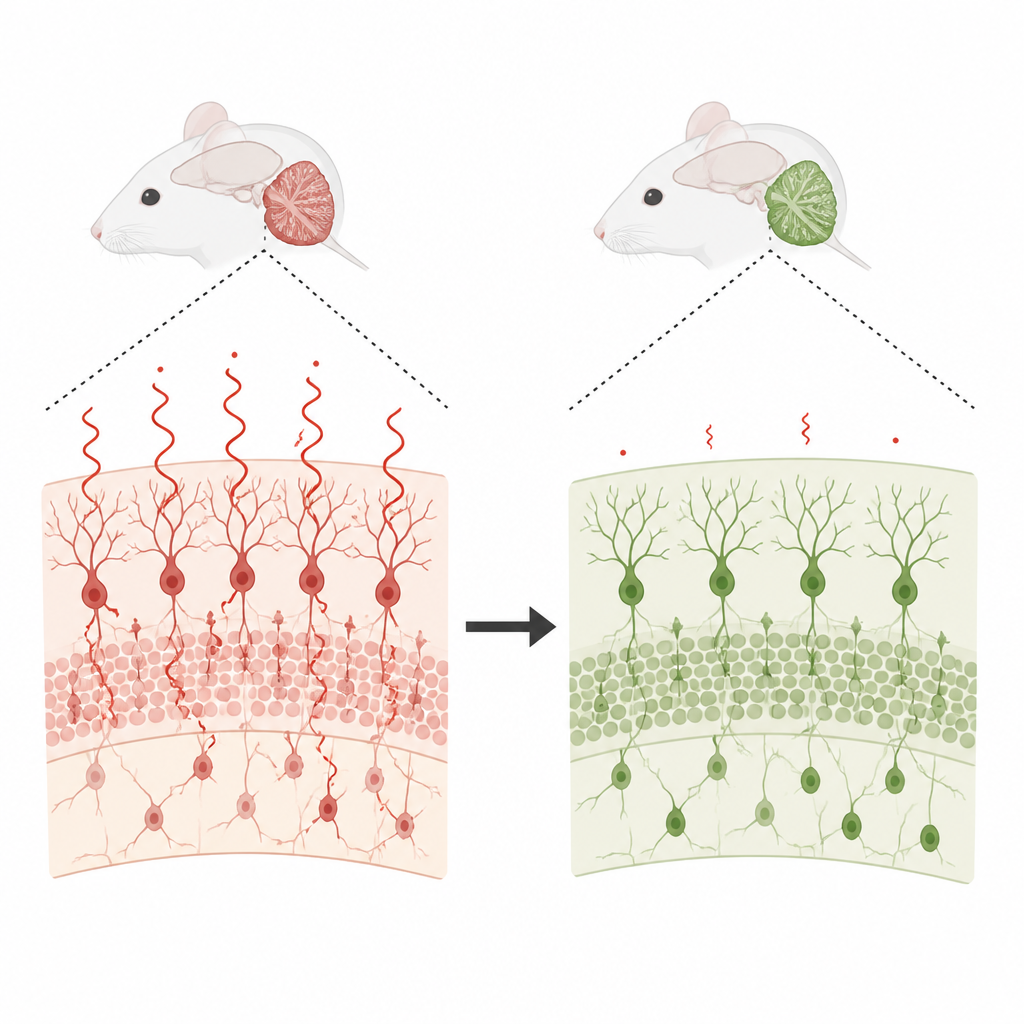
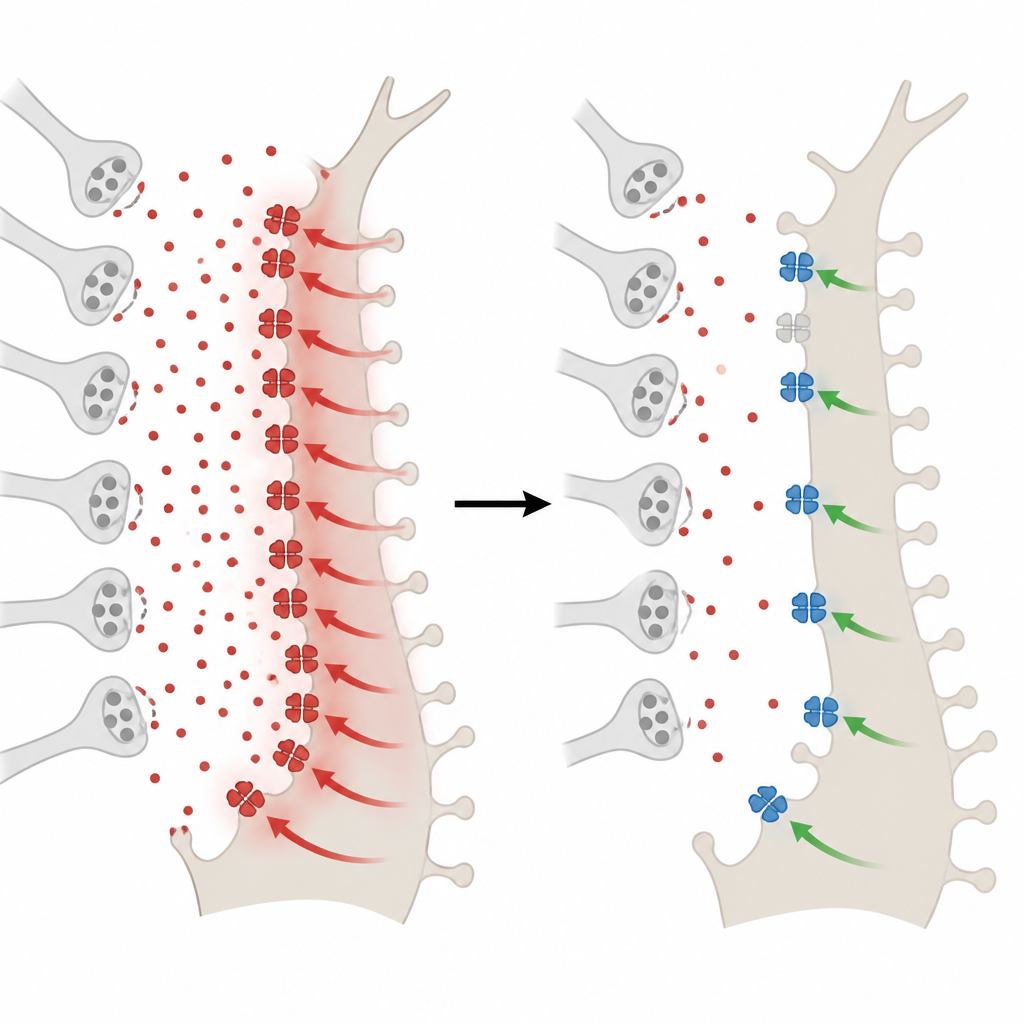
In this disease, a faulty version of a protein called ataxin-1 builds up in specific brain cells and disrupts the cerebellum, the region that fine-tunes movement. The researchers used a virus to make only supportive cells in the cerebellum, known as astrocytes or Bergmann glia, produce the mutant protein. When these helper cells become sick, they stop clearing away excess glutamate, a chemical messenger used for communication between nerve cells. Glutamate then spills out of the normal contact points between cells and overstimulates receptors on nearby neurons, leading over time to cell stress and death.
A more selective way to calm harmful signals
Earlier work suggested that blocking glutamate receptors can slow damage, but a common blocker called memantine also interfered with normal signaling and actually worsened movement in mice. In this new work the team tested Ro25-6981, a drug that mainly targets one subtype of glutamate receptor found outside the usual contact zones between cells. Young mice received the viral treatment to trigger an ataxia-like condition, and starting in mid-disease some of them were given daily injections of Ro25-6981 for four weeks. The animals then completed standard tests of balance, movement, and anxiety-like behavior, while brain slices and tissue samples were examined for changes in cells and communication.
Protection of movement and brain cells
Mice with the disease-like mutation gradually lost their ability to stay on a rotating rod, mimicking the clumsy gait seen in patients. Those treated with Ro25-6981, however, largely maintained their performance, staying on the rod as long as healthy controls. In behavior mazes that probe anxiety and exploration, the disease model mice showed altered patterns of movement, some of which were partly or fully corrected by the drug. When the scientists looked at brain slices, they saw that untreated diseased mice had more reactive support cells and thinner layers of the main cerebellar neurons, called Purkinje cells. Mice given Ro25-6981 had calmer support cells, thicker tissue layers, more surviving Purkinje cells, and larger cell sizes, pointing to better structural preservation.
Preserving healthy signaling while blocking the bad
To understand how the drug worked, the team recorded electrical signals between the nerve fibers that bring information into the cerebellum and the Purkinje cells that send signals out. Fast moment-to-moment communication remained largely intact with Ro25-6981, unlike with broader-acting drugs that dulled these signals and disrupted short-term adjustments in strength. At the same time, Ro25-6981 sharply reduced slow, long-lasting currents triggered when glutamate overflows beyond the normal contact site. These slow currents load cells with calcium and sodium and are thought to be especially harmful. In diseased mice, these damaging currents were greatly boosted, but long-term Ro25-6981 treatment prevented this increase and partially preserved certain forms of short-term plasticity that depend on the brain’s own cannabinoid-like messengers.
What this could mean for future treatment
Overall, the study shows that long-term dosing with Ro25-6981 in a mouse model of spinocerebellar ataxia type 1 can reduce support-cell overreaction, protect key nerve cells from degeneration, and maintain motor skills, all while sparing many forms of normal cerebellar communication. Although this approach is still at an experimental stage and has only been tested in mice, it suggests that carefully targeting extrasynaptic glutamate receptors may offer a more refined strategy to slow or soften this devastating disease without the movement-sapping side effects seen with less selective drugs.
Citation: Belozor, O.S., Mileiko, A.G., Mosina, L.D. et al. Long term administration of selective NMDA GluN2B receptor blocker Ro25-6981 attenuates neurodegeneration in mouse model of spinocerebellar ataxia type 1 (SCA1). Cell Death Discov. 12, 228 (2026). https://doi.org/10.1038/s41420-026-03120-z
Keywords: spinocerebellar ataxia type 1, cerebellum, glutamate receptors, neurodegeneration, mouse model