Clear Sky Science · en
Quantifying cultural landscape structure in historic Nanjing: a landscape ecological approach
Why City History Still Matters
Walk through the old streets of any great city and you will find traces of many pasts: ancient walls next to glass towers, quiet temples beside busy shopping districts. This study looks at how such pieces of history are scattered across the old urban core of Nanjing, one of China’s ancient capitals. By treating these historic places as parts of a larger citywide pattern, rather than as isolated monuments, the authors ask a pressing question for fast-growing cities everywhere: how can we keep the deeper story of a place alive when its historic fabric has been broken into fragments?
From Scattered Sites to a Hidden System
The researchers start from a simple observation: in modern Nanjing, most cultural spaces survive not as intact old quarters, but as separate “patches” embedded in new development. These include city walls, palace ruins, traditional streets, gardens, temples, museums and new cultural venues. Instead of looking at each site’s story in isolation, the team maps 187 such patches across the old city and asks how they relate to one another in space, form and use. This shift from single sites to the whole pattern echoes a broader change in heritage thinking, which now sees historic areas as living parts of the city rather than frozen relics. 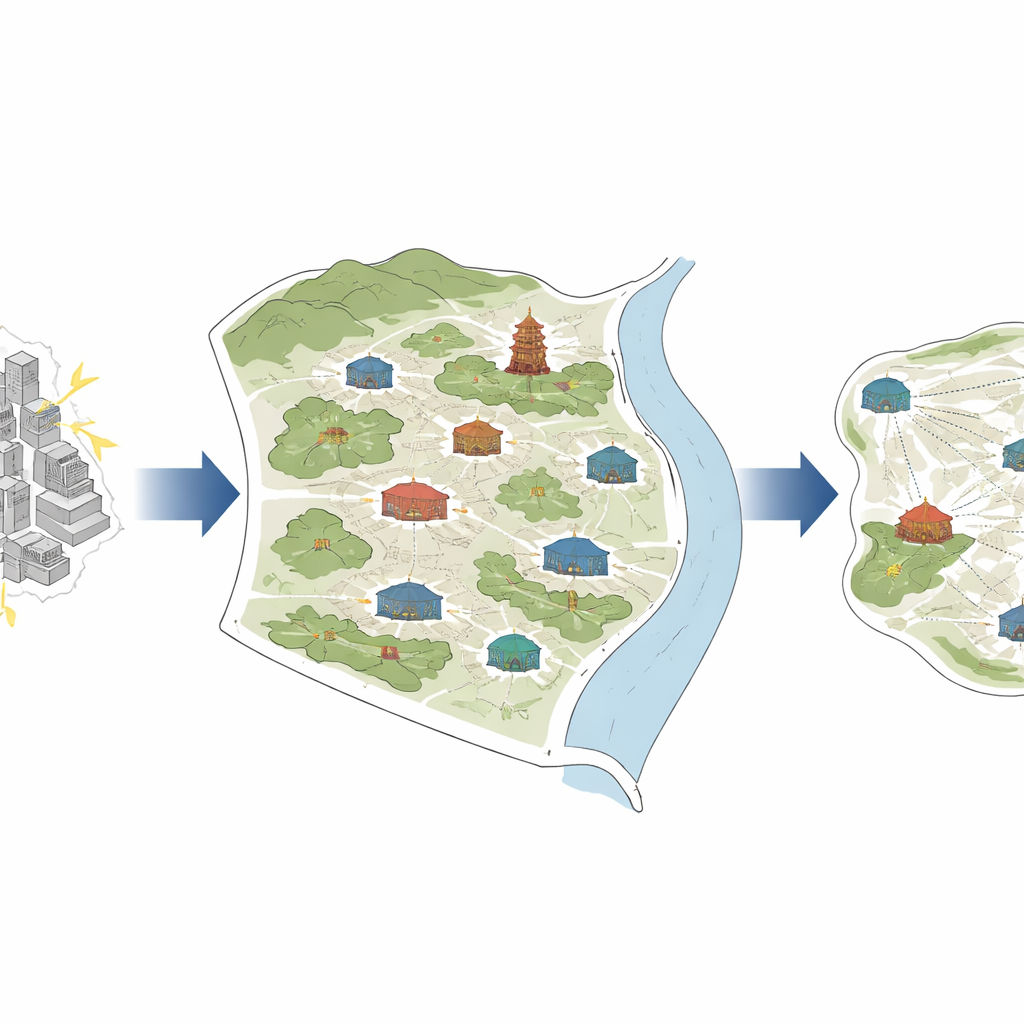
Reading the City with Ecological Tools
To make sense of this complex patchwork, the authors borrow tools from landscape ecology, a field that studies how pieces of natural habitats are arranged and connected. They translate three big questions into measurable terms: How large and clear are the historic patches (space and boundaries)? How well are they linked or cut off (organisation and connectivity)? And how varied are their activities (function and diversity)? Using detailed digital maps, land-use data, historic records and points of interest such as cultural facilities, they build a database for every patch and calculate indicators that describe its size, shape, distance to neighbours, edge contrast with surrounding modern areas, and mix of functions.
A Core That Is Fading and Edges That Are Fraying
The numbers reveal a city where historic fabric is both rich and fragile. Many important sites date from the Ming and Qing dynasties or the early modern era, and they still cluster along famous areas such as the old city wall and Confucius Temple district. Yet no single historic area dominates the map anymore: a few large patches sit amid many small, scattered ones, and overall connectivity is weak. Boundaries vary sharply—some sites stand out clearly from their surroundings, while others blur into nearby development. Functionally, a handful of districts have successfully woven culture, commerce and tourism together, but many other patches serve only one narrow role, feeling like “cultural islands” cut off from everyday city life. 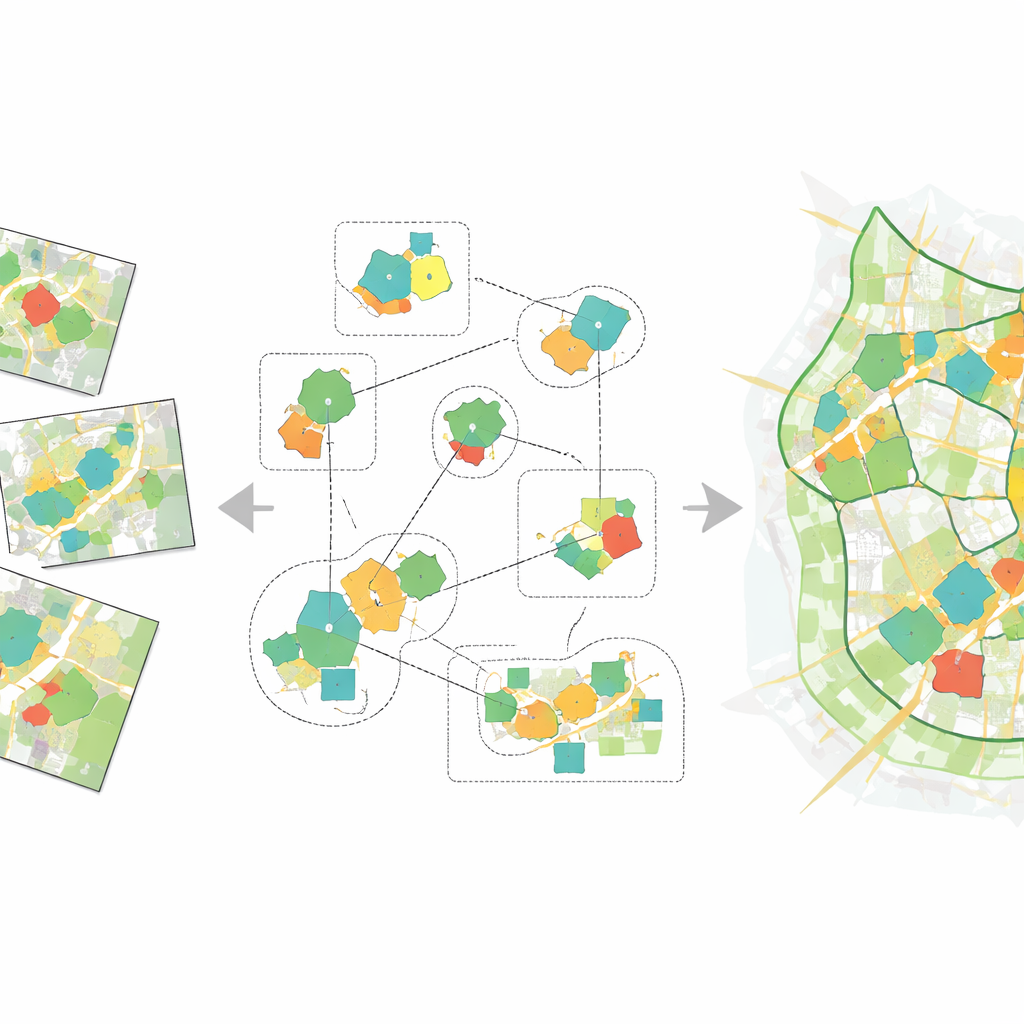
Different Patches, Different Pressures
Not all historic places share the same fate. The team distinguishes three broad kinds of cultural patches. Primary patches are long-standing sites such as major monuments and classical gardens; they are usually smaller, more regular in shape and under stricter protection, which keeps them intact but can also isolate them. Secondary patches are traditional streets and historic blocks reshaped by renewal; they tend to be larger, more irregular and closely woven into surrounding neighbourhoods, yet risk losing their distinct identity. Emergent patches are new cultural venues and landmarks that have strong visual impact and flexible uses, but can remain symbolic showpieces unless tied into the older cultural network. Protection policies add another layer: strongly protected sites keep clear edges and some functional variety, while weakly protected areas may sprawl, lose sharp boundaries and slip into simplified uses under development pressure.
Rethinking How We Care for Historic Cities
The study concludes that the main challenge for Nanjing’s cultural landscapes is not simply saving individual sites, but rebuilding the relationships among them. Fragmentation here is spatial, structural and functional: protected places can become well-kept but lonely enclaves, while less-protected ones may blend into ordinary urban fabric and lose their character. By treating historic areas as a network of different but interacting patches, and by measuring how that network is holding together or falling apart, the authors offer a new way for planners and conservationists to act. Rather than applying a single model of preservation everywhere, cities can stabilise core sites, help secondary areas serve as connectors, and better weave new cultural spaces into the existing web. This landscape-based view, they argue, can be adapted to historic cities worldwide that are struggling to balance growth with memory.
Citation: Rong, J., Tao, X., Zhang, F. et al. Quantifying cultural landscape structure in historic Nanjing: a landscape ecological approach. npj Herit. Sci. 14, 266 (2026). https://doi.org/10.1038/s40494-026-02537-0
Keywords: cultural landscapes, historic cities, urban regeneration, landscape ecology, Nanjing