Clear Sky Science · en
Oracle bone inscriptions information processing: a comprehensive survey
Ancient bones, modern questions
More than 3,000 years ago, diviners in China carved questions to their rulers on turtle shells and ox bones, then cracked them with heat to read omens. These oracle bone inscriptions are the earliest known Chinese writing and a rare window into Bronze Age politics, religion, and daily life. Today, however, the bones are badly broken, the script is hard to read, and many characters remain undeciphered. This article explains how new waves of artificial intelligence are transforming the way scholars clean, reconstruct, read, and interpret these fragile traces of the past, and what challenges still stand in the way.
From hand and eye to silicon and code
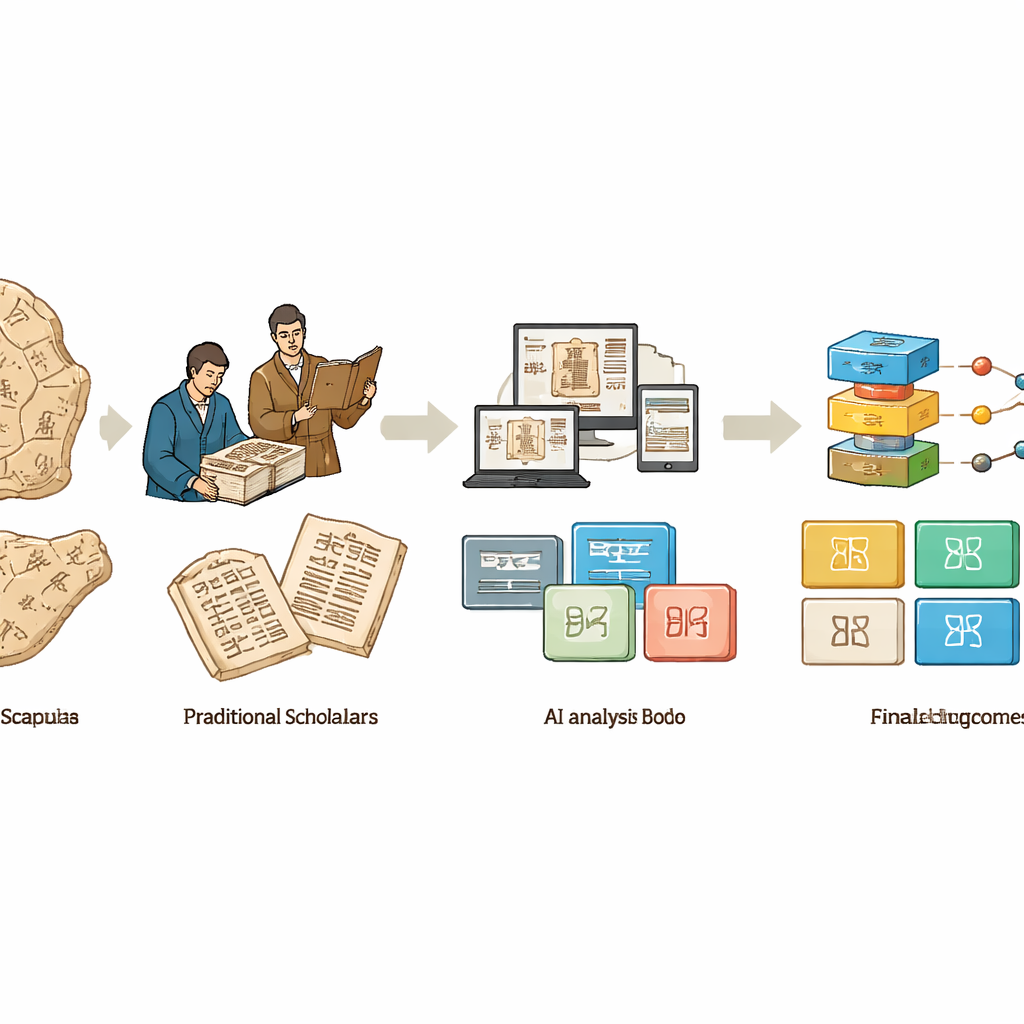
For most of the last century, oracle bones could only be studied by a small circle of experts who painstakingly examined ink rubbings, tracings, and photographs. They collated massive printed catalogues, proposed readings of individual characters, and argued over how inscriptions should be dated and grouped. This work laid the foundations of the field but was slow, hard to reproduce, and heavily dependent on each scholar’s personal memory and judgement. As computers arrived, researchers began to digitize rubbings and apply basic image-processing tricks like contrast enhancement and edge detection. These early tools made bones easier to see and share, but treated characters as mere shapes, not as meaningful writing.
Deep learning steps into the archives
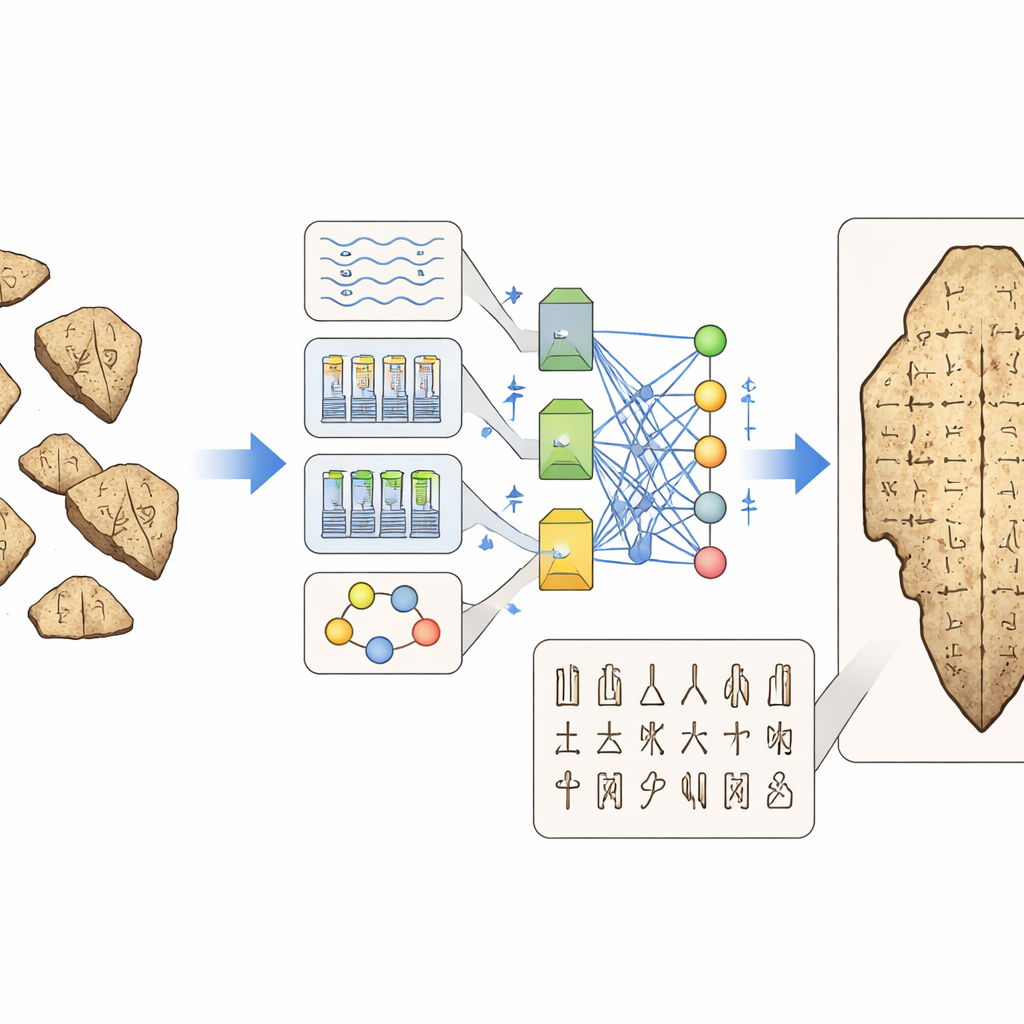
The rise of deep learning changed the landscape. Convolutional neural networks and transformers, first honed on everyday photographs, were retrained to pick out characters on noisy rubbings, sort them into categories, and even help match broken fragments that once belonged to the same bone. To feed these data-hungry models, teams compiled dozens of specialized datasets: some focused on identifying every character in a rubbing, others on classifying cropped glyphs, linking radicals and components, or pairing ancient forms with later scripts. Yet the data reflect historical reality: a few common characters appear thousands of times, while many rare or undeciphered signs show up only once. Researchers respond with clever data augmentation, generative models that synthesize new examples, and training schemes designed to recognize characters from only a handful—or none at all—of known samples.
Teaching machines to bridge vision and meaning
In the latest phase, large multimodal models that combine vision and language are being adapted to oracle bones. Instead of only spotting where characters are, these systems try to connect what a glyph looks like with what it might mean, much as a human paleographer does. New benchmarks test whether such models can recognize characters, rejoin fragments, retrieve similar inscriptions, and suggest plausible readings. Some frameworks try to map ancient signs directly onto modern Chinese characters, tracing visual evolution over centuries; others link pictorial signs to images of real-world objects; still others attempt full textual explanations of what a divination line might say. Agent-style systems go further by orchestrating multiple tools and databases, helping users search across images, transcriptions, and scholarly notes in one workflow.
Data, evaluation, and the puzzle of broken history
Despite rapid progress, the survey highlights stubborn obstacles. Many of the best image collections and 3D scans sit in museums or private archives and are not openly available, making it hard to compare methods fairly or train truly general models. Even public datasets often have long-tailed class distributions, inconsistent labels, or low image quality. Standard performance scores borrowed from object detection or handwriting recognition may not capture what really matters to historians—for example, whether a model confuses two accepted variants of the same character, or whether its proposed reading respects how a sign is built from smaller parts. Human evaluation is equally fragmented: different studies enlist different kinds of experts, ask different questions, and rarely report in enough detail for others to replicate their tests.
Where ancient writing meets future AI
To move forward, the authors argue for richer, better-documented datasets; evaluation methods that reward structural and semantic understanding, not just pixel-level matches; and closer collaboration between technologists and specialists in early Chinese writing. They envision text-to-image generators that can produce realistic oracle-style characters from descriptions, foundation models trained specifically on ancient scripts, multi-agent systems that debate and refine competing readings, and even 3D reconstructions that restore the original shape of broken bones. In plain terms, the article’s conclusion is that AI will not “solve” oracle bones on its own, but it can become a powerful partner—amplifying expert insight, making vast archives searchable, and opening Bronze Age voices to a much wider public.
Citation: Chen, Z., Hua, W., Li, J. et al. Oracle bone inscriptions information processing: a comprehensive survey. npj Herit. Sci. 14, 220 (2026). https://doi.org/10.1038/s40494-026-02511-w
Keywords: oracle bone inscriptions, ancient Chinese writing, digital humanities, artificial intelligence, multimodal models