Clear Sky Science · en
COL1A1-induced LOXL2 promotes ovarian cancer metastasis via a feedback loop upon inhibiting EGFR lysosomal degradation
Why the Tumor’s Neighborhood Matters
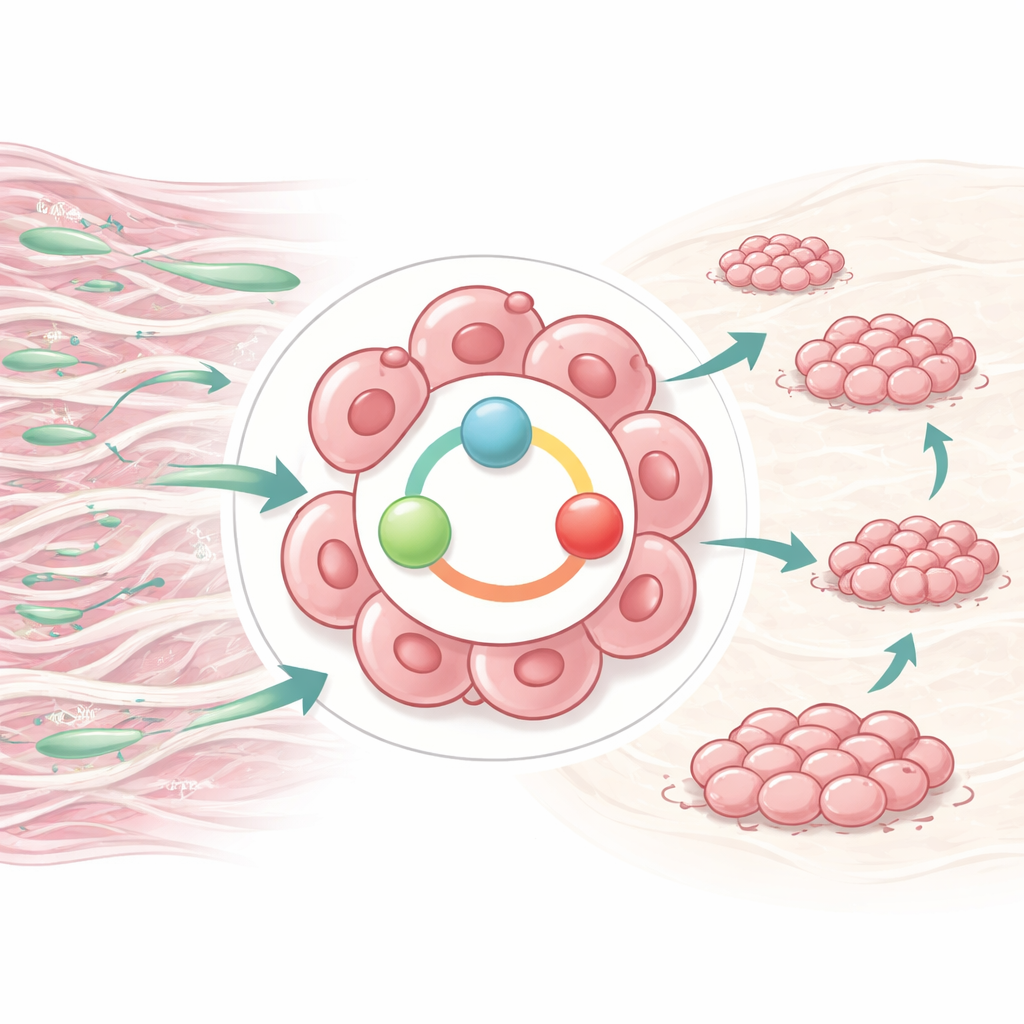
Ovarian cancer is often deadly not because of the original tumor, but because cancer cells spread widely through the abdomen. This study looks at how the “neighborhood” around a tumor—especially a structural protein called collagen—can secretly coach ovarian cancer cells to become more aggressive. By tracing this hidden conversation between tumor cells and their surroundings, the researchers uncover a self-reinforcing loop that helps cancer spread and suggest new ways doctors might break that loop.
A Sticky Protein That Signals Trouble
The team focused on a protein called LOXL2, which helps crosslink collagen and elastin, giving tissues their strength. Earlier work showed that another collagen component, COL1A1, produced by nearby fibroblast cells, could make ovarian cancer cells more mobile. Here, the scientists found that when ovarian cancer cells are exposed to COL1A1, they dramatically increase their production and release of LOXL2. In samples from patients, LOXL2 levels were much higher in ovarian cancer tissue than in normal ovaries, and even higher in metastatic deposits compared with the primary tumors. Women whose tumors had more LOXL2 tended to have more advanced disease, greater fluid buildup in the abdomen, higher tumor marker levels, and shorter survival.
Helping Cancer Cells Move and Invade
To see what LOXL2 actually does, the researchers turned genes on and off in ovarian cancer cell lines and in mice. When they reduced LOXL2 in cancer cells, those cells moved and invaded less through artificial membranes, and their actin “feet” structures—tiny protrusions used for movement—were diminished. Boosting LOXL2 had the opposite effect: cells became more mobile and invasive. In mouse models where cancer cells were introduced into the abdominal cavity, tumors overproducing LOXL2 formed more and heavier metastatic nodules and shortened the animals’ survival. Crucially, when LOXL2 was silenced, the metastasis-boosting effect of COL1A1 largely disappeared, showing that LOXL2 is a key middleman between the collagen-rich environment and the cancer’s spread.
How a Hidden Feedback Loop Forms
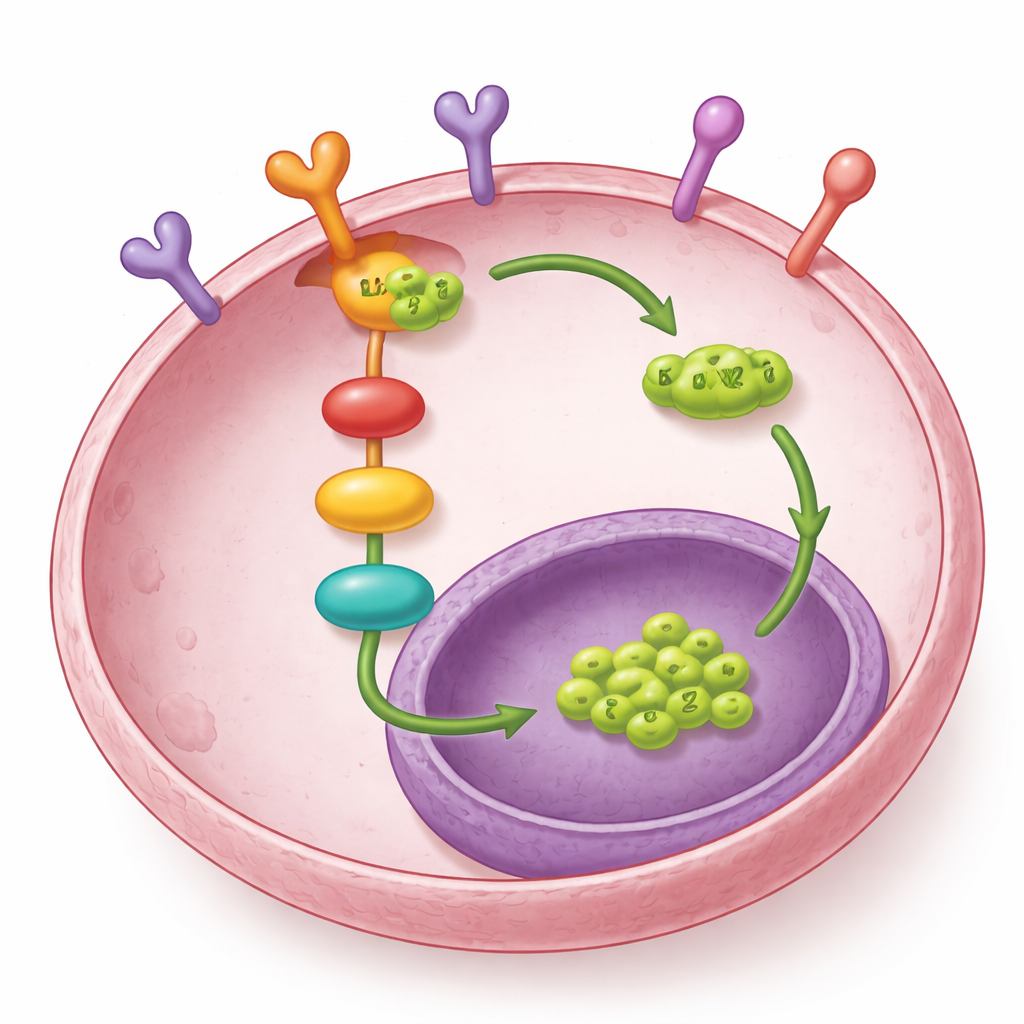
Diving deeper, the scientists asked how COL1A1 drives LOXL2 levels so high. They discovered that COL1A1 activates a chain of signals inside cancer cells known as the EGFR–MEK–ERK pathway. This pathway moves a transcription factor called SP1 from the cell’s outer fluid into its nucleus, where DNA is housed. Once inside, SP1 binds a specific region of the LOXL2 gene and turns it on more strongly, increasing LOXL2 production. Blocking the MEK–ERK step with a chemical inhibitor prevented SP1 from entering the nucleus, reduced LOXL2 levels, and cut metastasis in mice, even when COL1A1 was present. In essence, collagen outside the cell flips on a switch inside the nucleus that tells the cell to make more LOXL2.
Protecting a Powerful Growth Signal
The story does not stop there. The researchers found that LOXL2 also physically interacts with EGFR, a well-known growth receptor on the cell surface that initiates the MEK–ERK pathway. Instead of changing EGFR’s gene activity, LOXL2 protects the EGFR protein from being sent to the cell’s “recycling bin,” the lysosome. When LOXL2 was low, more EGFR was tagged for destruction and ended up in lysosomes; when LOXL2 was high, EGFR persisted longer, and downstream signaling (MEK and ERK activation) stayed active. A specific region of LOXL2—its SRC3 domain—was essential for binding EGFR and for promoting metastasis. This means LOXL2 not only responds to EGFR signaling but also helps keep that signaling alive.
What This Means for Future Treatments
Put together, the findings reveal a vicious circle: COL1A1 in the tumor’s surroundings activates EGFR in ovarian cancer cells, which turns on MEK–ERK, moves SP1 into the nucleus, and ramps up LOXL2 production. LOXL2, in turn, stabilizes EGFR by shielding it from degradation, feeding back to keep the same pathway firing. This loop helps cancer cells travel and seed new tumors throughout the abdomen. For patients, this research suggests that targeting LOXL2—especially its internal actions, not just the portion outside cells—could both weaken EGFR signaling and blunt metastasis. Combined with existing EGFR-blocking drugs, such strategies may one day offer more effective ways to slow or stop the spread of ovarian cancer.
Citation: Shen, Z., Gu, L., Zheng, M. et al. COL1A1-induced LOXL2 promotes ovarian cancer metastasis via a feedback loop upon inhibiting EGFR lysosomal degradation. Exp Mol Med 58, 864–878 (2026). https://doi.org/10.1038/s12276-026-01675-6
Keywords: ovarian cancer metastasis, tumor microenvironment, LOXL2, EGFR signaling, collagen COL1A1