Clear Sky Science · en
Challenge or threat? The double-edged sword effect of AI use on innovative teaching behavior among primary and secondary school teachers in China
Why this matters for everyday classrooms
As artificial intelligence moves from tech labs into real classrooms, many parents and students wonder what it means for teachers. Will smart software help teachers tailor lessons and spark creativity, or will it pile on pressure and make teaching feel more mechanical? This study looks at how primary and secondary school teachers in China actually experience AI in their daily work, and shows that the same tools can both encourage bolder teaching and quietly hold it back.
AI tools arrive in the school day
Across China, schools are being urged to bring AI into lessons, from planning classes and grading work to tracking student progress in real time. The researchers surveyed 1275 primary and secondary school teachers who already used AI in their teaching. They asked how often teachers turned to AI for tasks like lesson design and feedback, how innovative their teaching was, and how they felt about AI: as a helpful opportunity or as a worrying burden. They also measured how much support teachers sensed from their schools for trying new ideas, such as training, resources, and tolerance for experiments that might not work perfectly the first time.
Two ways teachers read the same technology
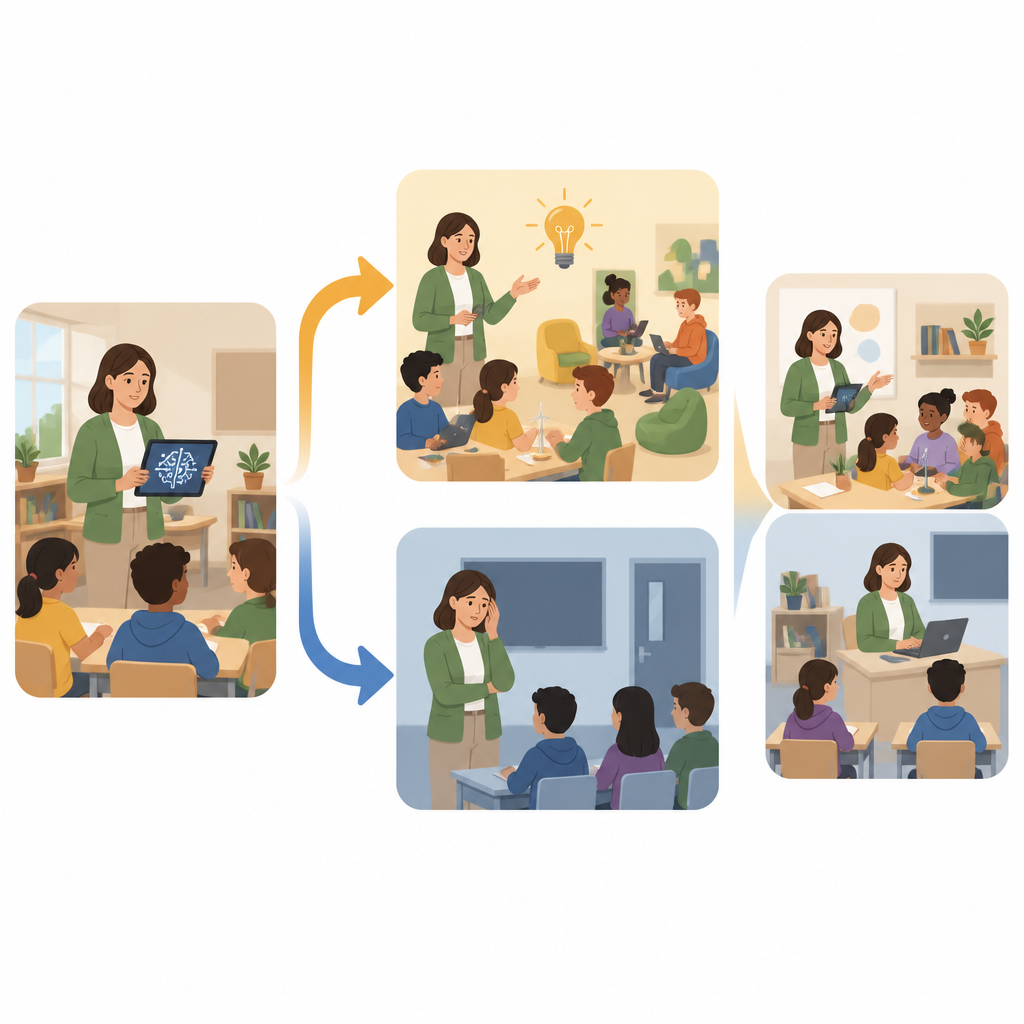
The team drew on a well-known idea from psychology: people do not respond to events in a fixed way, but based on how they mentally “size them up.” A situation can be seen as a challenge that offers growth, or as a threat that may cause loss. The survey found that greater use of AI in class was linked to both kinds of reading at once. Many teachers saw AI as a helpful partner that could boost efficiency, free them from routine chores, and open fresh teaching possibilities. Others, often the very same people, also worried that AI might weaken their control over lessons, dull their creativity, or make them overly dependent on software.
How feelings about AI shape creative teaching
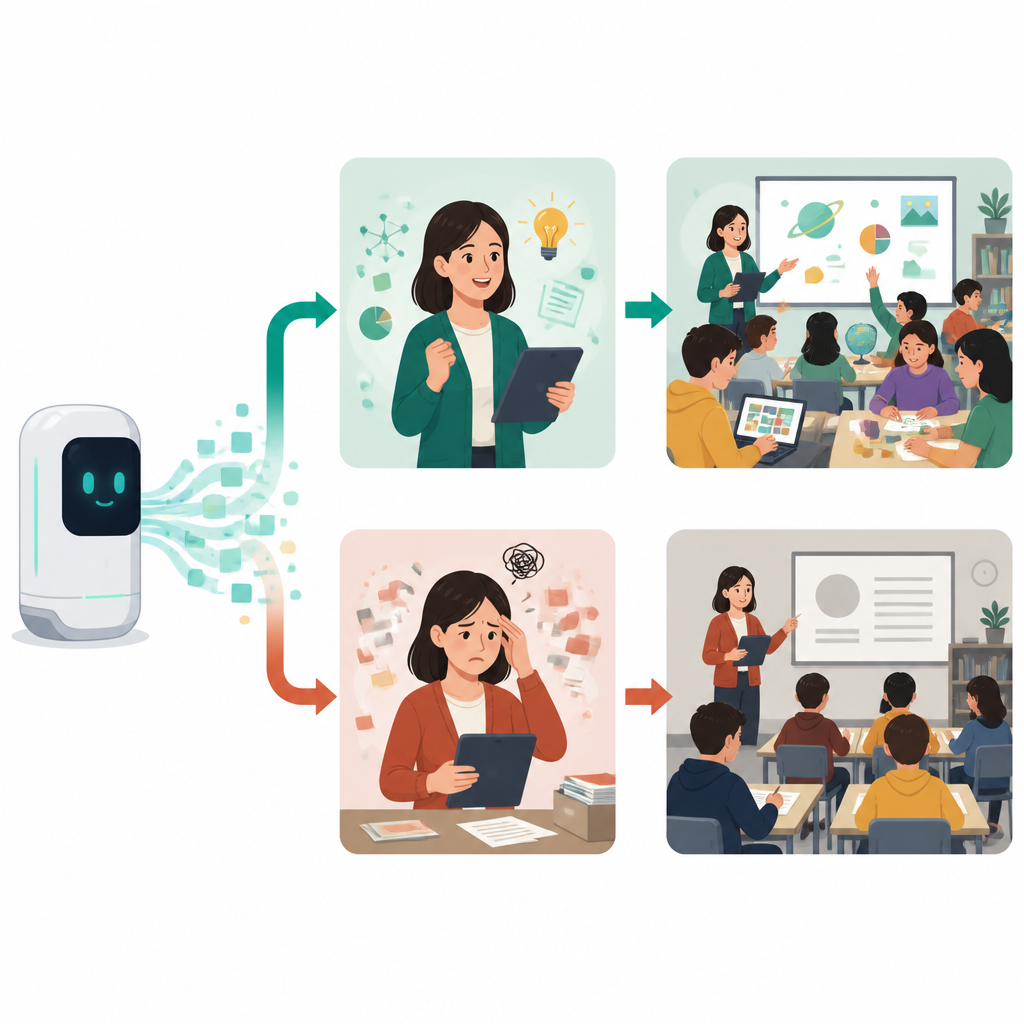
These two appraisals turned out to be key for understanding innovation in the classroom. When teachers tended to view AI as a challenge, they were more likely to experiment with new digital activities, rethink their teaching methods, and design more creative lessons. When they leaned toward seeing AI as a threat, they were less inclined to change their routines or try unfamiliar approaches. Once these inner reactions were taken into account, the simple link between using AI and teaching innovation largely disappeared. In other words, it was not AI use on its own that mattered most, but whether teachers felt encouraged or undermined by it.
When school support helps and when it adds pressure
School culture also played an important role. In schools where leaders invested in training, celebrated new ideas, and gave teachers room to experiment, AI use was more likely to be read as a promising challenge. Yet this support had a twist: it also strengthened feelings of threat. High expectations to “keep up with AI” could heighten the sense of pressure, especially for teachers who felt less confident with technology. Overall, strong school support amplified both sides of the AI experience, making the positive path to innovation stronger without clearly weakening the negative path of anxiety and caution.
What this means for the future of teaching
This study suggests that AI in education is a true double-edged sword. Simply installing smart systems will not automatically make teaching more creative, nor will it inevitably hollow out the teacher’s role. What matters is how teachers interpret these tools and how schools shape the conditions around them. Helping teachers see AI as a controllable aid rather than a looming threat, while avoiding heavy-handed pressure to perform, may tip the balance so that AI supports richer, more imaginative learning experiences for students.
Citation: Kong, L., Zhang, W., Huang, W. et al. Challenge or threat? The double-edged sword effect of AI use on innovative teaching behavior among primary and secondary school teachers in China. Humanit Soc Sci Commun 13, 710 (2026). https://doi.org/10.1057/s41599-026-07072-8
Keywords: artificial intelligence in education, teacher innovation, stress appraisal, school support, K-12 teaching