Clear Sky Science · en
Do energy policy uncertainty, trade openness, and renewable energy drive artificial intelligence investment? Evidence from the United States
Why the future of AI spending matters
Artificial intelligence now underpins everything from online shopping to medical scans, and the United States is the largest hub for this technology. Yet big AI projects depend on much more than clever code. They are shaped by how fast the economy grows, how open trade borders are, how quickly clean energy spreads, and how predictable energy rules remain. This study asks a simple question with far reaching consequences: which of these forces really drive AI investment in the United States, and under what conditions?
Big picture: what this study set out to explore
The researchers focused on AI investment as the main outcome rather than treating AI as a vague buzzword. They examined five broad influences: overall economic growth, use of renewable energy, openness to international trade, the degree of global integration, and uncertainty around energy policy. Using quarterly data for the United States from 2013 to 2024, they traced how these factors move together with AI spending over short, medium, and long stretches of time and across low and high levels of investment. 
How the authors followed the money
Instead of using a single straight line to connect causes and effects, the team applied a set of tools that can pick up twists and turns in the data. These methods sort the numbers into different “slices” of time and different layers of the investment range, from low to high. They also break each series into short term ripples, medium term waves, and long term swells. With this approach, the authors could ask questions such as: does renewable energy matter more when AI investment is already high, or when it is just taking off? Do policy surprises hurt only in the long run, or can they give a short lived jolt to innovation?
What they learned about growth, trade, and clean power
The results show that steady economic growth is one of the strongest supports for AI investment across most conditions. When the economy expands, companies and governments have more resources and confidence to fund data centers, research labs, and new applications. Renewable energy also emerges as a clear ally of AI. As more solar and wind power feed the grid, they provide cleaner and often cheaper electricity for energy hungry computing. Over time, this pairing of green power and digital technology reinforces itself, with AI helping manage complex grids and renewables making AI operations more sustainable. Trade openness and globalisation play helpful roles as well, especially over medium and long time frames. By easing flows of hardware, software, and expertise, they encourage firms to adopt AI tools to stay competitive in global markets.
When policy uncertainty helps and when it hurts
Energy policy uncertainty behaves differently from the other factors. The study finds that a modest level of uncertainty can actually push firms to experiment with AI driven solutions, for instance to cope with shifting fuel prices or changing efficiency standards. In the short and medium term, such conditions can trigger adaptive investments. However, when uncertainty becomes too strong or lasts too long, its effect flips. Prolonged confusion over future rules, taxes, or subsidies raises financing costs and makes investors wary of committing to long lived AI infrastructure. Over extended periods, this dampens the very innovation that mild uncertainty once encouraged. 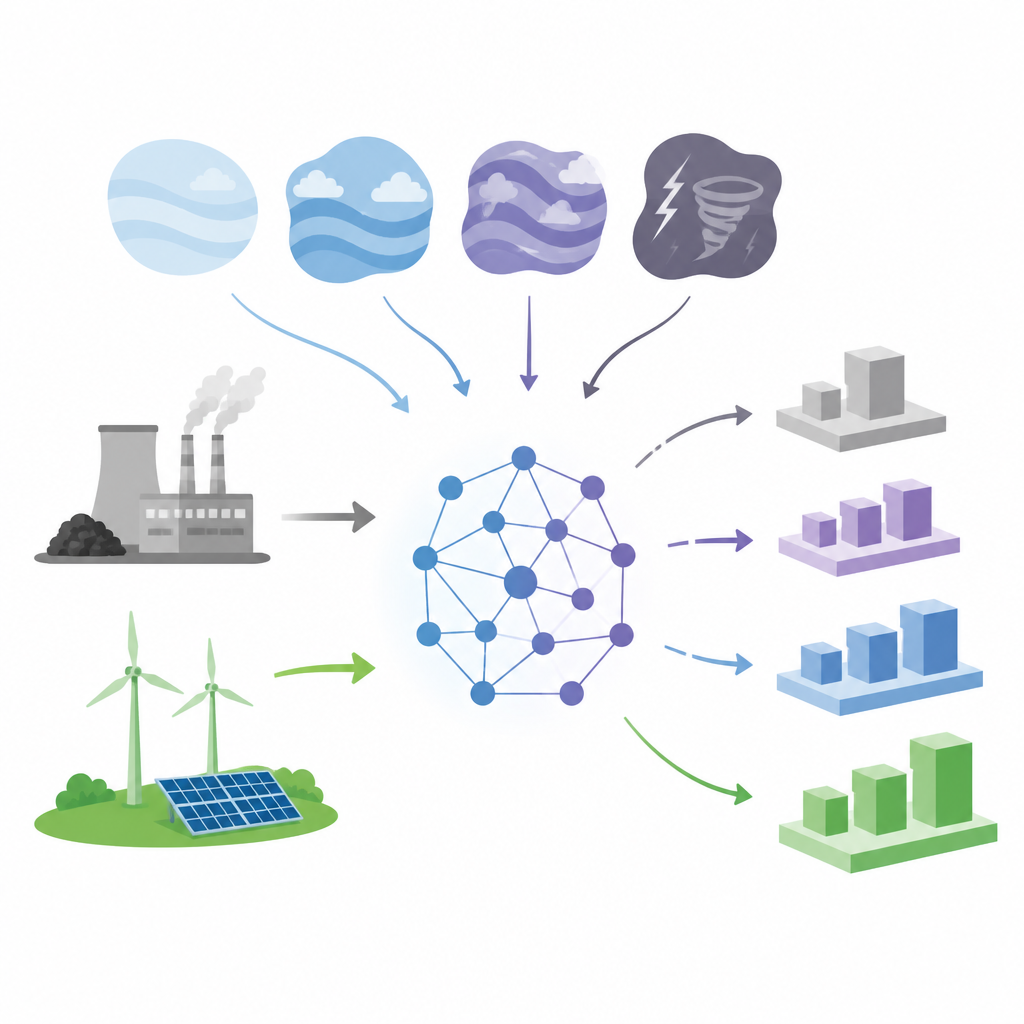
Why this matters for citizens and decision makers
For a lay reader, the takeaway is straightforward: AI does not grow in a vacuum. It thrives when the economy is healthy, when the country is well connected to world markets, and when data centers and networks can run on reliable clean power. At the same time, AI investment is sensitive to how predictable energy policy appears. A bit of policy movement can spark creativity, but wild swings scare off long term backers. The authors conclude that if the United States wants to keep its lead in AI, it must link digital ambitions with stable, transparent energy rules, continued economic growth, and deeper engagement with the global economy, all while accelerating the shift to renewable energy.
Citation: Jin, X., Eweade, B.S., Ozsahin, D.U. et al. Do energy policy uncertainty, trade openness, and renewable energy drive artificial intelligence investment? Evidence from the United States. Humanit Soc Sci Commun 13, 679 (2026). https://doi.org/10.1057/s41599-026-06955-0
Keywords: artificial intelligence investment, renewable energy, trade openness, energy policy uncertainty, United States economy