Clear Sky Science · en
Discursive representations of China in the Gulf Cooperation Council English press: an appraisal system approach
Why Gulf News about China Matters
When people in the Gulf read about China in English-language newspapers, they are not just learning about a distant country; they are also seeing how their own region understands one of the world’s biggest powers. This article looks closely at how major newspapers in Saudi Arabia, the United Arab Emirates, and Qatar talk about China, revealing what kind of partner, rival, or model China appears to be in Gulf public life.
How the Study Was Carried Out
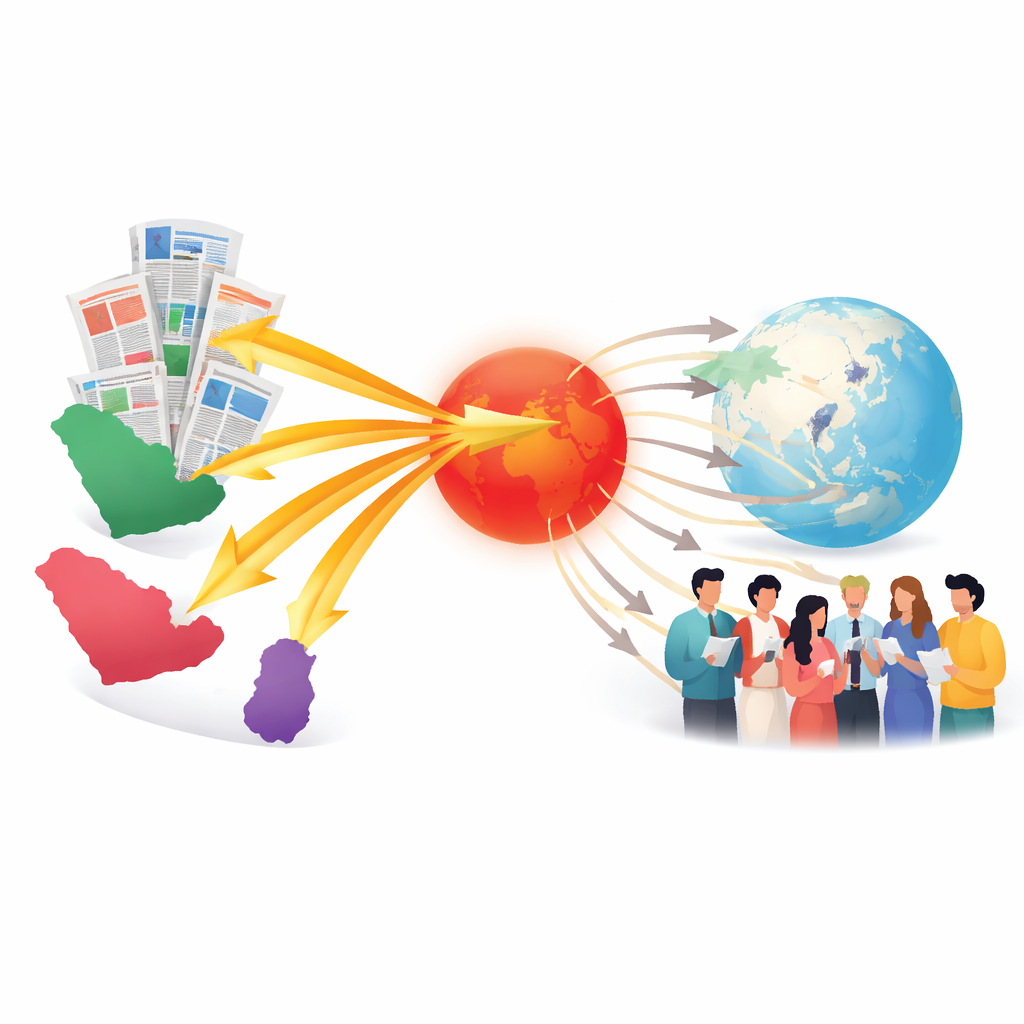
To uncover these patterns, the researchers built a large collection of news stories from six high-circulation English newspapers in Saudi Arabia, the UAE, and Qatar, published between 2010 and mid‑2020. They selected nearly seven thousand articles that mentioned China or Chinese several times and then zoomed in on sentences that directly described what “China is” or “China as …”. Using a detailed framework for studying how language expresses approval, disapproval, strength, and perspective, they manually coded more than a thousand such descriptions to see whether China was being praised, criticized, intensified, or simply reported.
China as an Economic Partner
The clearest picture that emerges is of China as a strongly valued economic partner. The most common descriptions present China as the largest or one of the most important trade partners of Gulf states, a major buyer of their oil and gas, and a key supplier of goods, technology, and investment. Words like partner, market, important, key, importer, exporter, and strategic appear again and again, often boosted with phrases that highlight size and speed, such as largest, biggest, fastest, and world’s. In these stories, China is not just a big economy somewhere else; it is portrayed as central to the Gulf’s own growth, diversification plans, and energy future.
China as a Rising Power
Beyond trade, the newspapers also paint China as a country whose influence reaches far beyond the Gulf. Descriptions often stress China’s rapid economic growth over the past four decades and its role as a leading power in fields like manufacturing, renewable energy, digital technology, and e‑commerce. Visual language links China to global reach, using terms associated with the world and international activity to show that its actions matter on a planetary scale. In this way, the Gulf press presents China as both an emerging superpower and a leader in practical fields that directly affect everyday life, from online shopping to clean energy.

Echoes of Western Concerns
Alongside the overwhelmingly positive coverage, there is a thinner but noticeable strand of negative or worrying portrayals. These mostly appear when the Gulf newspapers reprint material from large Western and Indian news agencies or well-known American and British papers. In those pieces, China may be described as a threat, or as a country associated with closed politics, human rights problems, or environmental harm. Strong terms are sometimes attached to China’s role as the only major supporter of sanctioned states, or as the largest source of greenhouse gases. Importantly, such criticisms rarely come from Gulf leaders themselves; instead, they are quoted from foreign officials, dissidents, or outside commentators.
Whose Voice Shapes the Image
The study shows that the warmest portrayals of China usually come from Gulf political and business leaders. Their statements, quoted directly or indirectly, emphasize China’s constructive role in promoting peace, stability, and mutual benefit. This fits the wider media environment of the region, where newspapers tend to support government positions and highlight official partnerships. At the same time, dependence on Western news wires means that some negative images are “imported” from abroad, keeping alive stereotypes that circulate widely in international media. Thus, the Gulf English press becomes a meeting point where local admiration for China as a partner coexists with outside doubts about its global behavior.
What This Means for Readers
For a lay reader, the article’s main message is that, in Gulf English-language newspapers, China is mostly presented as a trusted economic ally and rising global power, especially in energy, trade, and technology. Critical views of China’s politics and rights record do appear but mainly when Western or Indian sources are quoted rather than when Gulf voices speak directly. This suggests that the way people in the Gulf come to see China depends not only on their governments’ growing ties with Beijing but also on international news flows. Understanding these overlapping influences can help readers recognize why China often looks like a promising partner on the business page while sometimes appearing as a problem in world news columns.
Citation: Hu, X., Hu, Y. Discursive representations of China in the Gulf Cooperation Council English press: an appraisal system approach. Humanit Soc Sci Commun 13, 514 (2026). https://doi.org/10.1057/s41599-026-06722-1
Keywords: China–GCC relations, media representation, English-language press, Belt and Road, public opinion