Clear Sky Science · en
Preferences of young people reshape modeled national energy system designs toward offshore wind
Why this story about wind and youth matters
Across the world, countries are racing to replace fossil fuels with cleaner power. But where to put wind farms and solar panels is not just a technical puzzle; it is also about people’s values, landscapes, and ideas of fairness. This study shows how Norwegian teenagers, when invited into the planning process, would reshape their country’s future electricity system and what it would cost to follow their preferences.
Listening to young voices on clean energy
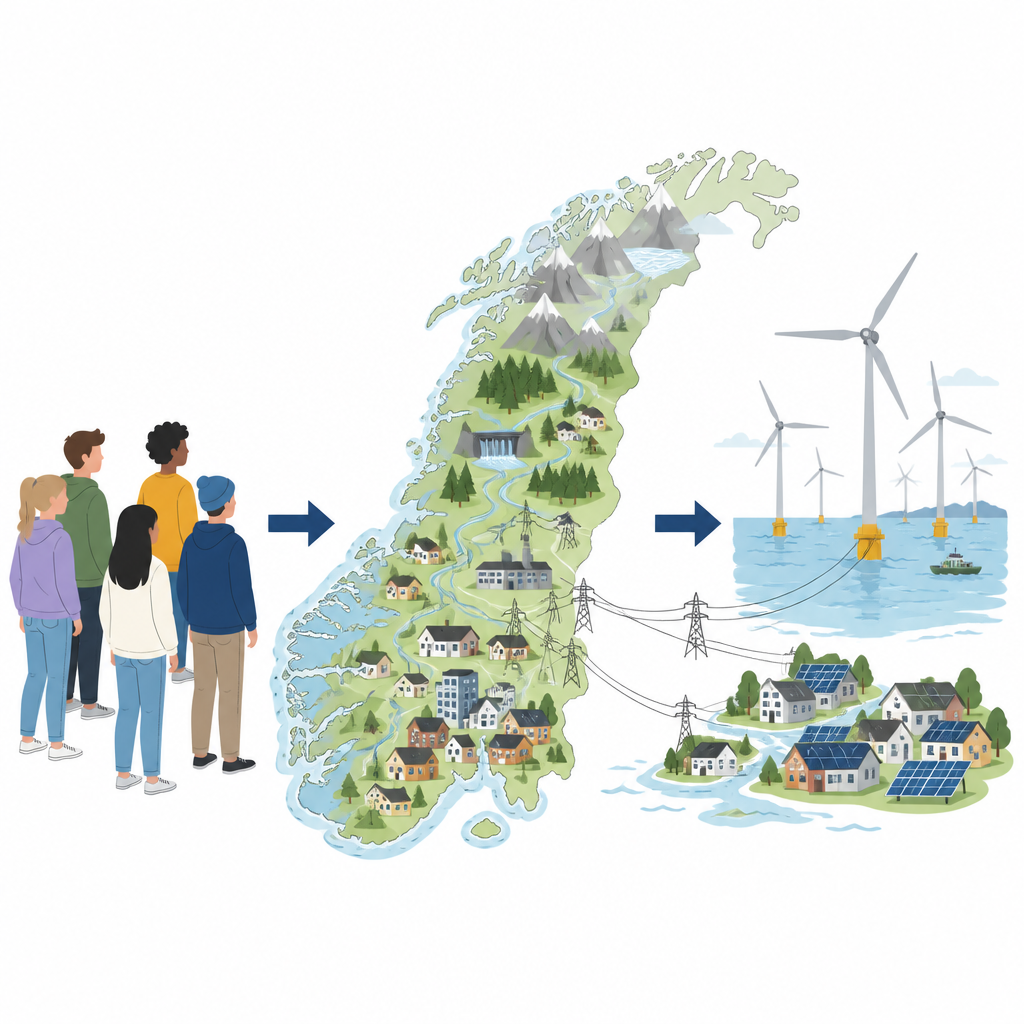
The researchers worked with 286 high school students, aged 15 to 16, in full day workshops at five schools. Through games and discussions, the students learned basic ideas about the green energy transition, conflicts around wind and solar power, and climate justice. Each student then filled out a detailed questionnaire about what kinds of renewable energy they preferred, where they thought turbines and panels should go, how much electricity Norway should trade with its neighbors, and which landscapes should be kept free of development. Instead of treating these opinions as loose comments, the team translated them into hard numbers and rules inside a sophisticated computer model of Norway’s power system for the year 2050.
How preferences became a future power grid
The model plans a net zero electricity system, meeting Norway’s projected demand in 2050 without producing carbon emissions. Hydropower and existing power lines are kept fixed, while new wind, solar, storage, and transmission can be added. Students’ preferences are built in as strict limits. If they strongly opposed turbines in forests or farmland, those areas were removed from the model’s possible sites. If they favored certain technologies, such as offshore wind or solar, the model could only build them up to levels that matched these preferences. In this way, the software searched for the cheapest possible system that still respected what the students wanted.
From hills to sea: offshore wind takes over
Students were especially wary of onshore wind farms in landscapes they valued, including agricultural land, residential areas, and forests. Once these places were ruled out, the available area for onshore wind shrank dramatically, cutting national land based wind potential about in half. The model responded by shifting future electricity production out to sea. In the strictest scenario, onshore wind disappeared entirely from the new system, while offshore wind’s share grew from less than a tenth in the baseline to more than four fifths of new wind and solar capacity. Solar power still appeared in all futures, often supplying 20 to 50 percent of new capacity, mostly near the more populated and sunnier south and east. However, building in these more limited and remote areas, and adding longer transmission lines and storage, raised overall system costs.
Cost, fairness, and the hidden trade offs
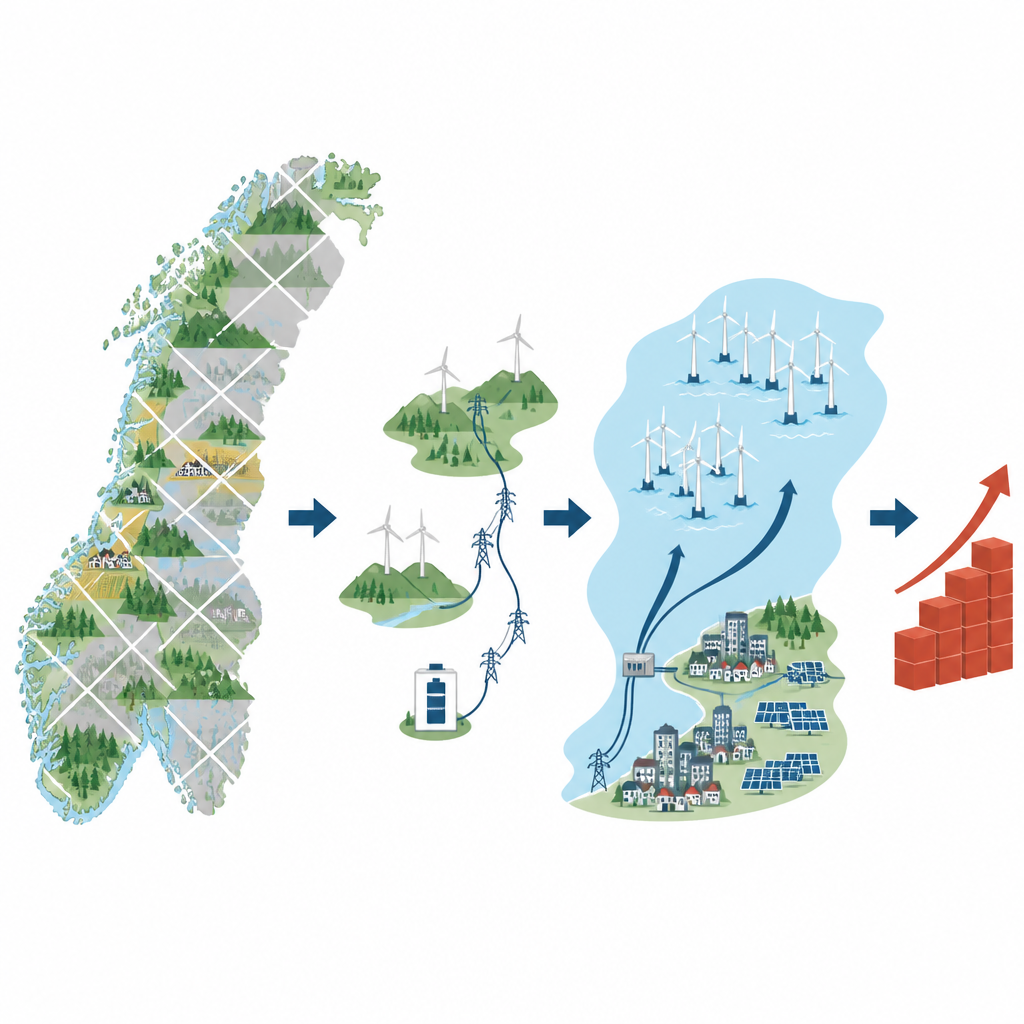
Respecting the students’ choices made the net zero system up to 25 percent more expensive than the cost focused baseline. Excluding favored landscapes forced wind turbines into less windy or more distant places and pushed the system toward more costly offshore technology. Yet high spending did not automatically bring a fairer outcome. By examining where new infrastructure and electricity generation would be located, and comparing this to how many people live in each region, how much land they have, and how much power they use, the researchers found that some high cost futures were actually less equal than cheaper ones. Scenarios with more underground power lines and more electricity trading often reduced costs, but they could also concentrate infrastructure in certain areas, increasing local burdens.
What students learned by seeing their choices
In a follow up feedback session, the team showed one of the schools how their collective choices had reshaped the future power system in the model. Many students were pleased to see strong roles for offshore wind and solar, which they associated with protecting nature and avoiding conflict on land. At the same time, some were surprised by the higher costs and by the amount of onshore wind that still appeared in less restrictive scenarios. Confronted with these trade offs, several students said they might soften some of their earlier limits on wind siting. The exercise not only produced new scenarios for planners but also helped young people understand the difficult balance between nature protection, affordability, and fairness.
What this work means for the energy transition
This study shows that when young people’s views are built directly into technical models, the resulting power systems look different: more offshore wind, similar levels of solar, and higher costs driven by strict protection of valued landscapes. It also reveals that costly systems are not always more fair, and that ideas of equity depend on how we measure burdens and benefits across regions. By turning youth preferences into concrete planning rules and then discussing the outcomes with them, the researchers offer a practical way to bring underrepresented groups into serious energy debates, helping societies design cleaner power systems that are not only efficient, but also more understood and more widely accepted.
Citation: Javed, M.S., Fossheim, K., Roithner, M. et al. Preferences of young people reshape modeled national energy system designs toward offshore wind. Commun. Sustain. 1, 85 (2026). https://doi.org/10.1038/s44458-026-00094-y
Keywords: offshore wind, youth participation, energy transition, Norway electricity, energy justice