Clear Sky Science · en
Optimized afforestation reduces flood risk and limits water loss in Europe
Why where we plant trees matters
As Europe races to plant billions of trees to fight climate change, a key question looms: will these new forests ease floods and safeguard water supplies, or could they unintentionally dry out rivers and soils? This study explores how carefully choosing where to plant trees across Europe can reduce flood risk while limiting water loss, offering guidance for policies that aim to turn abandoned farmland into thriving forests.
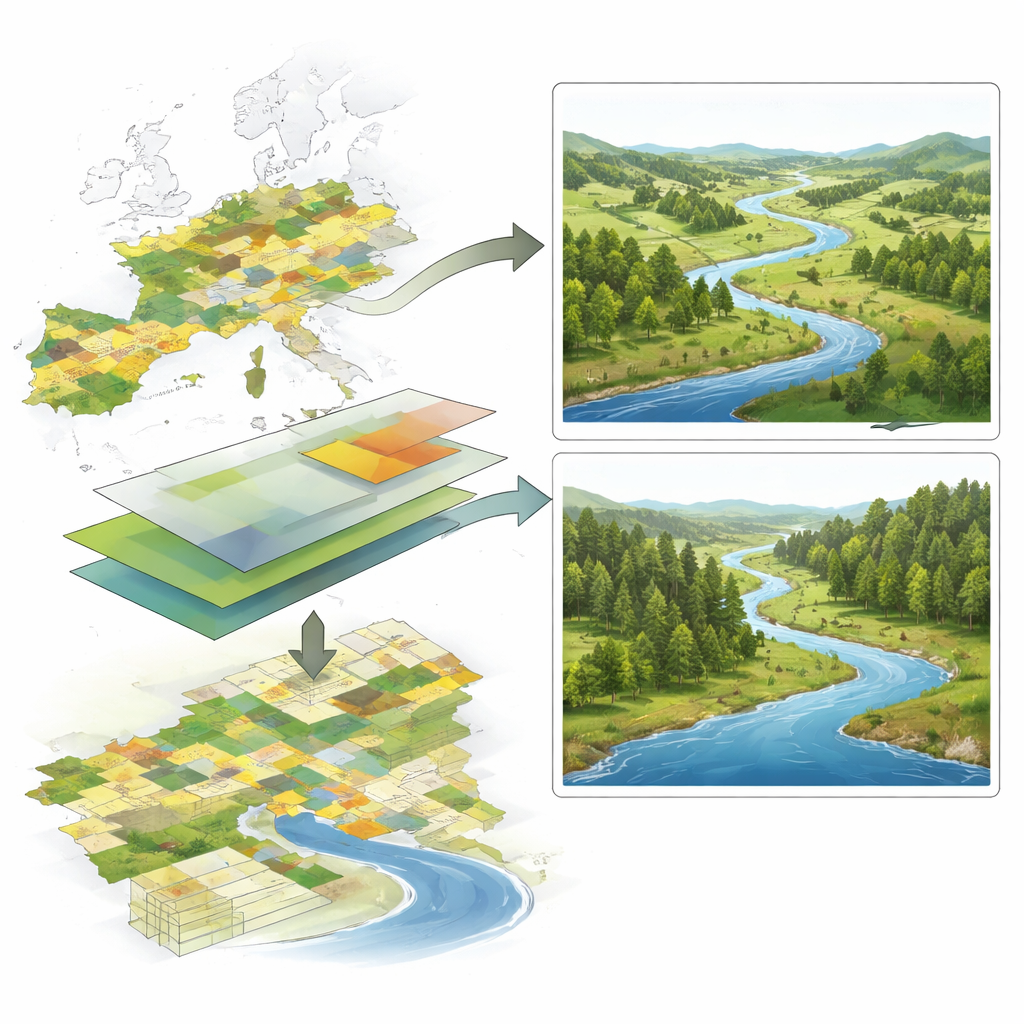
Turning empty fields into helpful forests
The researchers focus on abandoned croplands across Europe—farms no longer in use that are prime candidates for ecological restoration. The European Union’s Biodiversity Strategy envisions converting about 10% of agricultural land into forest. However, trees use a lot of water, and large-scale planting can increase evaporation and reduce runoff, especially in drier regions. To balance these trade-offs, the team asked whether a “smart” placement of new forests could both tame floods and help keep enough water in rivers and underground storage.
Smart planting versus random planting
To test this, the authors compared two different ways of adding the same amount of new forest. The smart strategy uses a machine-learning algorithm inspired by natural selection. It weighs many factors—such as where cropland has already been abandoned, how wet the land is in spring, how suitable the climate and soils are for forest growth, and how previous experiments suggest forests affect floods and groundwater. This approach spreads trees more thinly across many locations, favoring places where they can slow runoff without draining too much water. The naive strategy, in contrast, selects sites more or less randomly from eligible farmland, often creating dense forest “islands” in areas that are already quite wooded.
How forests reshaped floods and water
Using a detailed European hydrological model, the team simulated river flows, soil moisture, evaporation, and groundwater for 1991–2020 under both strategies and a baseline with no new forests. Smart afforestation cut peak river discharges across much of Europe, with typical reductions of about 3% and local decreases above 40% in some catchments. Flood peaks arrived later and receded more smoothly, especially in smaller rivers dominated by quick runoff. The naive approach, however, barely changed peak flows at most locations. When it came to groundwater, both strategies reduced average storage because trees pull more water from the soil. Yet the smart strategy kept these losses modest and actually improved the lowest groundwater levels during dry spells, roughly tripling minimum water retention compared with the naive approach. In contrast, naive planting caused far larger and more widespread groundwater declines.
Finding the “just right” amount of trees
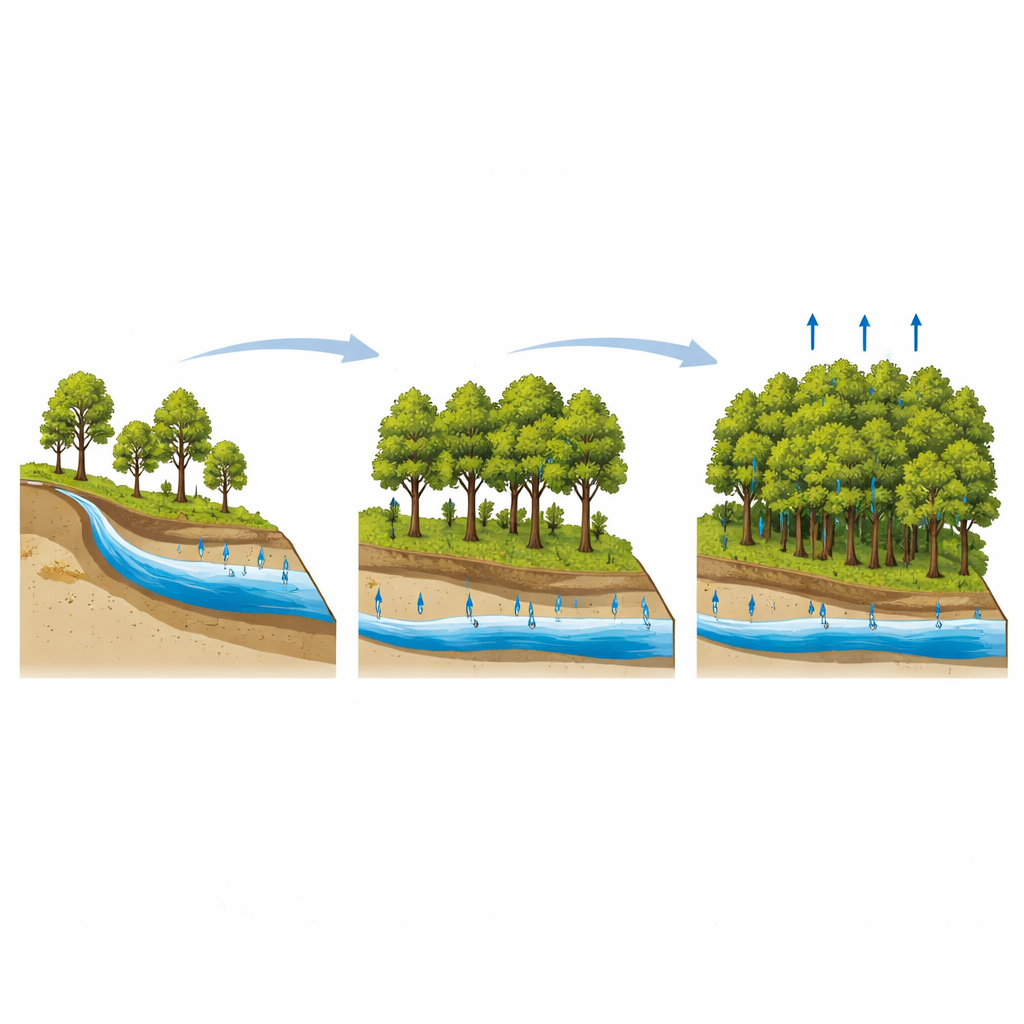
By examining how runoff changed with different degrees of forest cover, the authors identified a “sweet spot.” Up to around 40% forest cover in a given area, extra trees mainly boost evaporation, steadily reducing runoff. Between about 40% and 80% cover, forests act more like a temporary reservoir: their canopy and soils store rainwater and release it slowly, reducing floods without sharply cutting total water availability. Beyond this range, additional trees lead again to stronger water losses. The smart algorithm naturally favored this middle band of forest cover, choosing locations where trees would most effectively trade short-term storage for lower flood peaks, while avoiding the heaviest depletion of groundwater and runoff.
What happens in a warmer future
The team also explored a future in which European air temperatures are 2 °C higher, in line with mid-century climate projections. Warmer conditions alone reduced flood peaks by shortening the snow season and changing when meltwater reaches rivers, but at the cost of larger water losses due to increased evaporation. Smart afforestation still lowered maximum river discharges under this warming, yet its relative benefit shrank: flood peaks fell by about a third in today’s climate, but only by about one-eighth in the warmer world. Importantly, the extra water loss caused by new forests remained modest compared with the drying driven by higher temperatures and did not grow worse under warming.
What this means for future tree planting
For non-specialists, the main message is that tree planting is not a simple “more is better” solution. Where and how densely trees are planted can spell the difference between forests that quietly reduce floods while keeping rivers and groundwater resilient, and forests that worsen water shortages. This study shows that using data and models to guide the placement of new forests—rather than relying on opportunistic or random planting—can significantly cut flood risk and limit water loss across Europe. As governments roll out large-scale tree-planting plans, incorporating such optimized, evidence-based strategies can help ensure that new forests support both climate goals and long-term water security.
Citation: El Garroussi, S., Wetterhall, F., Barnard, C. et al. Optimized afforestation reduces flood risk and limits water loss in Europe. Commun. Sustain. 1, 60 (2026). https://doi.org/10.1038/s44458-026-00057-3
Keywords: afforestation, flood risk, water resources, climate adaptation, European agriculture