Clear Sky Science · en
Recent explosive lava-water interaction in Tharsis, Mars
Hidden Clues Beneath Martian Volcanoes
What if some of the best places to look for past life on Mars are not giant canyons or ancient riverbeds, but fields of small, overlooked mounds on lava plains? This study zooms in on a region near Ascraeus Mons, one of the huge volcanoes in the Tharsis area, and shows that tiny cones dotting its lava flows are likely scars of violent encounters between hot lava and buried ice. These features offer new evidence that water ice survived near the Martian equator far more recently than once thought, and that brief but potentially habitable hot-spring systems may have flickered on beneath the Red Planet’s surface.
Small Hills with a Big Story
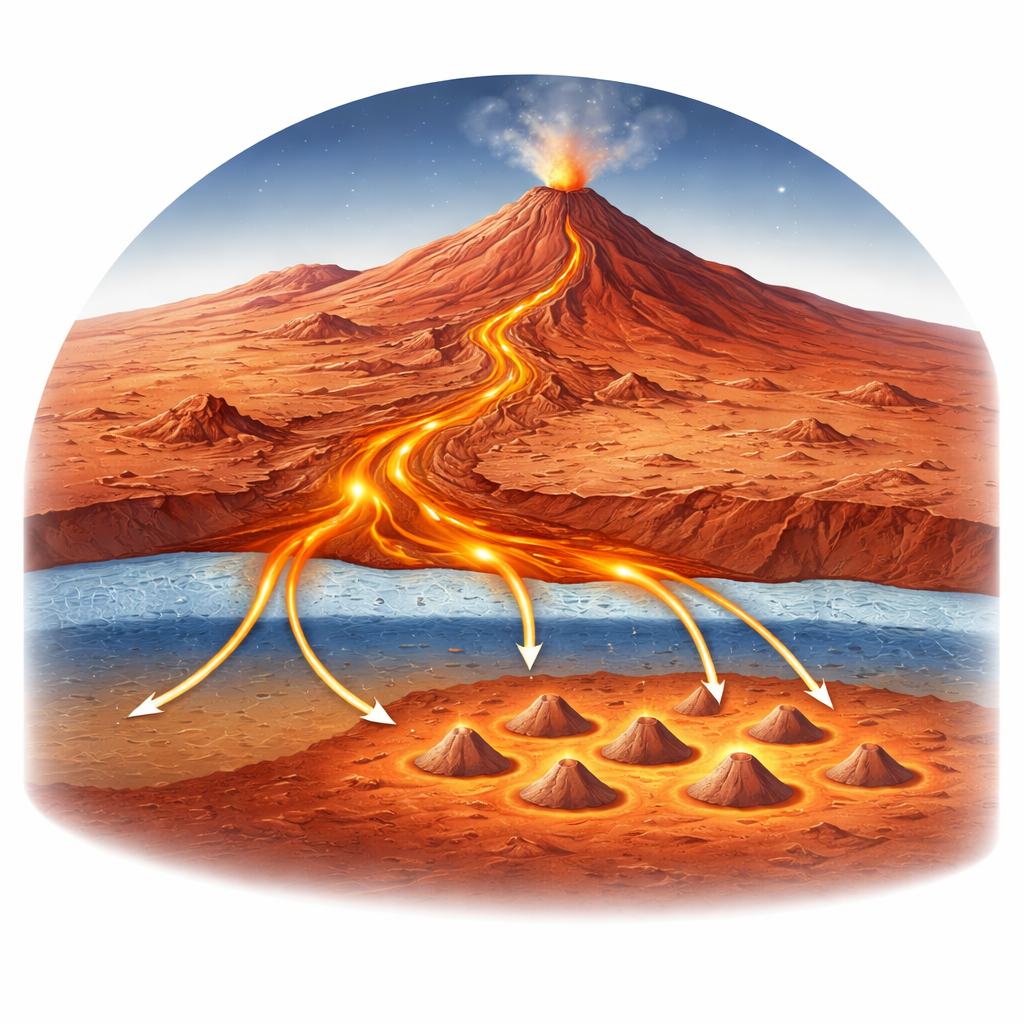
South of Ascraeus Mons, the researchers mapped more than two thousand low, conical mounds sitting directly on top of young lava flows. High-resolution images and 3D elevation models reveal that most of these mounds are nearly circular, only a few meters tall, and often contain central pits or flat tops. The cones cluster near the fronts and edges of the lava flows, sometimes merging together or lining up in chains that trace the paths where lava once advanced. By comparing their shape and size with similar features elsewhere on Mars and on Earth, the team concludes these are “rootless cones,” landforms created when lava travels over wet or icy ground and explodes without a direct pipe from deep magma.
Proving Lava Met Ice, Not Mud
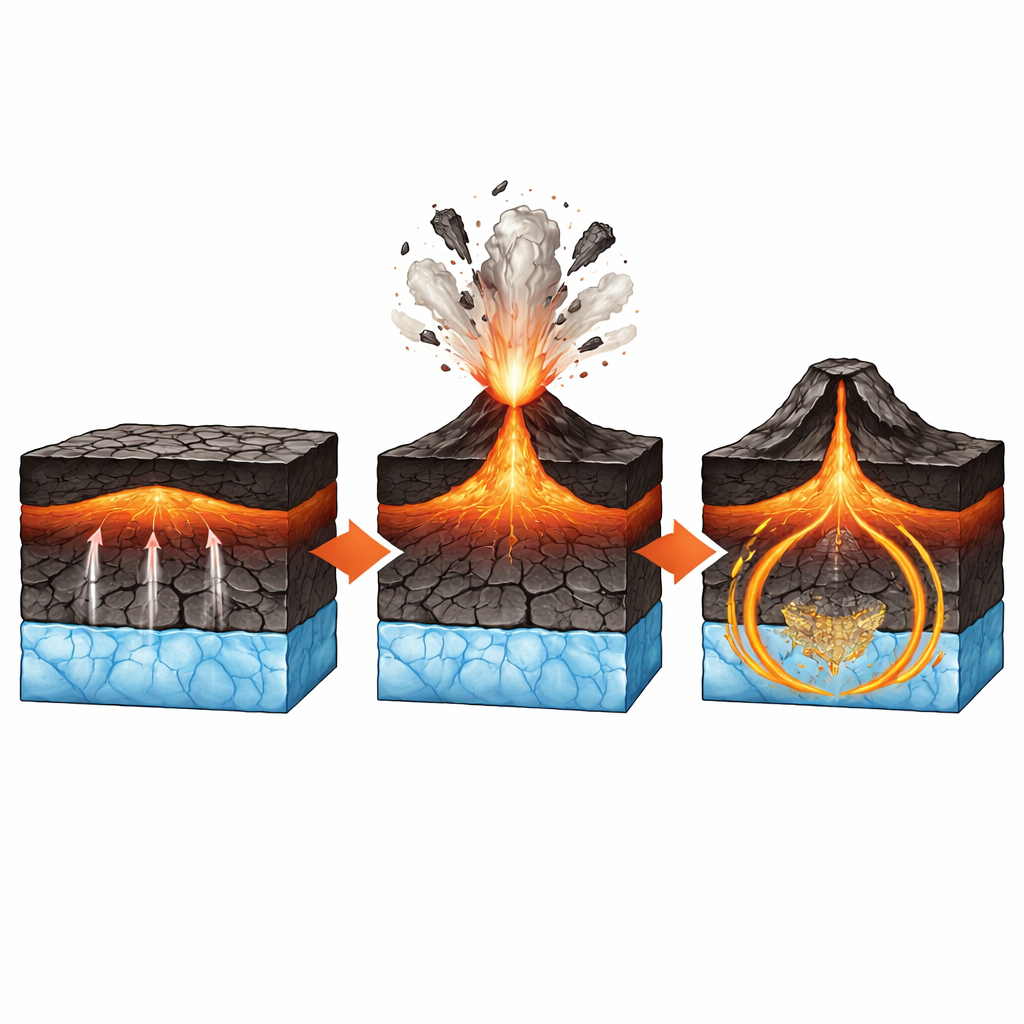
Several alternative explanations are carefully ruled out. Cones made by mud eruptions, ground-ice growth, or simple lava blisters typically form in thick, water-rich sediments or stable lava tubes—conditions that do not match the bare, draining surfaces of these Tharsis lava plains. Those other features also lack the neat summit pits and explosive debris seen here. Instead, the cones’ close tie to specific lava layers and their resemblance to rootless cones in Iceland and other Martian regions strongly support an origin in sudden steam blasts. In this picture, molten lava moving through internal channels heats a shallow layer of buried ice or ice-soaked soil. As water turns to steam and pressure builds, the lava crust bursts, throwing out fragments that pile up into small rings and mounds.
Tracing Ancient Ice and Brief Hot Springs
The ages of the lava flows beneath these cones, estimated from impact crater counts, fall between about 215 and 69 million years ago—geologically recent on Mars. This means ground ice or frost survived in the Tharsis highlands long after major glaciations, at elevations and latitudes once thought to be too warm and dry. The cones are scattered in clusters rather than forming a continuous belt, implying that the ice existed in patches rather than as a single thick sheet. Spectral measurements from an orbiting instrument further reveal hydrated minerals, likely sulfate-bearing deposits, on the flank of at least one cone. Such minerals commonly form when hot, mineral-rich fluids circulate through fractured rock, pointing to short-lived hydrothermal systems fueled by the heat of the lava-ice encounters.
What This Means for Mars’s Climate
The survival of ice beneath relatively young lava challenges the idea that near-equatorial water deposits quickly vanished after early Mars. Instead, the findings fit with climate models in which shifts in the planet’s tilt periodically drive ice and frost toward the tropics, where they can linger in shaded or buried pockets. The fact that rootless cones of similar age appear in several Martian regions suggests that lava-ice interactions were not rare quirks, but recurring episodes tied to both ongoing volcanism and climate swings. Together, the cone ages and their high-altitude setting help refine estimates of when and where subsurface ice could have been stable during the late Amazonian period.
New Targets in the Search for Life
Hydrothermal environments—places where heat and water mix—are considered prime habitats for microbes on Earth, and good sites for preserving traces of life in mineral deposits. The sulfate-rich, lava-heated systems inferred in this study would have been brief, lasting decades to a few centuries as the lava cooled and the ice was consumed. Even so, they could have offered pockets of liquid water and chemical energy far more recently than the ancient river valleys often highlighted in Mars exploration. Because these cones are small, young, and linked to minerals that can entomb organic material, the authors argue that rootless cone fields near Tharsis should be high-priority targets for future landers and rovers seeking signs of past Martian life.
Citation: Pieterek, B., Jones, T.J. Recent explosive lava-water interaction in Tharsis, Mars. npj Space Explor. 2, 15 (2026). https://doi.org/10.1038/s44453-026-00031-2
Keywords: Mars volcanism, subsurface ice, rootless cones, hydrothermal activity, Martian habitability