Clear Sky Science · en
Scene variability affects action decisions, confidence and behaviour dynamics
Why busy streets can feel so hard to read
Standing at a crosswalk, some roads feel easy to judge while others seem confusing, even if the gaps between cars are equally safe. This study asks why a more chaotic scene can make us hesitate, feel less sure about crossing, and subtly change how we move, even when our chances of getting across safely do not actually change.
A virtual city to test street smarts
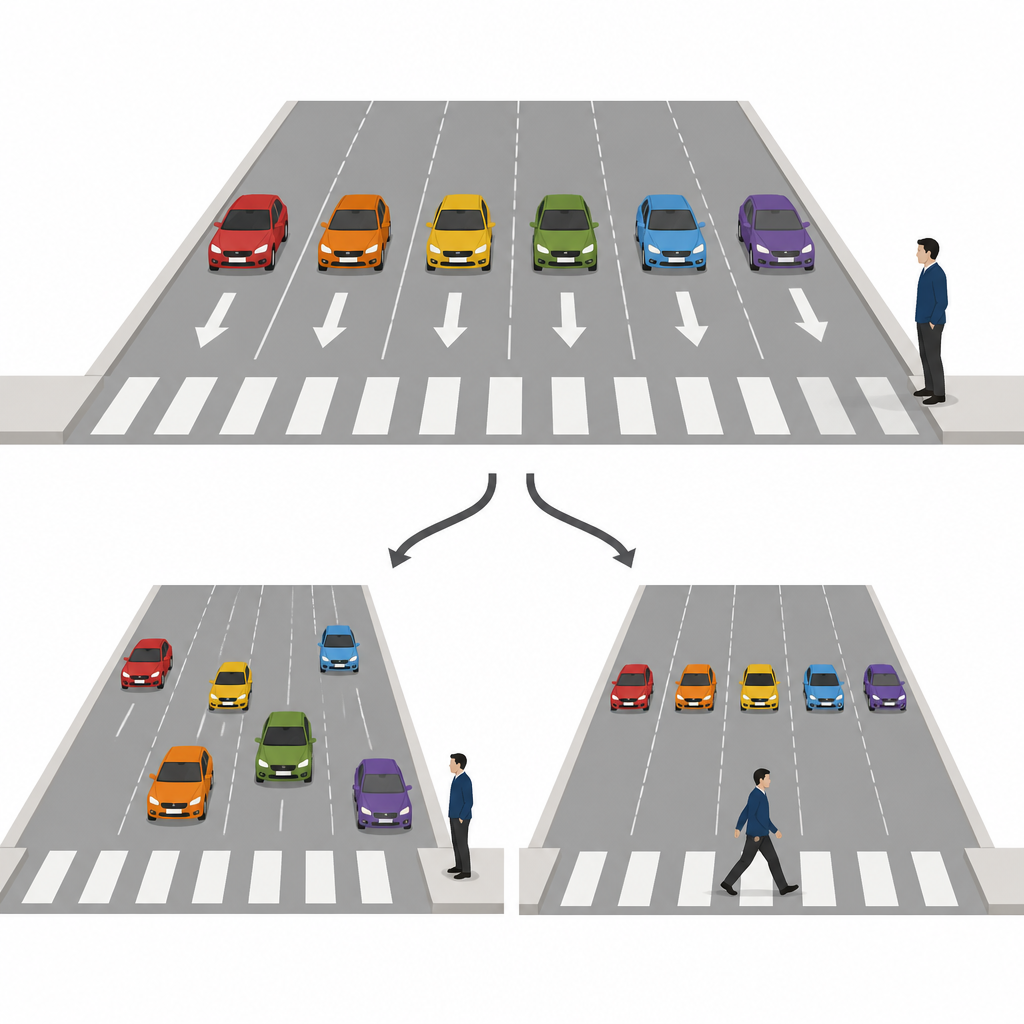
The researchers built an immersive virtual reality street with six lanes of traffic and a wide crosswalk. Participants wore a headset, could walk freely in a large room, and saw six cars approaching the crossing, three from each side. In different sessions, they either rated how sure they were that they could cross safely, judged how risky it would be, or actually tried to cross the street when they thought it was safe. Across hundreds of trials, the team varied how long it would take the cars to reach the crosswalk and, crucially, how similar or different the cars’ speeds were.
When scenes look messy, we feel less sure
In all versions of the task, people were more willing to cross and more confident when cars were far away and moving in a predictable way. When the researchers increased "scene variability" by giving cars a wider spread of speeds, people reported feeling less confident and labeled the situation as riskier, even though the timing of the cars reaching the crosswalk was arranged so that, in principle, the objective danger was the same. Participants attempted to cross less often in the high-variability scenes, requiring more time before they would accept a gap as safe.
Hesitation now, quicker steps later
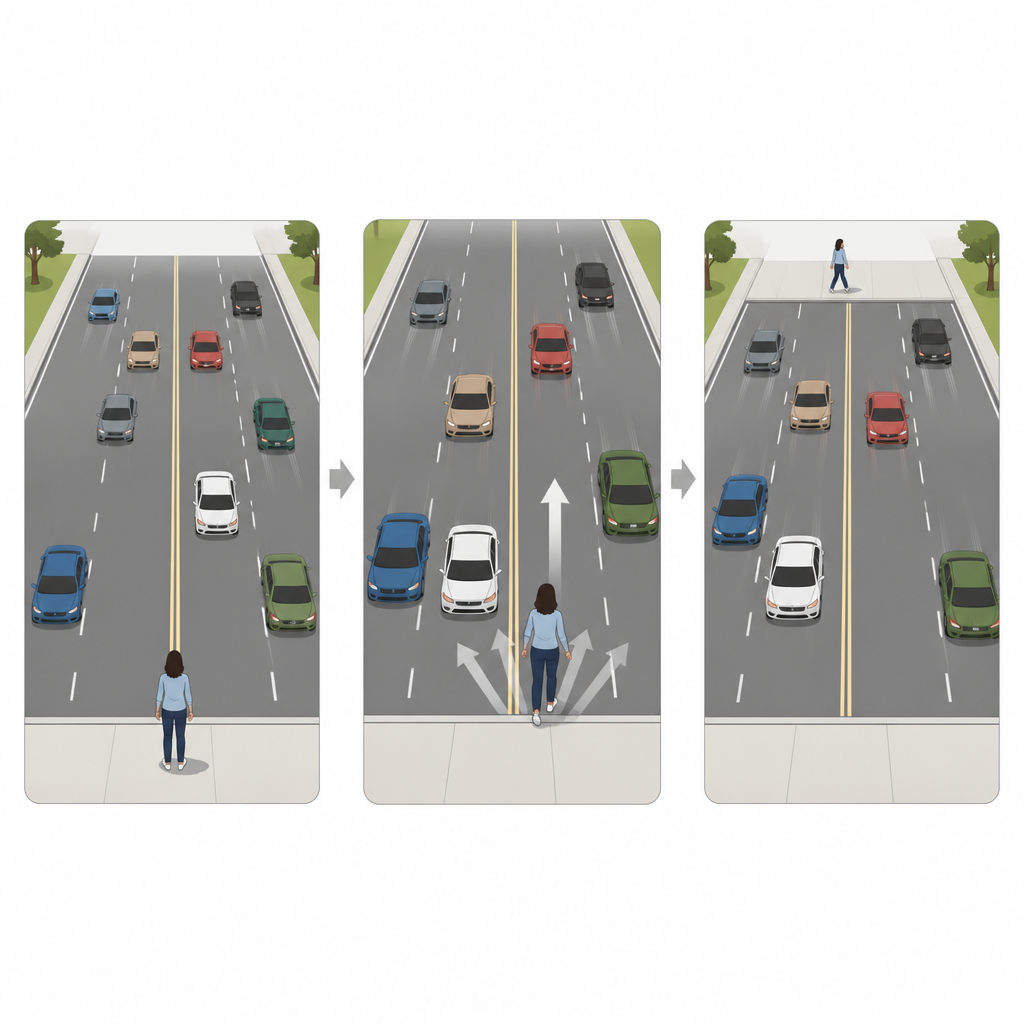
For trials where participants did choose to cross, their movements also changed with scene variability. When car speeds were more mixed, people delayed the moment they stepped off the sidewalk. Once they committed, however, they moved slightly faster across the road. Those who started later tended to speed up more, suggesting that people used flexible, on-the-fly adjustments in their walking to compensate for lost time and still clear the road safely. Despite feeling less sure and being more cautious about when to go, their actual success rate in getting across remained very high and did not differ meaningfully between simple and complex scenes.
How our eyes scan the road
The team also tracked where participants looked. In both the judgment and crossing tasks, people quickly focused on the approaching cars, especially those in the nearest lanes. Trials that ended in high confidence or in a decision to cross showed a pattern of fast engagement with the cars, followed by earlier disengagement, as if a decision had been reached and attention could shift elsewhere. Variability in car speeds itself did not strongly change eye-movement patterns. Instead, gaze behavior was more tightly linked to whether the person ultimately felt sure enough to go or chose to stay put.
From virtual crossings to real-life choices
The study shows that even when extra motion in a scene does not truly add danger, it can make people feel less certain, choose safe actions less often, and delay their movements, while their bodies quietly adjust to keep outcomes successful. In other words, messy traffic can shake our confidence without hurting our actual performance. Understanding how visual clutter and our own sense of certainty shape decisions and movement could help improve models of pedestrian behavior, design better virtual training for safe crossing, and shed light on why some people find busy streets especially hard to judge.
Citation: Aguilar-Lleyda, D., González-Del Pozo, A., López-Moliner, J. et al. Scene variability affects action decisions, confidence and behaviour dynamics. Commun Psychol 4, 83 (2026). https://doi.org/10.1038/s44271-026-00448-1
Keywords: street crossing, decision making, confidence, virtual reality, eye movements