Clear Sky Science · en
Learning alters salience and proactive attentional priority
How the Brain Learns to Tune Out Distractions
Everyday life bombards us with sights and sounds competing for our attention, from flashing ads on a website to bright packages on a supermarket shelf. Yet we usually manage to focus on what matters—our friend’s face in a crowd, or the cereal we actually want to buy. This study explores how experience teaches the brain to ignore eye‑catching but unimportant objects, and reveals that learning can literally change how bright those distractions appear to us.
Finding a Target in a Sea of Look‑Alikes
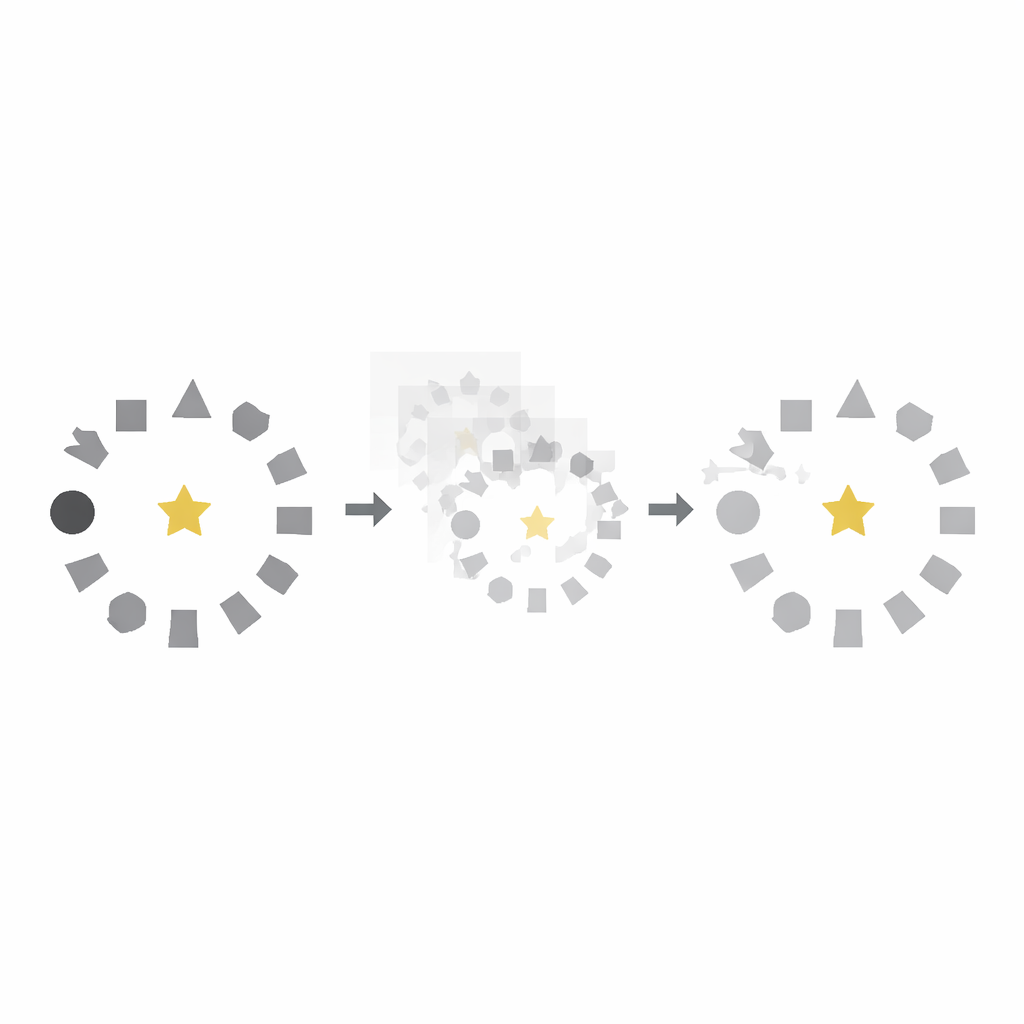
The researchers asked hundreds of online volunteers to perform a demanding computer task. On each trial, people saw a ring of simple shapes, mostly all the same, with one shape that was different. Their job was to find this odd one out and report the orientation of a tiny line inside it as quickly as possible. Often, another shape in the ring stood out strongly because of its color or brightness—a classic “distractor” that tends to grab the eyes even though it is irrelevant to the task.
Learning Where Distractions Usually Appear
Unbeknownst to participants, this distracting item appeared much more often at one particular spot in the ring than at others. Over many trials, people grew better at resisting distraction from this high‑probability location: responses were faster and less disrupted when the distractor showed up there compared with rarer locations. Interestingly, this improvement spilled over to anything presented in that favored spot: when the actual target happened to appear there, people were slower to process it, suggesting that the entire region of space had become down‑weighted by the brain.
When Less Attention Makes Things Look Dimmer
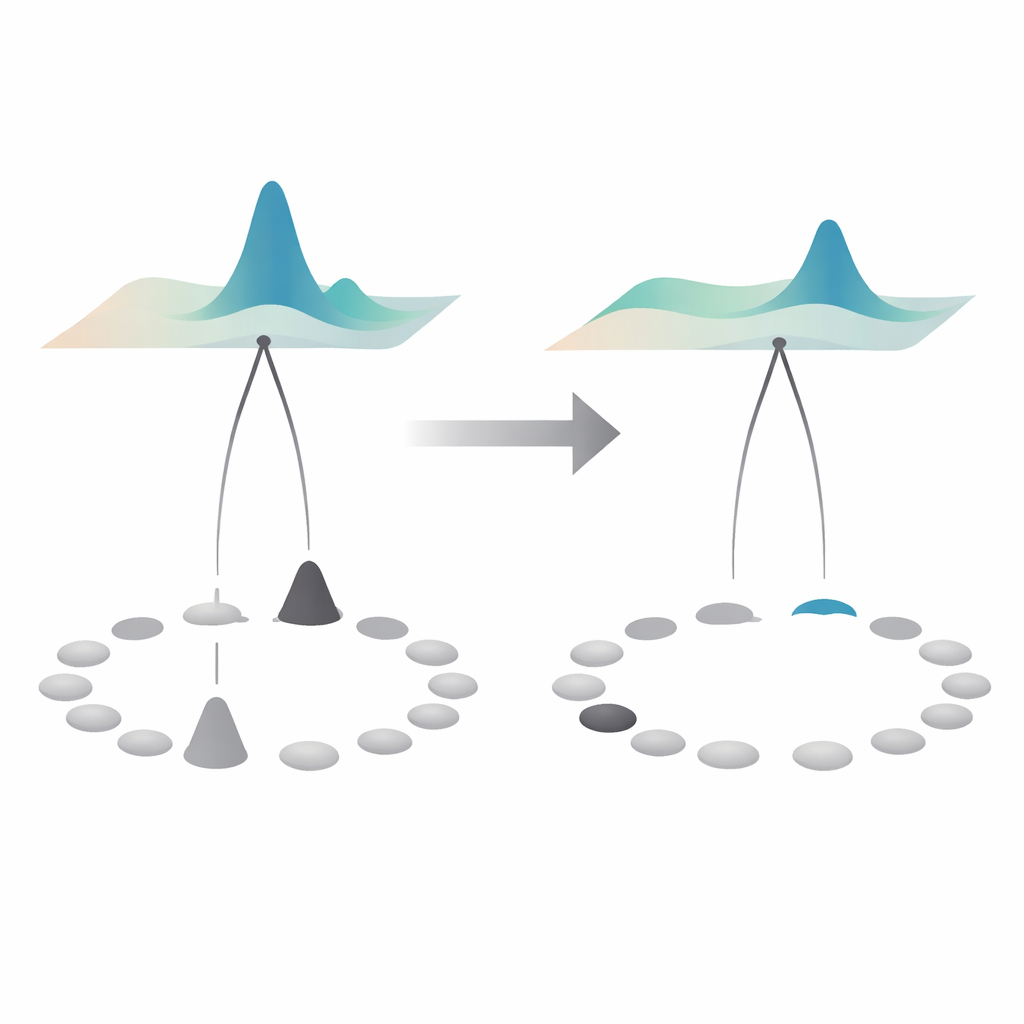
To test whether this learned “down‑weighting” affected perception itself, the team occasionally replaced the search display with a simple brightness judgment. Instead of eight shapes, only two appeared, one on the left and one on the right. People had to choose which patch looked brighter (or, in a variant of the task, darker). A clever staircase procedure adjusted the true brightness difference between the two until participants were guessing around chance. Crucially, one of these positions overlapped with the frequent‑distractor location from the search task. Across several experiments using colored and gray shapes, items shown at the previously suppressed location had to be physically brighter to be judged as equally bright as items at other locations. In other words, after learning, that region of space made things look less vivid.
Peeking Inside the Timing of Attention
Reduced distraction could arise in two ways: the brain might avoid being captured by a distractor in the first place, or it might still be captured but recover more quickly. To distinguish these options, the authors modeled the entire distribution of reaction times. They treated each trial as either a “no‑capture” event, where attention goes straight to the target, or a “capture” event, where attention first lands on the distractor and then shifts to the target, producing slower responses. By fitting mathematical curves to the data from different distractor locations, they compared models that changed how often capture occurred versus how long it lasted. Across experiments, the best‑fitting model was one in which learning mainly reduced the probability of being captured by a distractor at the frequent location, with little change in the time it took to recover when capture did occur.
Why This Matters for Everyday Attention
Taken together, the results suggest that the brain builds a kind of internal “map” of space that marks some regions as less worthy of attention based on past experience. In those regions, incoming signals are weakened right from the start, making objects appear less bright and less able to compete for attention. This proactive filtering helps us cope with busy, cluttered scenes by silencing predictable distractions before they hijack our focus. In practical terms, it shows that what we repeatedly ignore does not just seem less important—it may literally fade in our perception.
Citation: Duncan, D.H., van Moorselaar, D. & Theeuwes, J. Learning alters salience and proactive attentional priority. Commun Psychol 4, 57 (2026). https://doi.org/10.1038/s44271-026-00411-0
Keywords: selective attention, visual distraction, statistical learning, perceptual salience, attention suppression