Clear Sky Science · en
Non-random patterns in the co-occurrence and accumulation of adverse life events in two national panel datasets
Why Bad Things Rarely Happen by Pure Chance
Most of us like to think that misfortunes such as illness, job loss, or a break-up are simply a matter of bad luck. This study challenges that comforting idea. By following tens of thousands of people in Switzerland and Australia over more than two decades, the researchers show that serious setbacks tend to cluster in certain lives and households, and that one blow often raises the chances of the next. Understanding these patterns matters because it can point to fairer policies and smarter ways to step in before a rough patch turns into a lifelong downward spiral.
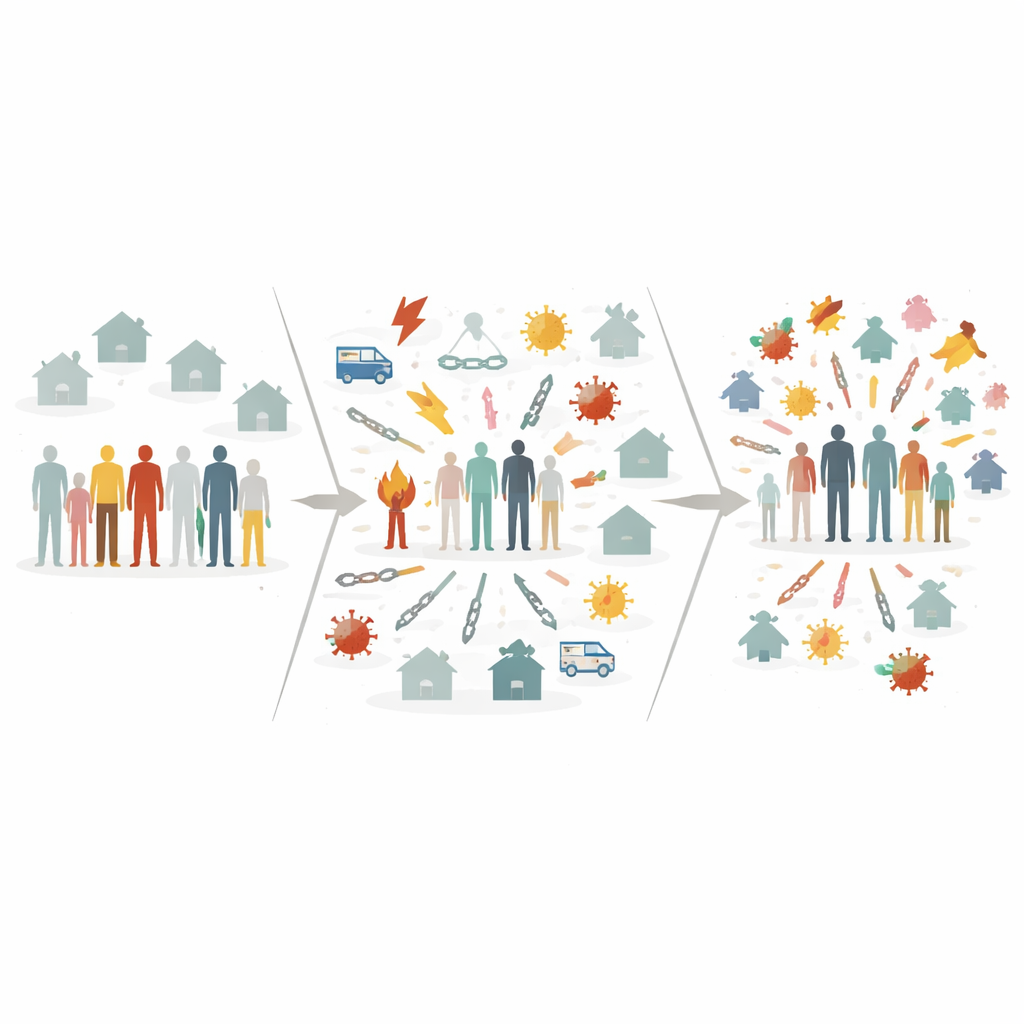
Following Lives Over Many Years
The authors drew on two large national surveys: the Swiss Household Panel and the Australian HILDA study. These projects regularly interview the same people year after year, asking about major adverse life events such as serious illness or injury, death of loved ones, divorce or separation, job loss, financial crises, crime victimization, and disasters. The team focused on clearly negative events and included only adults. Altogether, they analyzed hundreds of thousands of “person-years” of data, which allowed them to see not just how often each type of event happens, but also which events tend to appear together and how they build up over decades.
When Troubles Arrive Together
The first question was whether particular events tend to show up in the same year. Using statistical models that accounted for differences between individuals and households, the researchers found that positive links between events were the rule, not the exception. For example, in the Australian data, losing a job and suffering a major hit to finances strongly went hand in hand, as did being a victim of violence and going through a separation. In the Swiss data, ending a close relationship was tightly linked to ongoing conflicts within the family. Even after adjusting for the presence of other events, the odds that one problem would accompany another were typically higher than chance, especially for intuitive pairings like crime and later conflict or illness and later bereavement.
When One Year’s Crisis Sets Up the Next
The team then looked at what happens from one year to the next. Many event types showed a “returning storm” pattern: if a person experienced a serious illness, bereavement, or separation in one year, they were much more likely to face the same kind of event the following year. Some cross-links also stood out. A serious illness in a family member raised the chances of that person’s death the next year; separation increased the likelihood of financial hardship; being jailed raised the odds of later separation, violence, and crime victimization. When the researchers simply counted how many adverse events each person experienced per year, they again found that higher counts one year predicted higher counts the next. In other words, adversity often begets further adversity.
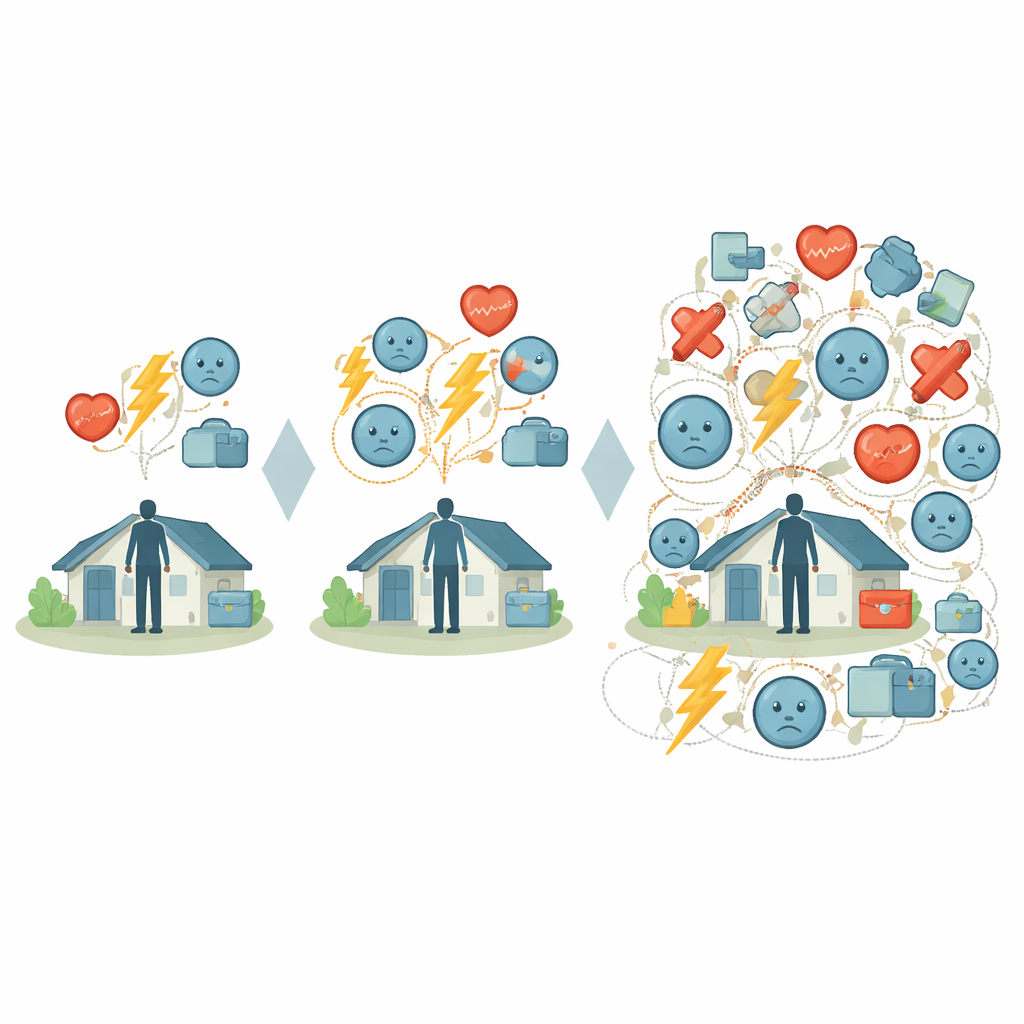
Why Some Lives Are Hit Much Harder
Perhaps the most striking finding emerged when the authors examined how events piled up over twenty consecutive years. If misfortune were truly random and evenly spread, the long-term pattern would look like a narrow, bell-shaped curve: most people would have roughly similar numbers of adverse events. Instead, the real data formed a long-tailed curve. Many people experienced relatively few serious setbacks, while a smaller but notable group lived through dozens. To explain this, the researchers compared three models. A simple “bad luck” model, where everyone faces the same steady risk each year, fit the data poorly. A second model allowed some people and households to be generally more exposed to risk than others; this fit better but still overpredicted extremely high event counts. The best match was a self-reinforcing model, in which individuals differ in their baseline risk and each new event slightly raises the chance of future events. This dynamic, sometimes called “the rich get richer and the poor get poorer,” captured the observed widening gap between lives marked by few versus many hardships.
What This Means for Helping People
Finally, the authors stress that the strongest predictors of who experiences adversity are stable differences between people and households—such as personality, long-term health, and socioeconomic conditions—rather than any single event. At the same time, the clear evidence for self-reinforcing chains of events suggests powerful opportunities for prevention. Interrupting key links in these chains—for instance, providing support after bereavement to reduce loneliness, or cushioning job loss to prevent financial collapse—could stop adversity from spreading across life domains. The study also emphasizes the importance of early action on childhood adversity, which can set many such chains in motion. To a lay reader, the takeaway is simple but sobering: serious life problems rarely fall from the sky at random. They follow patterns, pile up for some more than others, and can snowball over time—which means that well-timed support and fairer social conditions can make a real difference in stopping hardship from cascading through a person’s life.
Citation: Evers, K., Borsboom, D., Fried, E. et al. Non-random patterns in the co-occurrence and accumulation of adverse life events in two national panel datasets. Commun Psychol 4, 66 (2026). https://doi.org/10.1038/s44271-026-00394-y
Keywords: adverse life events, cumulative adversity, stress and health, longitudinal surveys, risk and resilience